
On This Day
August 9 in History
At 11:02 on the morning of 9 August 1945, the B-29 Bockscar dropped a plutonium bomb, Fat Man, over Nagasaki — a city that had not even been the day's intended target. An estimated 35,000 to 40,000 people were killed outright. Six days later Japan announced its surrender. August 9 is also the day Nixon's resignation took effect and Singapore became an independent republic.
Choose another date: open the On This Day calendar to browse events, births and deaths for any day of the year.
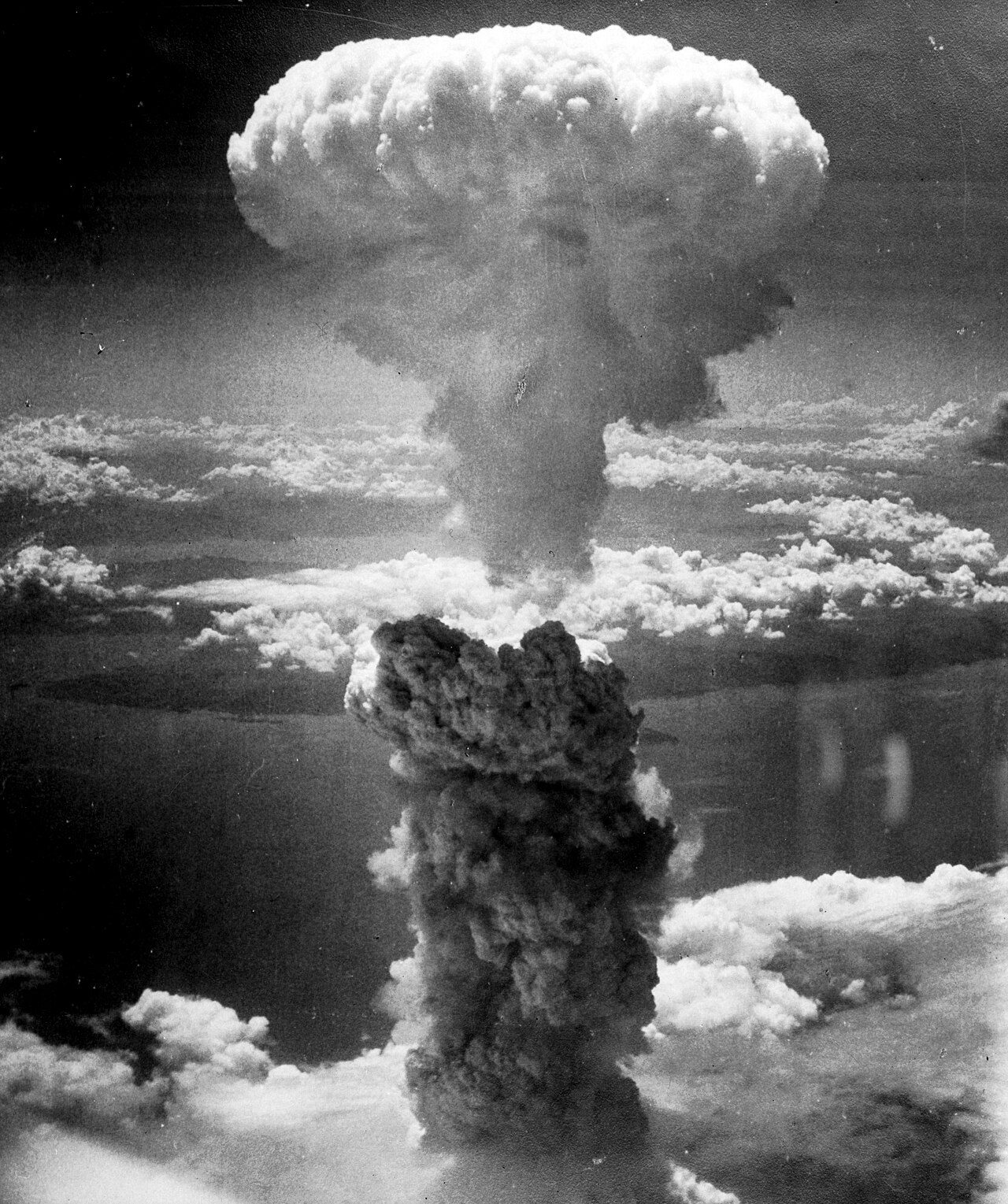
At a Glance
- The aircraft
- The B-29 Bockscar, piloted by Major Charles Sweeney
- The weapon
- 'Fat Man', a plutonium implosion bomb of about 21 kilotons, exploding over Nagasaki at 11:02 a.m.
- The target switch
- Nagasaki is the secondary target: the primary, Kokura, is hidden under cloud and smoke, so Bockscar diverts
- The toll
- An estimated 35,000–40,000 people killed immediately; total deaths reach an estimated 60,000–80,000 by the end of 1945
- The endgame
- Six days later, on 15 August, Japan announces its surrender, ending the Second World War
Events on this day
- 48 BCJulius Caesar defeats Pompey the Great at the Battle of Pharsalus in Greece, the decisive battle of Rome's civil war.
- 378A Gothic army destroys the forces of the eastern Roman Empire at Adrianople and kills the emperor Valens on the field.
- 1854Henry David Thoreau publishes Walden, his account of the two years he spent living deliberately in the woods beside Walden Pond.
- 1930Betty Boop makes her first appearance on screen, in the animated cartoon Dizzy Dishes.
- 1936Jesse Owens wins his fourth gold medal of the Berlin Olympics, anchoring the American 4×100-metre relay team.
- 1942The Quit India movement erupts across India, and the British arrest Gandhi and the entire Congress leadership in Bombay before dawn.
- 1945The United States drops a second atomic bomb, on Nagasaki — the featured story above.
- 1945Soviet forces invade Japanese-occupied Manchuria in overwhelming strength, one day after Moscow's declaration of war on Japan.
- 1965Singapore separates from Malaysia — expelled by a unanimous vote of the Malaysian parliament — and becomes an independent republic under Lee Kuan Yew.
- 1969Followers of Charles Manson murder the actress Sharon Tate and four other people at a house in Los Angeles, the first of two nights of killings.
- 1974At noon, Richard Nixon's resignation takes effect and Gerald Ford is sworn in as the 38th president of the United States.
Born on this day
- 1593Izaak Walton — English writer best known for The Compleat Angler, the meditation on fishing that has never been out of print.
- 1631John Dryden — English poet and playwright, the first official Poet Laureate.
- 1776Amedeo Avogadro — Italian scientist whose hypothesis about gases underlies the chemist's concept of the mole.
- 1896Jean Piaget — Swiss psychologist who mapped the stages by which children's minds develop.
- 1914Tove Jansson — Finnish artist and author, creator of the Moomins.
- 1922Philip Larkin — English poet of The Whitsun Weddings and 'This Be The Verse'.
- 1938Rod Laver — Australian tennis player, the only man to win all four Grand Slam singles titles in a single year twice.
- 1963Whitney Houston — American singer, among the best-selling recording artists of all time.
Died on this day
- 1962Hermann Hesse — German-Swiss novelist of Siddhartha and Steppenwolf, and a Nobel laureate in literature.
- 1975Dmitri Shostakovich — Soviet composer whose symphonies and string quartets were written in the shadow of Stalin.
- 1995Jerry Garcia — American guitarist and co-founder of the Grateful Dead, dead at 53.
- 1996Frank Whittle — English engineer who invented the turbojet engine and co-founded the company that developed it.
- 2012David Rakoff — Canadian-American essayist and humorist, a beloved voice of American public radio.
- 2023Robbie Robertson — Canadian guitarist and songwriter, the musical architect of The Band.
The featured story: the atomic bombing of Nagasaki, 9 August 1945
Three days after Hiroshima, the United States prepared a second atomic strike. The target list had narrowed to two cities: Kokura, site of one of Japan's largest arsenals, and Nagasaki, a port and shipbuilding city on the island of Kyushu. On the morning of 9 August 1945 the B-29 Bockscar, piloted by Major Charles Sweeney, carried the plutonium bomb nicknamed 'Fat Man' first to Kokura. It found the city hidden. Cloud covered most of Kokura, and smoke from the fire-bombing of nearby Yawata the day before drifted across it; after circling for the better part of an hour and making repeated runs without a clear view of the aiming point, Sweeney turned for the secondary target, Nagasaki, with his fuel reserves shrinking.
Nagasaki, too, was under cloud when Bockscar arrived, and the bombardier was briefed to bomb by radar if necessary. At the last moment a gap opened, and at 11:02 a.m. Fat Man fell, exploding above the Urakami valley in the north of the city. The weapon was more powerful than the one used at Hiroshima — about 21 kilotons — but Nagasaki's hills confined the destruction to the valley, sparing much of the city below. Even so, the toll was immense: an estimated 35,000 to 40,000 people killed immediately, with total deaths reaching an estimated 60,000 to 80,000 by the end of 1945, as the injured and the irradiated sickened and died. The cathedral in Urakami, then the largest Christian church in East Asia, stood close to the hypocentre; Nagasaki's ancient Catholic community was among the communities destroyed.
The second bomb fell on a day of converging blows. In the first hours of 9 August the Soviet Union, having declared war the day before, sent more than a million troops into Japanese-occupied Manchuria, crushing the fiction that Moscow might mediate a negotiated peace. In Tokyo the imperial council was already meeting to debate surrender when news of Nagasaki arrived. The twin shocks — a second city destroyed in a morning, and the Red Army advancing — broke the deadlock between the ministers who would fight on and those who would accept the Allied terms. The Emperor intervened, twice, to impose surrender.
Japan announced its acceptance of the Potsdam terms on 15 August, and the war ended. Nagasaki remains, to this day, the last city against which a nuclear weapon has been used in war. Every year at 11:02 the city observes a silence at the moment of the explosion. The men of Bockscar had bombed the wrong city on their list and the right one on their orders; the people of Kokura, who never learned until later how close they had come, gave Japanese a lasting phrase for an escape from a danger one never knew existed. The bomb that was meant for an arsenal fell instead on a valley of churches, schools and shipyards — and the world has lived in its shadow since.
Why this date matters
August 9 is a day of empires ending and orders turning. Rome's invincibility died with Valens on it in 378; Caesar settled a civil war on it; Japan's empire received its final blows on it in 1945, from two directions at once. It is also a day of abrupt beginnings — an independent Singapore, expelled into existence; a presidency begun at noon in a corridor of the White House. And in its quieter entries, a cartoon flapper, a poet of the fishing stream and the creator of the Moomins: the date holds both the machinery of catastrophe and the small, durable consolations built alongside it.
Sources
- Encyclopaedia Britannica — On This Day: August 9
- HISTORY — What Happened on August 9
- Encyclopaedia Britannica — Atomic Bombings of Hiroshima and Nagasaki
- Wikimedia — On This Day feed: August 9
The facts on this page were checked against these sources on 19 November 2026. The History Trail's permanent pages are researched and written for this site; the live profiles elsewhere on The History Trail are assembled automatically from Wikipedia and Wikidata.
About the Author
Researched and written by the The History Trail Editorial Team — the accountable editorial function behind this site's permanent story pages. The team works from the published sources cited on each page; it does not invent historians, reviewers or credentials, and it corrects errors openly.
Fact Check
Every load-bearing fact on this page traces to one of the sources listed above, and significant claims link to their source in the text. Our checking method is described on the methodology page; errors can be reported via the corrections page.
Sources & Citations
Cite this page as: The History Trail Editorial Team, The History Trail — this article's title, publication and update dates are shown beneath its headline. The full source list appears under Sources above; the site's source standards are on the sources page.