
Years
1963 in History
1963 is remembered for a single afternoon in Dallas: on 22 November President John F. Kennedy was assassinated, and Lyndon Johnson was sworn in within two hours. But it was also the civil rights movement's defining year — the March on Washington, King's Letter from Birmingham Jail, and the Birmingham church bombing — and the year the superpowers, chastened by Cuba, built the hotline and banned atmospheric nuclear tests.
At a Glance
- Defining event
- President John F. Kennedy is assassinated in Dallas on 22 November, at 46
- The movement's peak
- The March on Washington, 28 August — an estimated 250,000 people hear King's I Have a Dream speech
- The movement's cost
- Medgar Evers is shot on 12 June; four schoolgirls are killed in the Birmingham church bombing of 15 September
- The thaw
- The Partial Nuclear Test Ban Treaty is signed on 5 August, and the Moscow–Washington hotline agreed on 20 June
- Space
- Valentina Tereshkova becomes the first woman in space on 16 June, completing 48 orbits
- The succession
- Lyndon B. Johnson is sworn in aboard Air Force One less than two hours after the shooting
The defining story: the assassination of John F. Kennedy
Nineteen sixty-three was the American civil rights movement's year of fire and triumph. It opened with defiance: on 14 January George Wallace was inaugurated governor of Alabama declaring 'segregation now, segregation tomorrow, segregation forever'. On 16 April, jailed in Birmingham, Martin Luther King Jr. wrote his Letter from Birmingham Jail. On 11 June Wallace made his 'stand in the schoolhouse door' at the University of Alabama, then stepped aside and let two Black students enrol; that evening President Kennedy addressed the nation on civil rights and promised the bill that became the Civil Rights Act of 1964. The next day Medgar Evers, the NAACP's Mississippi field secretary, was shot dead in his own driveway in Jackson by a white supremacist.
The movement's peak came on 28 August, when an estimated 250,000 people joined the March on Washington for Jobs and Freedom — the largest demonstration the capital had seen. King, the sixteenth and final speaker, delivered his address from the steps of the Lincoln Memorial. Its most famous passage was not written down: the prepared text contained no 'I have a dream' sequence, but when Mahalia Jackson called out from behind him, King pushed the manuscript aside and improvised the ending. Eighteen days later, on 15 September, a bomb at the 16th Street Baptist Church in Birmingham killed four Black schoolgirls.
Abroad, the superpowers were learning caution from the missile crisis. On 20 June the United States and the Soviet Union signed the agreement creating the Moscow–Washington 'hotline', which went into operation on 30 August; on 5 August the US, USSR and UK signed the Partial Nuclear Test Ban Treaty in Moscow, banning nuclear tests in the atmosphere, in space and under water. On 26 June Kennedy spoke in West Berlin, declaring 'Ich bin ein Berliner' in solidarity with the divided city. On 16 June Valentina Tereshkova, launched aboard Vostok 6, became the first woman in space, completing 48 orbits. In South Vietnam, President Ngo Dinh Diem was killed on 2 November after a military coup overthrew his government.
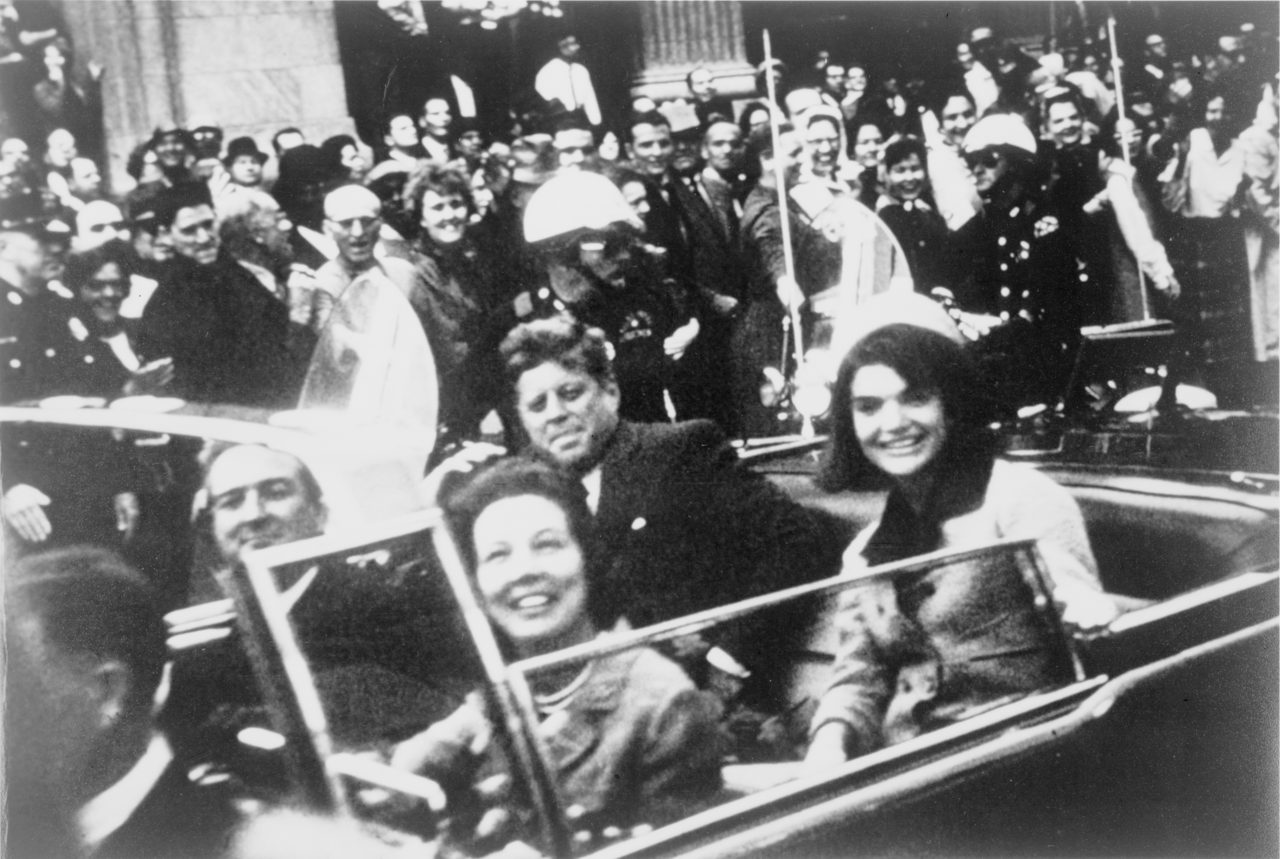
Then, on 22 November, Kennedy was assassinated in Dallas. As the open limousine turned past the Texas School Book Depository in Dealey Plaza at 12:30 p.m., shots were fired; the president, aged 46, was killed, and Texas governor John Connally, riding in the same car, was seriously wounded. Lee Harvey Oswald, a former Marine working at the depository, was arrested that afternoon — and himself shot dead two days later by Jack Ruby, live on television, in the basement of Dallas police headquarters. Vice President Lyndon B. Johnson was sworn in aboard Air Force One less than two hours after the shooting. Kennedy was buried at Arlington National Cemetery on 25 November, and on 29 November Johnson established the Warren Commission to investigate. The same day Kennedy died, C. S. Lewis died at home in Oxford at 64 and Aldous Huxley in Los Angeles at 69 — two of the century's defining writers, their deaths almost unnoticed in the news from Dallas.
Timeline of 1963
- 14 January
George Wallace is inaugurated governor of Alabama, declaring 'segregation now, segregation tomorrow, segregation forever'.
- 16 April
Martin Luther King Jr., jailed in Birmingham, Alabama, writes his Letter from Birmingham Jail.
- 11 June
Governor Wallace makes his 'stand in the schoolhouse door' at the University of Alabama, then steps aside.
- 12 June
Medgar Evers, the NAACP's Mississippi field secretary, is shot dead in his driveway in Jackson.
- 16 June
Valentina Tereshkova is launched aboard Vostok 6 and becomes the first woman in space.
- 20 June
The United States and the Soviet Union agree to create the Moscow–Washington 'hotline'.
- 26 June
President Kennedy, speaking in West Berlin, declares 'Ich bin ein Berliner'.
- 5 August
The US, USSR and UK sign the Partial Nuclear Test Ban Treaty in Moscow.
- 28 August
The March on Washington culminates in King's I Have a Dream speech before an estimated 250,000 people.
- 15 September
A bomb at the 16th Street Baptist Church in Birmingham, Alabama, kills four Black schoolgirls.
- 2 November
South Vietnamese president Ngo Dinh Diem is killed after a military coup overthrows his government.
- 22 November
President John F. Kennedy is assassinated in Dallas, Texas.
- 24 November
Jack Ruby shoots Lee Harvey Oswald in Dallas police headquarters, live on television.
- 12 December
Kenya becomes independent from Britain, with Jomo Kenyatta as its first prime minister.
Why 1963 still matters
The March on Washington supplied, in the record's words, the momentum for the Civil Rights Act of 1964 and the Voting Rights Act of 1965, and King's address was ranked the century's greatest American speech. The bill Kennedy had promised on 11 June became law under his successor the following summer — the assassination and the movement together carried it. Birmingham's murdered schoolgirls, and Medgar Evers before them, marked the price: the movement won its legislation in a year when its people were being killed in driveways and churches.
The assassination itself never closed. The Warren Commission of 1964 concluded that Oswald acted alone; its findings, the record notes, have been disputed ever since. The Zapruder film — 26 seconds shot almost by accident by a Dallas dress manufacturer — became the central evidence, its frames published for years before the whole sequence was first shown on American television in 1975. Few events in the century have generated so much scrutiny from so little film.
The year's quieter machinery may have saved more lives than any speech. The hotline and the Partial Test Ban Treaty were the missile crisis's direct lessons, institutionalised within ten months: a wire between Moscow and Washington, and an end to tests in the atmosphere, in space and under water. After October 1962, the superpowers began, slowly, to build the guardrails of the nuclear age — and 1963 is when the building started.
1963 on The History Trail
The year's biggest stories have full pages of their own on The History Trail.
- June 16 in History — Valentina Tereshkova becomes the first woman in space aboard Vostok 6.
- June 26 in History — Kennedy declares 'Ich bin ein Berliner' in West Berlin.
- August 5 in History — the Partial Nuclear Test Ban Treaty is signed in Moscow.
- August 28 in History — the March on Washington and King's I Have a Dream speech.
- November 22 in History — President Kennedy is assassinated in Dallas.
Sources
- HISTORY — What Happened on January 14
- Encyclopaedia Britannica — On This Day: April 16
- Encyclopaedia Britannica — On This Day: June 11
- Encyclopaedia Britannica — On This Day: June 12
- Encyclopaedia Britannica — On This Day: June 16
- Encyclopaedia Britannica — On This Day: June 26
The facts on this page were checked against these sources on 19 November 2026. The History Trail's permanent pages are researched and written for this site; the live profiles elsewhere on The History Trail are assembled automatically from Wikipedia and Wikidata.
About the Author
Researched and written by the The History Trail Editorial Team — the accountable editorial function behind this site's permanent story pages. The team works from the published sources cited on each page; it does not invent historians, reviewers or credentials, and it corrects errors openly.
Fact Check
Every load-bearing fact on this page traces to one of the sources listed above, and significant claims link to their source in the text. Our checking method is described on the methodology page; errors can be reported via the corrections page.
Sources & Citations
Cite this page as: The History Trail Editorial Team, The History Trail — this article's title, publication and update dates are shown beneath its headline. The full source list appears under Sources above; the site's source standards are on the sources page.