
Years
1956 in History
1956 is remembered as the year the Cold War's empires cracked in public. Nikita Khrushchev denounced Stalin in a secret speech in February; in October Hungary rose against Communist rule and Soviet forces crushed the revolution in November; the same weeks brought the Suez Crisis, as Egypt's nationalisation of the canal led Israel, Britain and France into a failed invasion. In America, the Supreme Court ended the Montgomery bus boycott by ruling segregated buses unconstitutional.
At a Glance
- Defining event
- Hungarian Revolution begins 23 October 1956; crushed by Soviet forces on 4 November
- Secret speech
- Khrushchev denounces Stalin to the Twentieth Party Congress on 25 February
- Suez
- Nasser nationalises the Suez Canal on 26 July; Israel invades Sinai 29 October; Britain and France bomb Egypt 31 October
- Boycott won
- Supreme Court rules segregated buses unconstitutional on 13 November, ending the Montgomery boycott
- Highways
- Eisenhower signs the Federal Aid Highway Act on 29 June, creating the Interstate Highway System
- In computing
- FORTRAN, the first widely used high-level programming language, is first shared on 15 October
The defining story: twelve days in Budapest
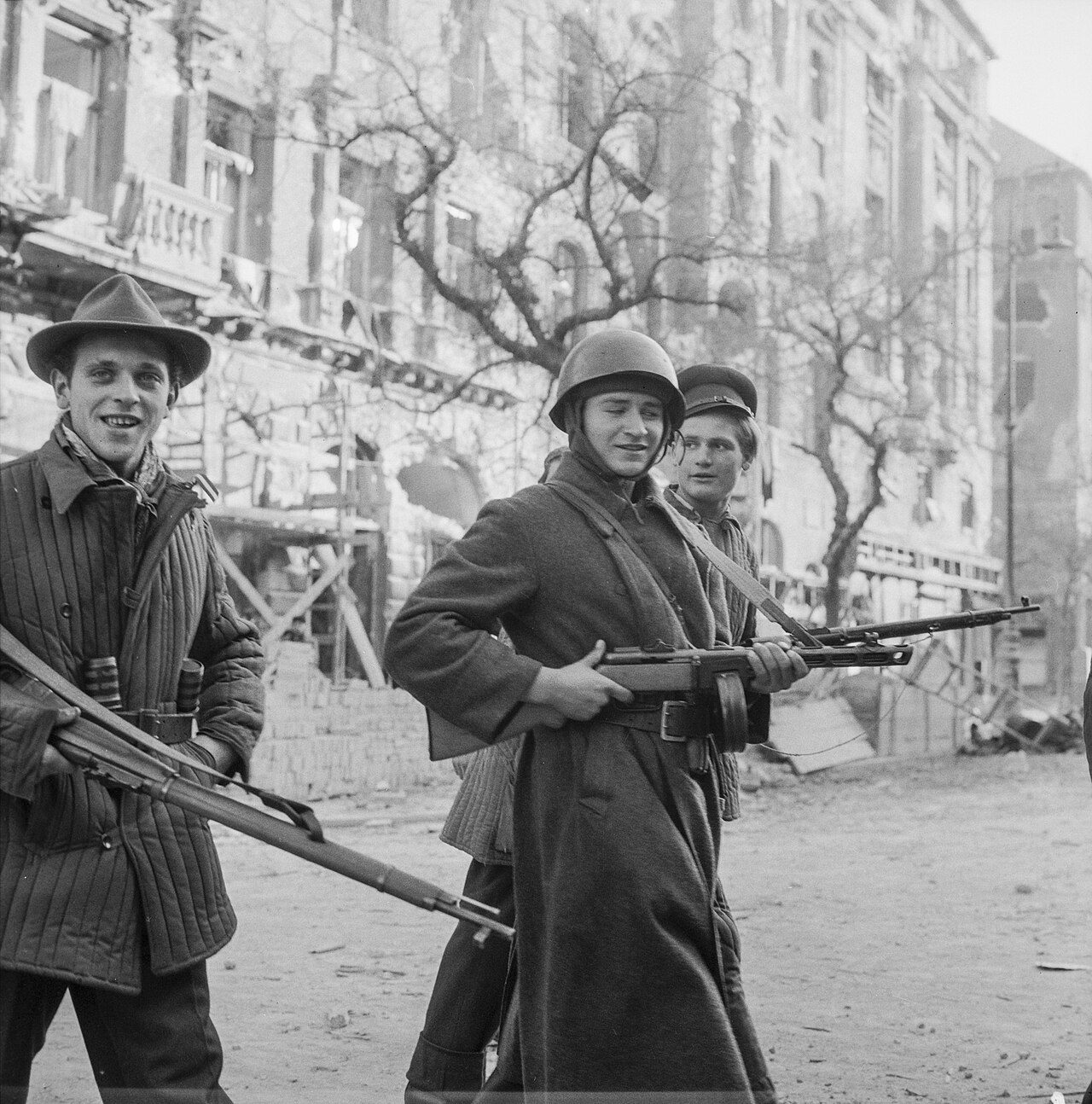
On 23 October 1956 the people of Budapest rose against their Communist government and its Soviet masters, beginning the Hungarian Revolution, the first great armed revolt against Soviet domination of Eastern Europe. The spark had been struck in Moscow: on 25 February Nikita Khrushchev had denounced Stalin's crimes in his secret speech to the closing session of the Twentieth Congress, and the admission loosened fear across the Soviet bloc. In Hungary, resentment of the hated security police, of censorship, shortages and the presence of Soviet troops had been building for a decade. When students marched through Budapest demanding reforms and the withdrawal of Soviet forces, crowds swelled behind them; protesters toppled the enormous statue of Stalin, shots were fired, and the demonstration became an uprising.
The government answered by calling in Soviet troops, who entered Budapest on 24 October. But the revolution would not be put down so easily. Imre Nagy, a reform Communist sidelined by the hardliners, was brought back as prime minister, and Hungarians — workers, students, soldiers who changed sides — fought tanks in the streets with rifles and petrol bombs. For a few astonishing days it seemed to work: a ceasefire was agreed on 28 October, Soviet forces pulled back from the capital, political prisoners were freed, and Nagy promised free elections and Hungary's withdrawal from the Warsaw Pact. Hungary appeared to have won its freedom in twelve days.
It was an illusion. In early November the Soviet Union returned in overwhelming force, determined that no satellite state would be allowed to leave its camp. Budapest was bombarded and stormed, and on 4 November the revolution was crushed in days of street fighting. About 2,500 Hungarians and some 700 Soviet soldiers are estimated to have died. Around 200,000 Hungarians fled the country, most across the border into Austria. János Kádár was installed at the head of a loyal government, and the reprisals lasted years: more than 300 participants were executed, among them, in June 1958, Imre Nagy himself, hanged after a secret trial.
Simultaneously, the old empires staged their own failure. Egypt's President Gamal Abdel Nasser, elected in June, nationalised the Suez Canal on 26 July, seizing the waterway from its British and French owners. Israel invaded Egypt's Sinai Peninsula on 29 October, opening the military phase of the Suez Crisis, and Britain and France began bombing Egypt on 31 October, seeking to force the reopening of the canal. The two crises ran in parallel — Soviet tanks in Budapest, British and French bombs in Egypt — and together they showed both blocs' limits: Hungary stayed behind the Iron Curtain for another three decades, while Suez became the byword for imperial overreach.
Timeline of 1956
- 25 February
Khrushchev delivers his secret speech denouncing Stalin.
- 20 March
Tunisia gains independence from France, with Habib Bourguiba as its first prime minister.
- 18 April
Grace Kelly marries Prince Rainier III of Monaco in a civil ceremony, becoming Princess Grace.
- 21 May
The United States drops a hydrogen bomb from an aircraft for the first time, over Bikini Atoll.
- 29 June
Eisenhower signs the Federal Aid Highway Act, creating the Interstate Highway System.
- 25 July
The liner Andrea Doria collides with the Stockholm off Nantucket; the liner sinks with the loss of 46 lives.
- 26 July
Nasser nationalises the Suez Canal, triggering the Suez Crisis.
- 9 September
Elvis Presley makes his first appearance on The Ed Sullivan Show, watched by an estimated 60 million viewers.
- 15 October
FORTRAN is first shared with the computing community.
- 17 October
Queen Elizabeth II opens Calder Hall, the world's first commercial-scale nuclear power station.
- 23 October
Hungary rises in revolt against Communist rule and Soviet domination.
- 29 October
Israel invades Egypt's Sinai Peninsula, opening the military phase of the Suez Crisis.
- 4 November
Soviet tanks and troops crush the Hungarian Revolution.
- 13 November
The Supreme Court rules segregated buses in Alabama unconstitutional, ending the Montgomery bus boycott.
Why 1956 still matters
The revolution failed, and Hungary remained behind the Iron Curtain for another three decades. But 1956 exposed the truth that Soviet power in Eastern Europe rested on tanks, and it became a permanent symbol of Hungarian nationhood. When Hungary finally broke with communism in 1989, Nagy was ceremonially reburied as a national hero, and 23 October is now Hungary's national holiday, honouring both the revolution and the republic proclaimed on the same date in 1989. Khrushchev's secret speech worked more slowly, loosening the fear on which Stalinism had rested without dismantling the system that speech defended.
Suez marked the old empires' demotion: Britain and France could still bomb Egypt, but they could no longer settle its ownership. In the United States, the year's endings were happier and more durable. The Supreme Court's 13 November ruling ended the 381-day Montgomery boycott in victory, vindicating the strategy Rosa Parks's arrest had begun. The Interstate Highway Act of 29 June redrew American geography for generations, and Calder Hall's opening on 17 October began commercial nuclear power. FORTRAN's release began the era of high-level programming.
Culture supplied the year's soundtrack: Elvis Presley scandalised television with Hound Dog on The Milton Berle Show on 5 June and drew an estimated 60 million viewers to The Ed Sullivan Show on 9 September, while Don Larsen pitched the only perfect game in World Series history on 8 October and The Wizard of Oz began its long television life on 3 November. Tom Hanks, Carrie Fisher and Martina Navratilova were all born in 1956.
1956 on The History Trail
Budapest and Suez dominate 1956 on The History Trail.
- October 23 in History — The Hungarian Revolution begins, told in full.
- November 4 in History — Soviet forces crush the Hungarian Revolution.
- February 25 in History — Khrushchev delivers his secret speech.
- July 26 in History — Nasser nationalises the Suez Canal.
- October 29 in History — Israel invades the Sinai.
- November 13 in History — The Supreme Court ends segregated buses in Alabama.
- United Nations — The institution tested by both Hungary and Suez.
Sources
- Encyclopaedia Britannica — Hungarian Revolution of 1956
- Encyclopaedia Britannica — On This Day: October 23
- Encyclopaedia Britannica — On This Day: November 4
- Encyclopaedia Britannica — On This Day: February 25
- Encyclopaedia Britannica — On This Day: July 26
- Encyclopaedia Britannica — On This Day: November 13
- Encyclopaedia Britannica — On This Day: June 29
The facts on this page were checked against these sources on 19 November 2026. The History Trail's permanent pages are researched and written for this site; the live profiles elsewhere on The History Trail are assembled automatically from Wikipedia and Wikidata.
About the Author
Researched and written by the The History Trail Editorial Team — the accountable editorial function behind this site's permanent story pages. The team works from the published sources cited on each page; it does not invent historians, reviewers or credentials, and it corrects errors openly.
Fact Check
Every load-bearing fact on this page traces to one of the sources listed above, and significant claims link to their source in the text. Our checking method is described on the methodology page; errors can be reported via the corrections page.
Sources & Citations
Cite this page as: The History Trail Editorial Team, The History Trail — this article's title, publication and update dates are shown beneath its headline. The full source list appears under Sources above; the site's source standards are on the sources page.