
On This Day
November 4 in History
On 4 November 1922, in Egypt's Valley of the Kings, workmen clearing ancient huts for the archaeologist Howard Carter uncovered a single step cut into the bedrock — the top of the staircase to the tomb of Tutankhamun, the only near-intact royal tomb ever found. November 4 is also the day Barack Obama was elected president, the Iran hostage crisis began, Yitzhak Rabin was assassinated and Jane Goodall first saw a chimpanzee make a tool.
Choose another date: open the On This Day calendar to browse events, births and deaths for any day of the year.
At a Glance
- The search
- Carter, funded by Lord Carnarvon, clears the Valley of the Kings grid by grid in what Carnarvon allows as a final season
- The find
- 4 November 1922 — a step cut in bedrock beneath ancient workmen's huts below the tomb of Ramesses VI
- The door
- By 5 November, a plastered doorway stamped with the royal necropolis seal; Tutankhamun's cartouche found on re-clearing
- The look inside
- 26 November 1922 — Carter peers through a hole by candlelight: 'Yes, wonderful things'
- The contents
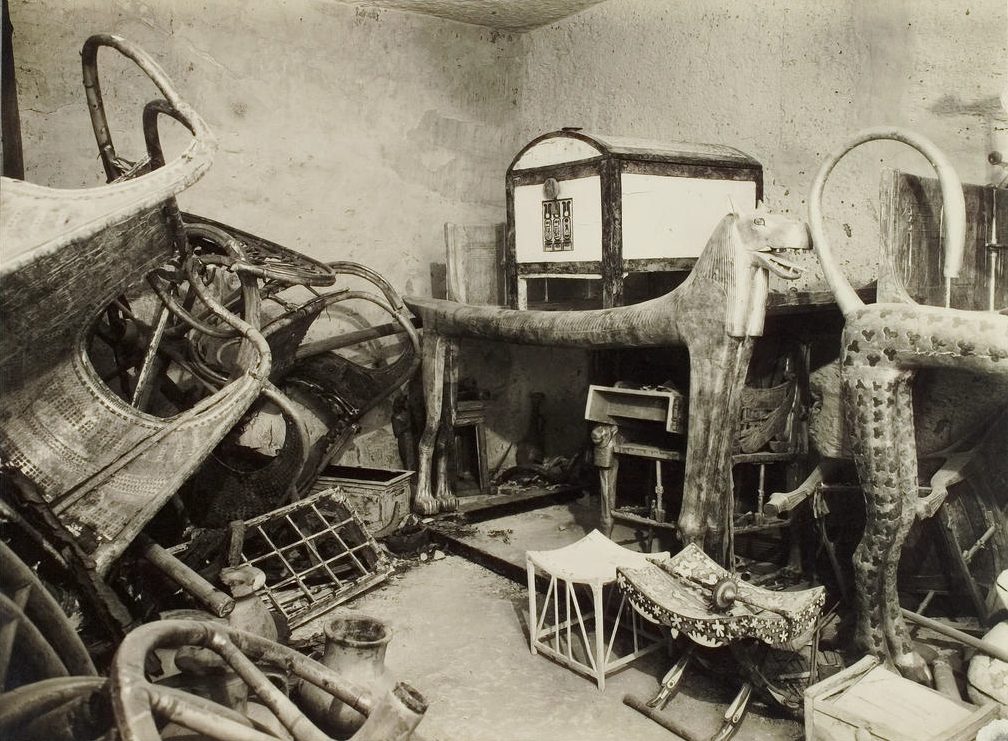
- More than 5,000 objects, including the gold mask; clearance and recording take ten years, to 1932
- The record
- Carter's notes, object cards and Harry Burton's photographs are held by the Griffith Institute, Oxford
Events on this day
- 1791Native American forces rout a U.S. army at the Battle of the Wabash — St. Clair's Defeat, the worst defeat ever inflicted on the U.S. Army by Native Americans.
- 1842Abraham Lincoln marries Mary Todd at her sister's home in Springfield, Illinois.
- 1918The poet Wilfred Owen is killed in action in France, one week before the First World War armistice (also in today's deaths).
- 1922Howard Carter's workmen find the first step of the staircase to Tutankhamun's tomb — the featured story above.
- 1924Nellie Tayloe Ross of Wyoming and Miriam Ferguson of Texas are elected the first women governors in the United States.
- 1946The constitution of UNESCO, the United Nations cultural and scientific agency, comes into force.
- 1956Soviet tanks and troops crush the Hungarian Revolution, twelve days after the uprising began.
- 1960Jane Goodall watches a chimpanzee at Gombe strip a twig and use it to fish for termites — the first observed tool-making by a wild animal.
- 1979Iranian students storm the U.S. embassy in Tehran and seize its staff, beginning the 444-day Iran hostage crisis.
- 1995Israeli prime minister Yitzhak Rabin, Nobel Peace laureate, is assassinated by an extremist at a peace rally in Tel Aviv.
- 2008Barack Obama defeats John McCain to become the 44th president of the United States, the first African American elected to the office.
- 2016The Paris Agreement on climate change enters into force, committing its signatories to limit global warming.
Born on this day
- 1575Guido Reni — Italian Baroque painter, the most famous artist of the Bolognese school in his lifetime.
- 1787Edmund Kean — English actor whose intense Shakespearean performances made him the star of the Romantic stage.
- 1879Will Rogers — American humorist and performer whose newspaper wit made him a national folk philosopher.
- 1969Matthew McConaughey — American actor, Academy Award winner for Dallas Buyers Club.
Died on this day
- 1847Felix Mendelssohn — German composer of the Hebrides overture and the music for A Midsummer Night's Dream, dead at 38.
- 1918Wilfred Owen — English war poet, killed at the Sambre Canal a week before the armistice he did not live to see.
- 1995Yitzhak Rabin — Israeli prime minister and soldier, assassinated after signing the Oslo peace accords (also in today's events).
- 2011Andy Rooney — American television essayist, the curmudgeonly closer of 60 Minutes for three decades.
The featured story: the first step to Tutankhamun's tomb, 4 November 1922
By the autumn of 1922 the archaeologist Howard Carter was nearly out of time, money and luck. Funded by Lord Carnarvon, he had spent years clearing the Valley of the Kings down to bedrock in a grid, looking for the one royal tomb that might have escaped the robbers of antiquity: that of the boy pharaoh Tutankhamun. Carnarvon had agreed to one final season. Carter arrived in Luxor on 28 October, and on 1 November his Egyptian workmen began clearing the last unexcavated triangle of ground, below the entrance of the tomb of Ramesses VI, where a row of ancient workmen's huts stood.
On the morning of 4 November, clearing beneath the first of those huts, the workmen uncovered a single step cut into the bedrock. Carter knew at once what a step in that valley meant. By the following evening twelve steps had been cleared, and at the bottom stood a doorway blocked with stones and plastered over, stamped again and again with the seal of the royal necropolis — the jackal Anubis crouched over nine bound captives. The Griffith Institute's archive of Carter's records, kept at Oxford, tells the sequence plainly: excavation began on 1 November; on 4 November the top step appeared; by 5 November the sealed doorway stood revealed.
Carter did the hardest thing in archaeology: he stopped. He refilled the staircase to protect the find and cabled Carnarvon in England — 'At last have made wonderful discovery in Valley, a magnificent tomb with seals intact.' Carnarvon crossed Europe and the Mediterranean, and on 24 November the full sixteen steps were cleared again; on the lower door the seals bore a cartouche, Tutankhamun's throne name. Two days later, in a rubble-filled corridor, Carter cut a small hole in a second sealed door, held a candle through it against the escaping air, and when Carnarvon asked if he could see anything, answered, 'Yes, wonderful things.'
What followed was the most famous excavation in history. The tomb — small, and in fact twice entered by robbers in antiquity, who had been caught or driven off — held more than 5,000 objects: gilded couches, chariots, shrines, the solid gold funerary mask, and nested coffins around the king's mummy. Recording and conserving them took Carter's team a full decade, until 1932, and set new standards for archaeological method. Tutankhamun, a minor king who died at about nineteen, became the most famous pharaoh of all — because on 4 November 1922 a workman's pick found one step in the rock.
Why this date matters
November 4 is a date of doors opening and closing. A staircase appears under the sand in Egypt; voters in 2008 open the White House to its first Black president; students in Tehran slam an embassy's gates into a 444-day siege; an assassin closes the life of a peacemaker in Tel Aviv. The Tutankhamun story gives the day its shape: history on this date tends to be found, or forced, one step at a time — and what lies at the bottom of the steps changes the people who descend them.
Sources
- Encyclopaedia Britannica — On This Day: November 4
- HISTORY — What Happened on November 4
- Griffith Institute, University of Oxford — Tutankhamun: 1st Season (1922–1923)
- Wikimedia — On This Day feed: November 4
The facts on this page were checked against these sources on 19 November 2026. The History Trail's permanent pages are researched and written for this site; the live profiles elsewhere on The History Trail are assembled automatically from Wikipedia and Wikidata.
About the Author
Researched and written by the The History Trail Editorial Team — the accountable editorial function behind this site's permanent story pages. The team works from the published sources cited on each page; it does not invent historians, reviewers or credentials, and it corrects errors openly.
Fact Check
Every load-bearing fact on this page traces to one of the sources listed above, and significant claims link to their source in the text. Our checking method is described on the methodology page; errors can be reported via the corrections page.
Sources & Citations
Cite this page as: The History Trail Editorial Team, The History Trail — this article's title, publication and update dates are shown beneath its headline. The full source list appears under Sources above; the site's source standards are on the sources page.