
Years
1938 in History
1938 is remembered as the year the peace was signed away: in the early hours of 30 September, Britain, France, Germany and Italy signed the Munich Agreement ceding the Sudetenland to Germany, and Chamberlain flew home declaring 'peace for our time'. The same year had already absorbed Austria into the Reich in the Anschluss, and it closed with Kristallnacht's burning synagogues — and, in America, with Orson Welles's War of the Worlds broadcast convincing some listeners that Martians had landed in New Jersey.
At a Glance
- Defining event
- The Munich Agreement, signed in the early hours of 30 September, cedes the Sudetenland to Germany; Chamberlain declares 'peace for our time'
- Annexation
- German troops march into Austria on 12 March, beginning the Anschluss; it is formally announced the next day
- Pogrom
- Kristallnacht, 9 November: Nazi mobs burn synagogues and Jewish businesses across Germany and Austria
- Broadcast legend
- Orson Welles's War of the Worlds, 30 October, told as fake news bulletins, frightens some listeners — and newspapers build a legend of mass panic
- Debut
- Superman makes his first appearance, in Action Comics No. 1, 1 June — the debut of the modern superhero
- Lost
- Mustafa Kemal Atatürk, founder and first president of the Republic of Turkey, dies on 10 November
The defining story: peace for our time
Munich is the twentieth century's great parable of a bargain, and it was struck by men who believed they were preventing a war, not postponing one. Through the summer of 1938 Adolf Hitler demanded the Sudetenland — Czechoslovakia's German-speaking frontier districts, which happened to contain its border fortifications and much of its industry — and set 1 October as his deadline. Britain's prime minister, Neville Chamberlain, who had never flown before that September, flew three times to Germany to negotiate, convinced that Hitler's aims were limited and that Czechoslovakia, a state created in 1919, was a quarrel in a faraway country. The endgame came at Munich on 29 September, where Chamberlain, France's Édouard Daladier, Italy's Benito Mussolini and Hitler settled Czechoslovakia's fate in a single day.
The Czechoslovak government, whose army was mobilised and whose forts were being signed away, was not in the room; its representatives waited in a corridor to be told the result. The Soviet Union, bound by treaty to Czechoslovakia, was not invited. In the early hours of 30 September the four powers signed: Germany would occupy the Sudetenland in stages between 1 and 10 October. That afternoon Chamberlain flew home, waved a paper at Heston Aerodrome, and promised 'peace for our time'. The paper he waved was not the Munich Agreement — it was the separate, three-paragraph Anglo-German declaration he had asked Hitler to sign that morning, a statement of intent with no terms, no enforcement and no mention of Czechoslovakia. The crowd was shown the promise, not the price.
Munich was the second act of a year that had opened with annexation. On 12 March German troops marched into Austria, beginning the Anschluss that absorbed the country into Nazi Germany; it was formally announced on 13 March, and on 10 April Austrians voted in a referendum staged by Nazi Germany to approve it. In May, in Washington, the House Un-American Activities Committee was created under chairman Martin Dies Jr. — America's own machinery of suspicion, built the same year. On 4 May Carl von Ossietzky, the German pacifist journalist and Nobel Peace laureate, died at 48 after years in Nazi custody.
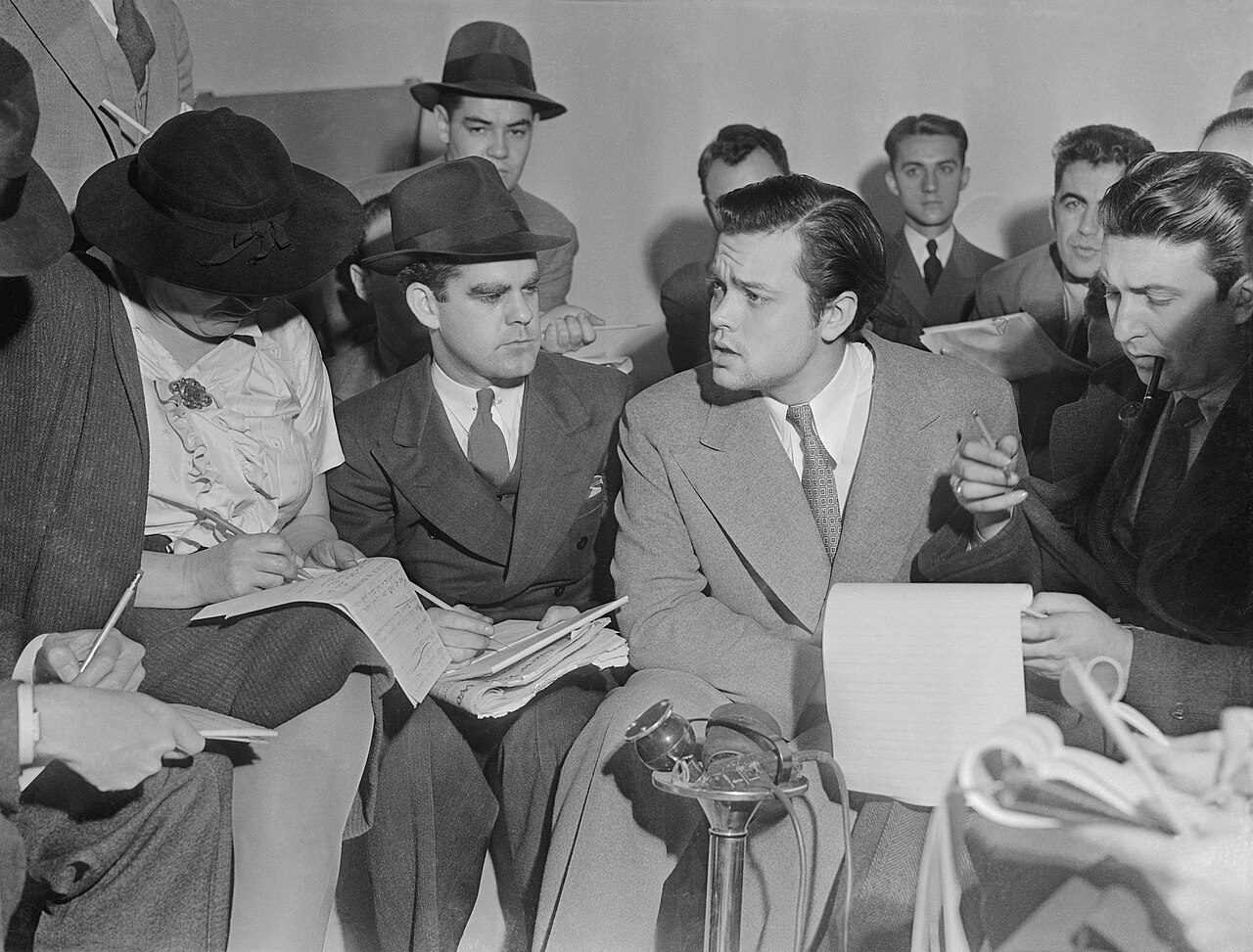
The year's ending showed where the road from Munich led. On 9 November, Kristallnacht: Nazi mobs burned synagogues and Jewish businesses across Germany and Austria. The next day, 10 November, Mustafa Kemal Atatürk — founder and first president of the Republic of Turkey proclaimed in 1923 — died at Dolmabahçe Palace in Istanbul. And in America, on 30 October, the year's other famous deception had played out in the opposite register: Orson Welles's Mercury Theatre broadcast The War of the Worlds as fake news bulletins, and some listeners, in a country already jittery with news of crisis in Europe, believed Martians had landed in New Jersey. The next morning Welles faced the press — the photograph on this page — professing bewilderment.
Timeline of 1938
- 16 January
Benny Goodman's orchestra plays Carnegie Hall, the landmark concert that carried swing jazz into America's concert halls.
- 4 February
Walt Disney's Snow White and the Seven Dwarfs opens in cinemas across the United States, proving a full-length animated feature can triumph.
- 12 March
German troops march into Austria, beginning the Anschluss that absorbs the country into Nazi Germany; the annexation is formally announced the next day.
- 10 April
Austrians vote in a referendum staged by Nazi Germany to approve the Anschluss, the annexation of Austria into the Reich.
- 4 May
Carl von Ossietzky dies at 48 — the German pacifist journalist and Nobel Peace laureate, dead after years in Nazi custody.
- 1 June
Superman makes his first appearance, in Action Comics No. 1 — the debut of the modern superhero.
- 3 July
The steam locomotive Mallard reaches 126 mph on a run south of Grantham, England, setting a world speed record for steam that still stands.
- 21 September
The Great New England Hurricane makes landfall on Long Island; the death toll is estimated at 500 to 700 people.
- 30 September
In the early hours, Britain, France, Germany and Italy sign the Munich Agreement ceding the Sudetenland to Germany; Chamberlain flies home and declares 'peace for our time'.
- 30 October
Orson Welles's Mercury Theatre broadcasts The War of the Worlds as fake news bulletins, frightening some listeners and making broadcast history.
- 9 November
Kristallnacht: Nazi mobs burn synagogues and Jewish businesses across Germany and Austria.
- 10 November
Mustafa Kemal Atatürk dies at Dolmabahçe Palace in Istanbul — founder and first president of the Republic of Turkey.
- 16 November
Swiss chemist Albert Hofmann first synthesises LSD at the Sandoz laboratories in Basel.
Why 1938 still matters
Munich matters because it became the century's standing warning about concession. The agreement bought eleven months: within a year Britain and France were at war with Germany anyway, and Czechoslovakia — disarmed of its fortifications by the signature of its own allies — had ceased to exist as an independent state. 'Peace for our time' entered the language as the emblem of a bargain whose price was paid by a third party who was not in the room, and the word Munich itself became the argument deployed against every later negotiation with an aggressor, apt or not.
The year's sequence is its meaning. Anschluss in March taught Hitler that annexation would be absorbed; Munich in September taught him that even a mobilised, fortified state could be signed away by its friends; Kristallnacht in November showed the regime, unresisted abroad, escalating at home. Each step was watched, and each was answered with paper. The War of the Worlds broadcast, three weeks before Kristallnacht, made the same point in miniature from the other side of the Atlantic: a public primed by crisis news could be made to believe an invasion that was not happening, while the real one was being prepared in plain sight.
Even the year's lighter artefacts endured. Superman, debuting in Action Comics No. 1 in June, founded the modern superhero and an industry; Snow White's February triumph proved the animated feature; the Mallard's 126 mph in July set a steam record that still stands. 1938 is remembered, though, for the corridor outside the Munich conference room — where the representatives of the country being dismembered waited to be told the result.
1938 on The History Trail
Munich and the Martians are this year's featured stories on The History Trail — the century's most famous bargain and its most famous broadcast.
- September 30 in History — The Munich Agreement is signed in 1938, and Chamberlain promises 'peace for our time'.
- October 30 in History — The War of the Worlds broadcast frightens America in 1938.
- March 12 in History — German troops march into Austria in 1938, on the date Gandhi began the Salt March in 1930.
- November 9 in History — Kristallnacht burns across Germany and Austria in 1938, on the date the Berlin Wall fell in 1989.
- June 1 in History — Superman makes his first appearance in 1938.
- BBC — The broadcaster that carried Britain through the crisis years that began in 1938.
Sources
- Encyclopaedia Britannica — On This Day: September 30
- Encyclopaedia Britannica — On This Day: October 30
- Encyclopaedia Britannica — On This Day: March 12
- Encyclopaedia Britannica — On This Day: June 1
- Encyclopaedia Britannica — On This Day: February 4
- Wikimedia — On This Day feed: November 10
- Encyclopaedia Britannica — On This Day: November 16
The facts on this page were checked against these sources on 19 November 2026. The History Trail's permanent pages are researched and written for this site; the live profiles elsewhere on The History Trail are assembled automatically from Wikipedia and Wikidata.
About the Author
Researched and written by the The History Trail Editorial Team — the accountable editorial function behind this site's permanent story pages. The team works from the published sources cited on each page; it does not invent historians, reviewers or credentials, and it corrects errors openly.
Fact Check
Every load-bearing fact on this page traces to one of the sources listed above, and significant claims link to their source in the text. Our checking method is described on the methodology page; errors can be reported via the corrections page.
Sources & Citations
Cite this page as: The History Trail Editorial Team, The History Trail — this article's title, publication and update dates are shown beneath its headline. The full source list appears under Sources above; the site's source standards are on the sources page.