
Years
1906 in History
1906 is remembered above all for 18 April, when a magnitude 7.9 earthquake ruptured the San Andreas Fault and the fires that followed burned for three days, destroyed more than 500 blocks of San Francisco, left about 250,000 people homeless and killed more than 3,000. The same year launched HMS Dreadnought, founded Rolls-Royce, and proclaimed America's first national monument.
At a Glance
- Defining event
- The San Francisco earthquake and fire, 18 April 1906 — magnitude estimated at 7.9, the fault rupturing along about 296 miles
- The toll
- More than 3,000 dead — early official counts of a few hundred are now considered a large underestimate — and about 250,000 homeless
- The fire
- Dozens of fires, fought without water after the mains broke, burned for three days and destroyed more than 500 city blocks
- Warship of the year
- HMS Dreadnought is launched on 10 February, making every other capital ship obsolete
- Conservation first
- Devils Tower is proclaimed the first United States national monument, 24 September
- Died this year
- Susan B. Anthony (13 March) and Pierre Curie (19 April), killed by a carriage in a Paris street
The defining story: the city that burned in a minute's shaking
San Francisco in April 1906 was the queen city of the Pacific coast — 400,000 people, the busiest port in the West, grand hotels, theatres and the mansions of Nob Hill. At 5:12 on the morning of Wednesday 18 April a foreshock woke light sleepers across the Bay Area. Twenty to twenty-five seconds later the main shock arrived: the northern 296 miles of the San Andreas Fault tore loose at once, in places shifting the ground sideways by twenty feet, and the city shook for less than a minute. Buildings on solid rock mostly stood; those on filled ground along the waterfront and in the Mission lurched, sank and collapsed.
The earthquake broke the city; the fire consumed it. Stoves overturned, gas lines and electrical wires snapped — and the water mains broke with the ground, leaving the fire department with dry hydrants. Fire Chief Dennis Sullivan, who had long warned the city was unprepared, was mortally injured in the first minutes. Over three days some thirty fires merged into a single advancing front; firefighters and soldiers dynamited whole streets to make firebreaks, sometimes spreading the blaze instead, while refugees streamed to the parks and the ferries and watched from the hills as the fire took the downtown, Chinatown and the waterfront.
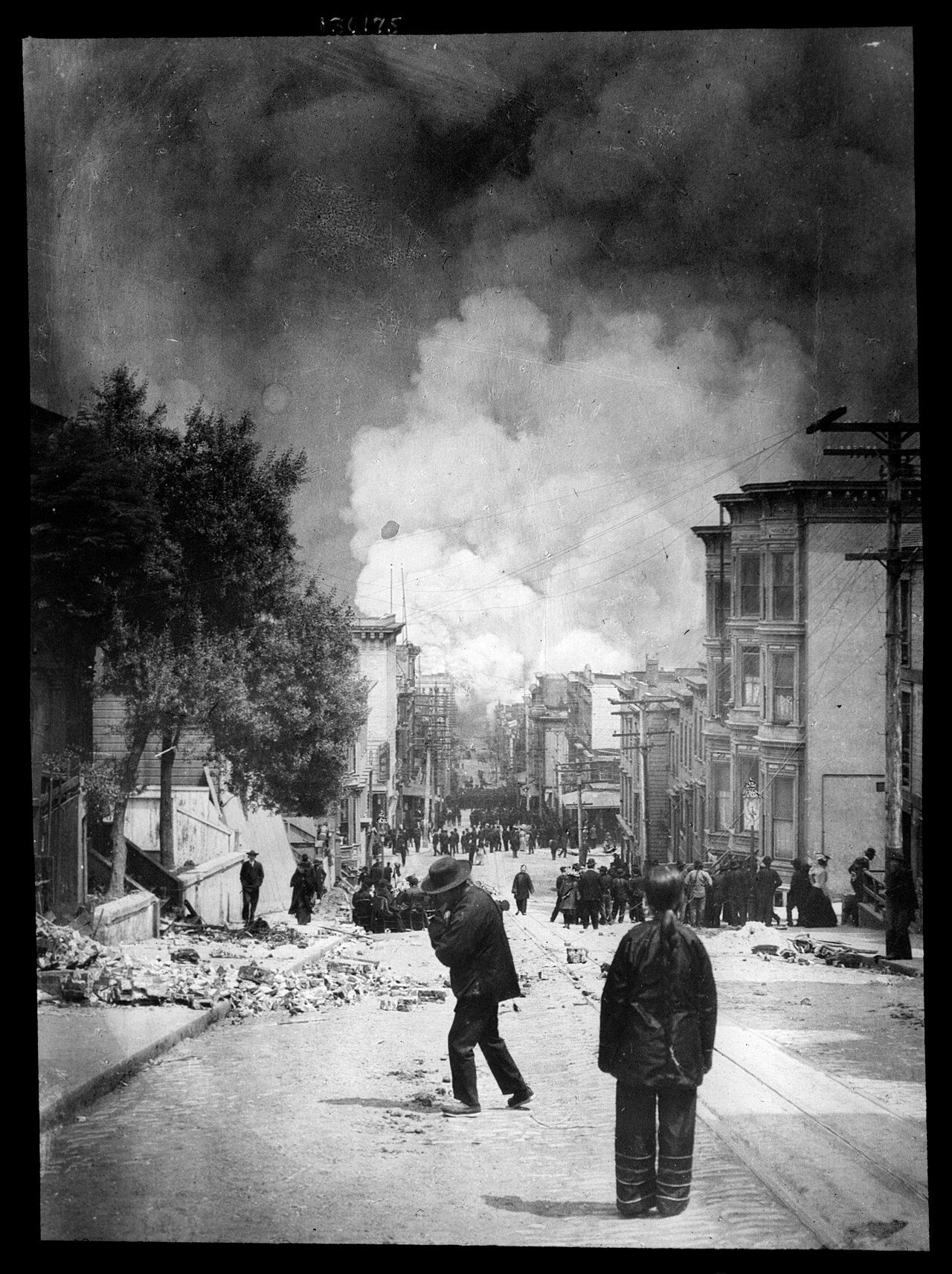
When the fire burned itself out on 21 April, more than 500 blocks — some 28,000 buildings across 4.7 square miles — were gone. The human count was falsified at the time, deliberately: city officials, fearing for investment and insurance, reported fewer than 600 dead. Later research, notably by the archivist Gladys Hansen, established that more than 3,000 people died, most of them never named. About 250,000 people, over half the city, were homeless, living in tent camps in the parks for years. Arnold Genthe's photograph of residents watching the fire from a Sacramento Street hill — this page's hero image — became the disaster's defining view precisely because it shows the watching, not the dying.
The rest of the year's earth moved more politely. On 7 April Mount Vesuvius erupted, devastating Naples and the surrounding towns and killing more than a hundred people. On 10 February Britain had launched HMS Dreadnought, the revolutionary all-big-gun battleship that made every other capital ship obsolete and restarted the naval arms race at a higher pitch. And on 24 September President Theodore Roosevelt proclaimed Devils Tower in Wyoming the first United States national monument — the preservationist counterweight to a year of destruction.
Timeline of 1906
- 10 February
HMS Dreadnought is launched, the all-big-gun battleship that makes every other capital ship obsolete.
- 13 March
Susan B. Anthony, leader of the American women's suffrage movement, dies; the Nineteenth Amendment follows in 1920.
- 15 March
Rolls-Royce Limited is founded in Britain by Charles Rolls and Henry Royce.
- 7 April
Mount Vesuvius erupts, devastating Naples and the surrounding towns and killing more than a hundred people.
- 13 April
Samuel Beckett, Irish novelist and playwright of Waiting for Godot, is born.
- 18 April
A magnitude 7.9 earthquake strikes San Francisco at 5:12 a.m.; the fires that follow burn for three days.
- 19 April
Pierre Curie, co-discoverer of radium and polonium, is killed by a carriage in a Paris street at 46.
- 28 April
Kurt Gödel, whose incompleteness theorems set limits on mathematics itself, is born.
- 3 June
Josephine Baker, entertainer, Resistance worker and civil rights activist, is born.
- 24 September
President Theodore Roosevelt proclaims Devils Tower in Wyoming the first United States national monument.
- 14 October
Hannah Arendt, political philosopher and author of The Origins of Totalitarianism, is born.
- 9 December
Grace Hopper, computer scientist who built the first compiler, is born.
- 30 December
The All-India Muslim League is founded in Dhaka, the party that will later lead the movement for Pakistan.
Why 1906 still matters
San Francisco rebuilt with famous speed — by the Panama-Pacific Exposition of 1915 it presented itself as reborn — but the earthquake's deepest legacy was scientific. Surveyors found fences and roads offset across the fault along its whole length, and from those measurements Harry Fielding Reid formulated the elastic-rebound theory: strain accumulates in rock until the fault snaps it back. It remains the foundation of earthquake science. The city destroyed in a minute became the place where earthquakes were first understood — and its falsified death toll, corrected from a few hundred to more than 3,000 only by later research, remains the standing warning about official numbers after disasters.
The year's other launches compounded in opposite directions. Dreadnought's launch made every existing battleship obsolete at a stroke, which meant every navy had to start again — an invitation to the arms race that helped carry Europe toward 1914. Rolls-Royce, founded a month after the launch, became the byword for engineering luxury. Devils Tower's proclamation created the national-monument instrument American presidents have used to protect landscapes ever since.
And in December, in Dhaka, the All-India Muslim League was founded — a party formed to represent Indian Muslims that would, four decades later, lead the movement for Pakistan. The births of the year — Beckett, Gödel, Arendt, Hopper — belonged to a century that would need all four kinds of mind: the dramatist of waiting, the logician of limits, the philosopher of totalitarianism and the engineer of the compiler.
1906 on The History Trail
The San Francisco earthquake leads this year on The History Trail, with Vesuvius, Dreadnought and the first national monument.
- April 18 in History — The San Francisco earthquake and fire, the featured story of the year.
- April 7 in History — Mount Vesuvius erupts, devastating Naples and the surrounding towns.
- February 10 in History — HMS Dreadnought is launched, restarting the naval arms race.
- September 24 in History — Devils Tower becomes the first United States national monument.
- April 19 in History — Pierre Curie is killed by a carriage in a Paris street.
- 1906 San Francisco Earthquake — The quake and fire that destroyed a city and founded earthquake science.
- Alzheimer's disease — The disease named from the Frankfurt case first admitted in 1901.
Sources
- Encyclopaedia Britannica — On This Day: April 18
- HISTORY — What Happened on April 18
- U.S. Geological Survey — The Great 1906 San Francisco Earthquake
- Encyclopaedia Britannica — On This Day: April 7
- Encyclopaedia Britannica — On This Day: February 10
- Encyclopaedia Britannica — On This Day: September 24
- Encyclopaedia Britannica — On This Day: April 19
- Encyclopaedia Britannica — On This Day: December 30
The facts on this page were checked against these sources on 19 November 2026. The History Trail's permanent pages are researched and written for this site; the live profiles elsewhere on The History Trail are assembled automatically from Wikipedia and Wikidata.
About the Author
Researched and written by the The History Trail Editorial Team — the accountable editorial function behind this site's permanent story pages. The team works from the published sources cited on each page; it does not invent historians, reviewers or credentials, and it corrects errors openly.
Fact Check
Every load-bearing fact on this page traces to one of the sources listed above, and significant claims link to their source in the text. Our checking method is described on the methodology page; errors can be reported via the corrections page.
Sources & Citations
Cite this page as: The History Trail Editorial Team, The History Trail — this article's title, publication and update dates are shown beneath its headline. The full source list appears under Sources above; the site's source standards are on the sources page.