
On This Day
September 24 in History
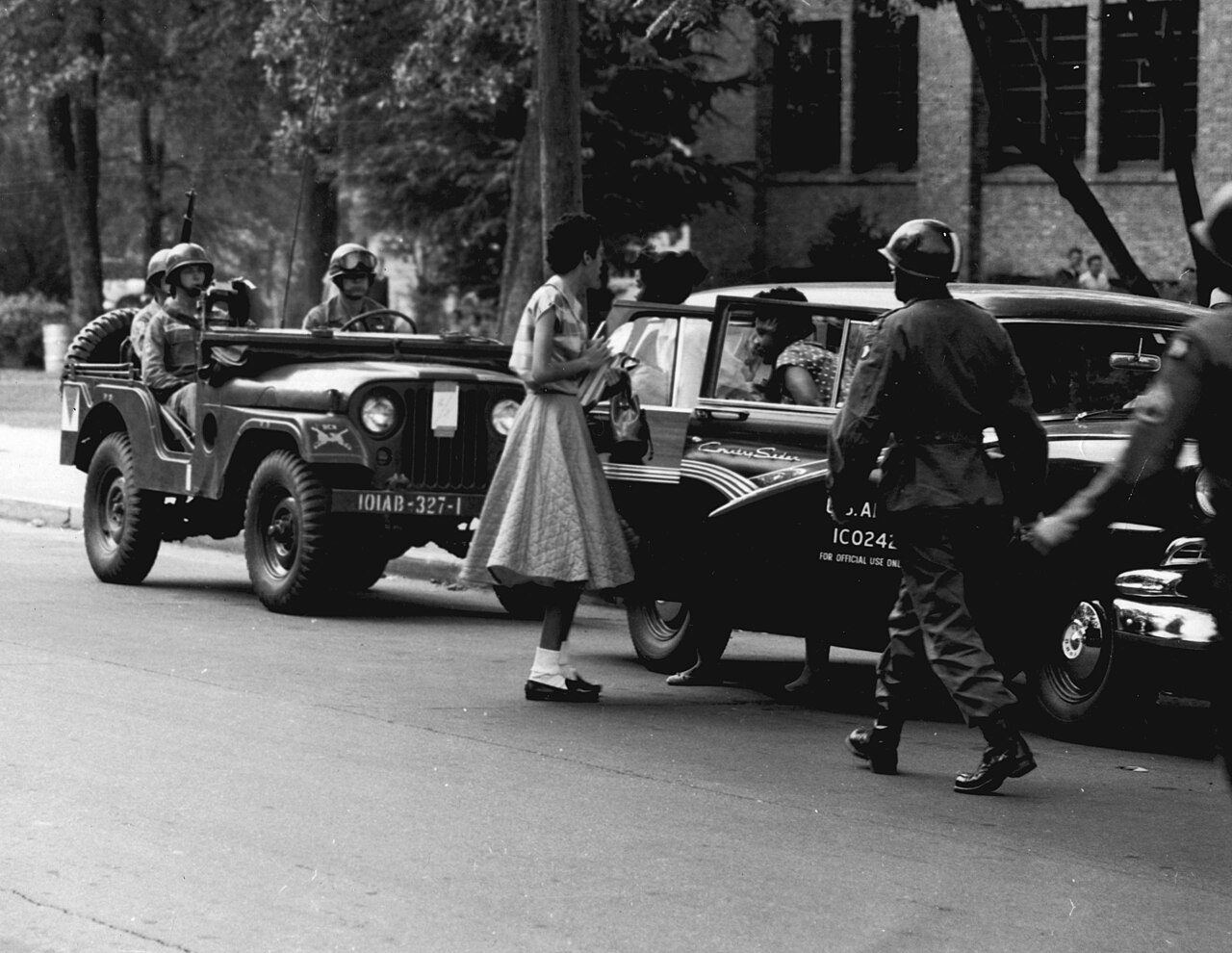
On 24 September 1957 President Dwight D. Eisenhower signed Executive Order 10730, federalising the Arkansas National Guard and sending 1,000 paratroopers of the 101st Airborne Division to Little Rock, Arkansas, so that nine Black students could attend Central High School as the courts had ordered. September 24 is also the day 60 Minutes premiered, Devils Tower became the first national monument, and Jim Henson was born.
Choose another date: open the On This Day calendar to browse events, births and deaths for any day of the year.
At a Glance
- The court order
- The Supreme Court's Brown v. Board of Education decision of 1954 had declared school segregation unconstitutional
- The blockade
- Governor Orval Faubus used the Arkansas National Guard to bar the Little Rock Nine from Central High School
- The order
- Executive Order 10730, signed 24 September 1957, put the Arkansas Guard under federal command
- The troops
- About 1,000 paratroopers of the 101st Airborne Division were flown into Little Rock
- The next morning
- On 25 September the Nine entered Central High under Army escort for their first full day of classes
- The cost of the year
- The students endured a year of harassment; Ernest Green became Central's first Black graduate in May 1958
Events on this day
- 1789Congress passes the Judiciary Act, creating the federal court system, the office of attorney general and a six-member Supreme Court.
- 1869Financiers Jay Gould and James Fisk try to corner the gold market, triggering the 'Black Friday' panic on Wall Street.
- 1906President Theodore Roosevelt proclaims Devils Tower in Wyoming the first United States national monument.
- 1957President Eisenhower sends federal troops to Little Rock to enforce the desegregation of Central High School — the featured story above.
- 1960USS Enterprise, the world's first nuclear-powered aircraft carrier, is launched at Newport News, Virginia.
- 1968The CBS news programme 60 Minutes is broadcast for the first time, hosted by Harry Reasoner and Mike Wallace.
- 1991Nirvana release their album Nevermind, which carries alternative rock — and 'Smells Like Teen Spirit' — into the mainstream.
- 1993Cambodia's monarchy is restored and Norodom Sihanouk again becomes king, two decades after his overthrow.
- 2015A crush during the hajj pilgrimage at Mina, Saudi Arabia, kills 769 people by the official Saudi count; other estimates put the toll above 2,400.
Born on this day
- 1755John Marshall — longest-serving chief justice of the United States, who established the Supreme Court's power of judicial review.
- 1821Cyprian Norwid — Polish poet, dramatist and artist, recognised after his death as one of Poland's great Romantics.
- 1896F. Scott Fitzgerald — American novelist of The Great Gatsby, chronicler of the Jazz Age.
- 1936Jim Henson — American puppeteer who created the Muppets and Kermit the Frog.
- 1941Linda McCartney — American photographer and musician, member of Wings with her husband Paul.
Died on this day
- 1541Paracelsus — Swiss physician and alchemist who pioneered the use of chemicals and minerals in medicine.
- 1877Saigō Takamori — Japanese samurai who led the Satsuma Rebellion and died at the Battle of Shiroyama, remembered as the 'last samurai'.
- 1991Dr. Seuss (Theodor Geisel) — American author and illustrator of The Cat in the Hat and How the Grinch Stole Christmas.
- 2004Françoise Sagan — French novelist who wrote Bonjour Tristesse at eighteen.
The featured story: federal troops are sent to Little Rock, 24 September 1957
Three years after the Supreme Court ruled school segregation unconstitutional in Brown v. Board of Education, Little Rock, Arkansas, set out to integrate its Central High School gradually, beginning with nine carefully chosen Black students. Arkansas's governor, Orval Faubus, chose defiance instead: on 2 September 1957 he called out the state National Guard, ostensibly to keep order, in fact to keep the nine out. On 4 September soldiers turned away fifteen-year-old Elizabeth Eckford, who walked alone through a jeering crowd in one of the century's defining photographs.
For three weeks the city stood at the edge of violence while President Eisenhower — no enthusiast for rapid desegregation — tried to negotiate. The breaking point came on 23 September, when the Nine slipped into the school through a side door and a mob of about a thousand people surged outside; police, fearing a lynching, smuggled the students out again. Little Rock's mayor telegraphed Washington asking for federal help. Eisenhower concluded that a governor's troops defying a federal court made the issue larger than schools: it was whether federal law ran in Arkansas at all.
On 24 September he acted. Executive Order 10730 federalised the entire Arkansas National Guard — taking Faubus's own soldiers out of his hands — and ordered regular Army troops to Little Rock: about a thousand paratroopers of the elite 101st Airborne Division, flown in from Fort Campbell, Kentucky. That evening Eisenhower addressed the nation on television, insisting he acted to uphold the courts and prevent anarchy, not to impose integration by bayonet. It was the first time since Reconstruction that a president had sent federal troops into a southern state to protect the rights of Black citizens.
The next morning the Nine entered Central High properly, each with a soldier escort, and the paratroopers stayed through the autumn while the federalised Guard took over corridor duty for the rest of a brutal school year. Faubus responded in 1958 by closing Little Rock's public high schools altogether for a year. But the precedent of 24 September stood: when a state government interposed itself between citizens and a federal court order, the United States would, in the end, send the Army.
Why this date matters
September 24 is a day when institutions show what they are for. A judiciary is created in 1789; a president tests whether court orders bind a state in 1957; a monument law is used for the first time in 1906; a news programme that would interrogate institutions for half a century starts in 1968. Even the day's births run to institution-builders — Marshall remaking a court, Henson building a company of puppets. It is the calendar's reminder that rules matter only on the day someone is made to obey them. That is why the photographs from Little Rock still stop people: not because soldiers are unusual in history, but because here the whole machinery of a constitution can be seen standing, quite literally, behind nine teenagers carrying schoolbooks.
Sources
- Encyclopaedia Britannica — On This Day: September 24
- HISTORY — This Day in History: September 24
- Wikimedia — On This Day feed: September 24
- National Park Service — Little Rock Central High School National Historic Site
The facts on this page were checked against these sources on 19 November 2026. The History Trail's permanent pages are researched and written for this site; the live profiles elsewhere on The History Trail are assembled automatically from Wikipedia and Wikidata.
About the Author
Researched and written by the The History Trail Editorial Team — the accountable editorial function behind this site's permanent story pages. The team works from the published sources cited on each page; it does not invent historians, reviewers or credentials, and it corrects errors openly.
Fact Check
Every load-bearing fact on this page traces to one of the sources listed above, and significant claims link to their source in the text. Our checking method is described on the methodology page; errors can be reported via the corrections page.
Sources & Citations
Cite this page as: The History Trail Editorial Team, The History Trail — this article's title, publication and update dates are shown beneath its headline. The full source list appears under Sources above; the site's source standards are on the sources page.