
On This Day
June 27 in History
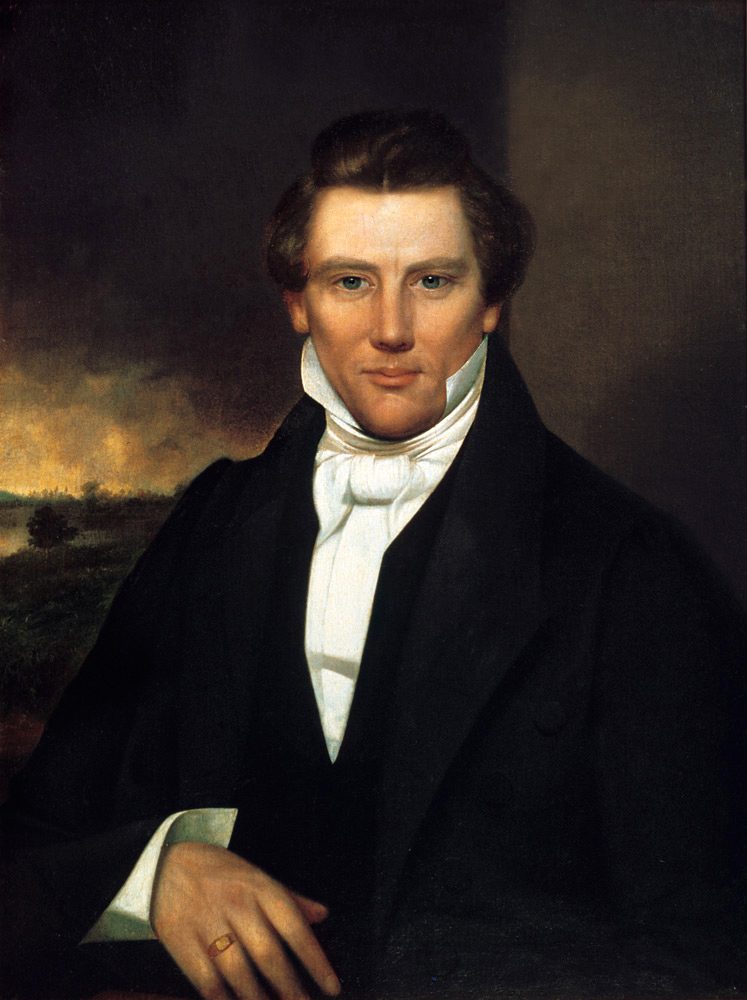
On 27 June 1844 a mob stormed the jail at Carthage, Illinois, and killed Joseph Smith, the 38-year-old founder of the Latter Day Saint movement, and his brother Hyrum. The murder made Smith a martyr and set up the westward migration that built Utah. June 27 is also Helen Keller's birthday, the day of the Potemkin mutiny and of the first nuclear power station.
Choose another date: open the On This Day calendar to browse events, births and deaths for any day of the year.
At a Glance
- The victim
- Joseph Smith, 38, founder of the Latter Day Saint movement, and his brother Hyrum
- The place
- Carthage Jail, Illinois, where Smith was held on charges arising from the destruction of the Nauvoo Expositor press
- The attack
- A mob with blackened faces stormed the jail on the afternoon of 27 June 1844; both brothers were shot
- The trial
- Five men were tried for the murders; all were acquitted
- The succession
- The largest body of Saints followed Brigham Young west to the Great Salt Lake in 1847
- The memory
- Smith is honoured by his followers as a martyr; Carthage Jail is preserved as a shrine
Events on this day
- 1743At the Battle of Dettingen, George II defeats the French — the last time a reigning British monarch leads troops in battle.
- 1844Joseph Smith, founder of the Latter Day Saint movement, is killed by a mob at Carthage, Illinois — the featured story above.
- 1871The yen is adopted as Japan's official currency under the Meiji government.
- 1898Joshua Slocum completes the first solo circumnavigation of the globe, sailing into Newport, Rhode Island, after three years at sea.
- 1905Sailors of the Russian battleship Potemkin mutiny in the Black Sea, the episode that becomes a symbol of revolution.
- 1929Engineers at Bell Laboratories give the first public demonstration of colour television, between New York and Washington.
- 1950President Truman orders United States air and naval forces to help South Korea, two days after the North's invasion.
- 1954The Obninsk power station in the Soviet Union begins supplying electricity, the world's first nuclear power plant on a grid.
- 1977France grants independence to Djibouti, its last African colony.
- 1985Route 66, the 'Mother Road' from Chicago to Los Angeles, is officially removed from the United States highway system.
- 1991Yugoslav forces move into Slovenia, beginning the Ten-Day War, the first conflict of Yugoslavia's disintegration.
Born on this day
- 1846Charles Stewart Parnell — Irish nationalist leader, the 'uncrowned king of Ireland' of the Home Rule movement.
- 1869Emma Goldman — Lithuanian-born anarchist and writer, deported from the United States for her activism.
- 1872Paul Laurence Dunbar — American poet and novelist, the first Black American writer to win national fame.
- 1880Helen Keller — American author and activist who, deaf and blind from infancy, became the era's emblem of education's possibilities.
- 1930Ross Perot — American businessman and independent candidate for president in 1992 and 1996.
- 1966J. J. Abrams — American film-maker, creator of Lost and director of Star Wars: The Force Awakens.
Died on this day
- 1831Sophie Germain — French mathematician who made foundational contributions to number theory and elasticity, largely self-taught.
- 1839Ranjit Singh — founder of the Sikh Empire and maharaja of Punjab, the 'Lion of Punjab'.
- 1844Joseph Smith — founder of the Latter Day Saint movement, killed by a mob at Carthage at 38; see the featured story above.
- 1999Georgios Papadopoulos — Greek colonel who led the 1967 junta and ruled Greece as dictator.
- 2001Jack Lemmon — American actor of Some Like It Hot and The Apartment, dead at 76.
- 2005Shelby Foote — American historian and novelist, chronicler of the Civil War, dead at 88.
The featured story: Joseph Smith is killed by a mob, 27 June 1844
On 27 June 1844 Joseph Smith, the founder of the Latter Day Saint movement, was shot and killed by a mob that stormed the jail at Carthage, Illinois, where he was being held. Britannica's account of the day is blunt: Smith was shot and killed by a mob while imprisoned and awaiting his hearing. He was 38 years old. With him died his brother Hyrum, shot in the same attack; two other prisoners were wounded. Fourteen years after Smith had organised a church of a few dozen followers in upstate New York, its prophet was dead at the hands of a crowd, and the movement he founded — today a global faith of millions — faced the question of whether it could survive him.
Smith had built, in succession, some of the most remarkable communities of the American frontier. The Book of Mormon, which he published in 1830 as a translation of ancient golden plates shown to him by an angel, drew converts first to Ohio, then Missouri, where violence drove them out, and finally to Nauvoo, Illinois, a city the Saints built on the Mississippi until it rivalled Chicago in size. There Smith's authority became civil as well as spiritual: he was mayor, lieutenant-general of the city's militia, and, by 1844, a candidate for president of the United States. He had also introduced, privately, the doctrine of plural marriage. When dissident members published a newspaper, the Nauvoo Expositor, attacking him, Smith as mayor ordered its press destroyed — the act that brought charges of riot and then treason, and took him to Carthage jail under a guarantee of protection from the governor of Illinois.
The protection failed. On the afternoon of 27 June a company of militia with blackened faces — members, by most accounts, of a local regiment left to guard the jail — rushed the building. The Smith brothers, who had been smuggled a pistol and a pepperbox revolver, fired back from the door of their cell room. Hyrum was killed at the door. Joseph emptied his revolver down the stairwell, ran to the window, and was shot from inside and outside the building, falling to the ground below with, in the traditional account, the Masonic cry of distress on his lips. The five men eventually tried for the murders were all acquitted.
The killing did not end the movement; it consecrated it. Smith was remembered by his followers as a martyr who had sealed his testimony with his blood, and the succession crisis that followed produced the church's enduring shape: the largest body followed Brigham Young, who led the Saints west to the Great Salt Lake in 1847, founding the Utah church; others followed Smith's son, or stayed in the Midwest. The violence at Carthage also fixed a pattern in the movement's memory — a prophet killed by the republic he had tried, in his own way, to perfect — and the jail at Carthage is preserved today as a shrine by the Church of Jesus Christ of Latter-day Saints.
Why this date matters
June 27 is a date about conviction carried to its end. A prophet died for a faith fourteen years old; a king fought in person for the last time in British history; sailors mutinied on the Potemkin for a cause still unborn; a lone sailor, Slocum, finished circling the planet simply to prove it could be done. Its modern entries carry the same charge into systems: a currency adopted, a colour image sent down a wire, a power station splitting atoms for a town's light, a superpower committing itself to a war on the far side of the world. The date keeps staging the moment when an idea — religious, national, technical — stops being argued about and starts being acted on.
Sources
- Encyclopaedia Britannica — On This Day: June 27 (podcast)
- HISTORY — What Happened on June 27
- Encyclopaedia Britannica — Joseph Smith
- Smithsonian Magazine — The Death of Joseph Smith
The facts on this page were checked against these sources on 19 November 2026. The History Trail's permanent pages are researched and written for this site; the live profiles elsewhere on The History Trail are assembled automatically from Wikipedia and Wikidata.
About the Author
Researched and written by the The History Trail Editorial Team — the accountable editorial function behind this site's permanent story pages. The team works from the published sources cited on each page; it does not invent historians, reviewers or credentials, and it corrects errors openly.
Fact Check
Every load-bearing fact on this page traces to one of the sources listed above, and significant claims link to their source in the text. Our checking method is described on the methodology page; errors can be reported via the corrections page.
Sources & Citations
Cite this page as: The History Trail Editorial Team, The History Trail — this article's title, publication and update dates are shown beneath its headline. The full source list appears under Sources above; the site's source standards are on the sources page.