
Years
1815 in History
1815 is the year the Napoleonic era ended — twice. It opened with a battle fought after its war was already over, when Andrew Jackson destroyed the British assault on New Orleans a fortnight after the Treaty of Ghent had ended the War of 1812. Then Napoleon escaped from Elba, retook Paris without fighting a battle, and began the Hundred Days, which closed on 18 June at Waterloo. The Congress of Vienna concluded its redrawing of Europe, and Napoleon sailed to exile on St Helena, from which he never returned.
At a Glance
- Defining event
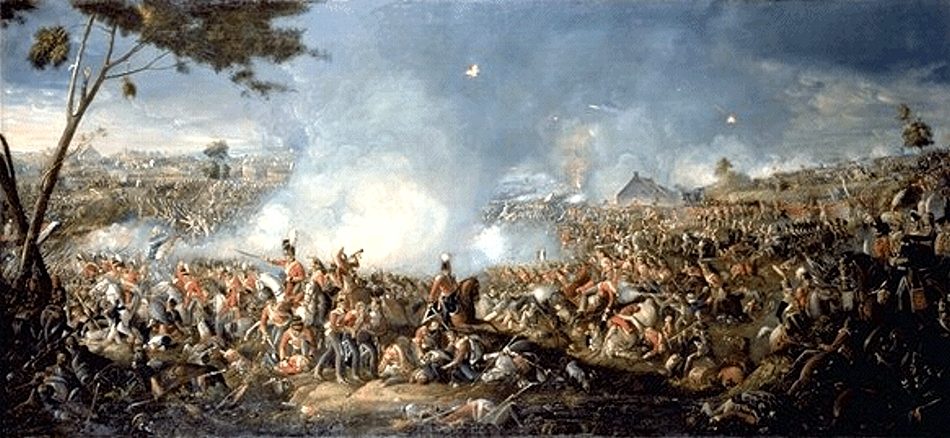
- Waterloo, 18 June — Napoleon is defeated by Wellington's Anglo-allied army and Blücher's Prussians
- The comeback
- Napoleon escapes Elba on 26 February with about a thousand men and enters Paris on 20 March
- The settlement
- The Congress of Vienna concludes on 9 June, redrawing the map of Europe after the Napoleonic Wars
- The unnecessary battle
- New Orleans, 8 January — fought a fortnight after the Treaty of Ghent had ended the War of 1812
- The exile
- Napoleon arrives on St Helena on 15 October, to begin the exile from which he never returns
- Born this year
- Otto von Bismarck, Elizabeth Cady Stanton and Ada Lovelace — three very different futures
The defining story: Napoleon defeated at Waterloo
The Hundred Days were the most dramatic comeback in military history. Exiled to Elba in 1814 — allowed, oddly generously, to keep the title of emperor, rule the island as his own tiny state and maintain a guard of several hundred men — Napoleon listened to reports of the restored Bourbon king Louis XVIII's unpopularity and of the victorious powers falling out at the Congress of Vienna. On 26 February 1815, while the British and French guard ships were absent, he slipped out of Portoferraio aboard the brig Inconstant with about a thousand men and landed at Golfe-Juan on the French Riviera on 1 March. He did not fight his way back: the soldiers ordered to arrest him joined him instead, including Marshal Ney, who had boasted he would bring the emperor back to Paris in an iron cage. On 20 March Napoleon entered Paris and Louis XVIII fled. Not one battle had been fought.
Europe's powers — Britain, Prussia, Austria and Russia — each pledged 150,000 men to remove him for good, but their armies needed until July to assemble. Napoleon's only chance was to strike first, in Belgium, and destroy Wellington's Anglo-allied army and Blücher's Prussians separately before they could combine. He nearly did it. On 16 June he beat the Prussians at Ligny while Ney held Wellington at Quatre Bras — but neither enemy was destroyed. Blücher's beaten army retreated north to Wavre, keeping contact with Wellington, instead of east away from him: the decision that decided the campaign. Wellington, promised Prussian help, stood his ground on a ridge south of the village of Waterloo, anchoring his line on the fortified farm of Hougoumont and the walled farmhouse of La Haye Sainte. Napoleon, his army slowed by a night of torrential rain, delayed his attack until late morning on 18 June to let the sodden ground dry.
The year's other theatre had already closed, in ignorance. On 8 January, at Chalmette outside New Orleans, Andrew Jackson's improvised army, dug in behind its defences, destroyed the main British assault in about half an hour — a fortnight after the Treaty of Ghent had ended the War of 1812, news of which had not reached the armies. The victory made Jackson a national figure and proved nothing about the war, which was already over; it remains the classic demonstration that in 1815 news travelled slower than armies. Meanwhile the peacemakers finished their work: the Congress of Vienna concluded on 9 June, redrawing the map of Europe, proclaiming a Congress Kingdom of Poland under the Russian crown along the way, and in September Russia, Austria and Prussia signed the Holy Alliance, pledging to govern by Christian principles after Napoleon's defeat.
At Waterloo the Prussian arrival settled what Wellington's defence had made possible: Blücher's men reached the French flank in the middle of the battle, and by evening Napoleon's army was broken. Thomas Picton, the most senior British officer killed that day, was among the dead. Napoleon abdicated four days later and was exiled not to another Elba but to St Helena, a remote island in the South Atlantic, where he arrived on 15 October to begin the exile from which he never returned; he died there in 1821. The wars that had begun in the French Revolution's aftermath — 23 years of conflict — were over.
Timeline of 1815
- 8 January
Jackson defeats the British at the Battle of New Orleans — a fortnight after the Treaty of Ghent ended the War of 1812.
- 11 January
John A. Macdonald is born — the first prime minister of Canada, who will stitch the Dominion together in 1867.
- 24 February
Robert Fulton dies — the American engineer whose Clermont made the steamboat a commercial success on the Hudson.
- 26 February
Napoleon escapes from exile on Elba with about a thousand men, beginning the Hundred Days.
- 20 March
Napoleon enters Paris after escaping from Elba, without fighting a battle on the way.
- 1 April
Otto von Bismarck is born — the statesman who will unify Germany and become its first chancellor.
- 3 May
The Congress Kingdom of Poland is proclaimed under the Russian crown as the Vienna settlement redraws Europe.
- 9 June
The Congress of Vienna concludes, redrawing the map of Europe after the Napoleonic Wars.
- 18 June
Napoleon is defeated at Waterloo by Wellington and Blücher, ending the Napoleonic Wars; General Thomas Picton is killed.
- 26 September
Russia, Austria and Prussia sign the Holy Alliance, pledging to govern by Christian principles.
- 15 October
Napoleon arrives on St Helena to begin the exile from which he never returns.
- 12 November
Elizabeth Cady Stanton is born — American leader of the women's rights movement and co-organiser of Seneca Falls.
- 10 December
Ada Lovelace is born — whose notes on Babbage's Analytical Engine contain what is recognised as the first computer algorithm.
Why 1815 still matters
1815 still matters because the settlement made that year shaped the century that followed. The Congress of Vienna's map — completed nine days before Waterloo, while its authors still did not know whether Napoleon would win — was an attempt to settle Europe by balance rather than revolution, and the order it built, policed by alliances such as the Holy Alliance signed that September, defined the continent's politics for generations. Waterloo itself became the language's shorthand for final defeat, and the campaign its permanent lesson in coalition warfare: Napoleon lost not to a single army but to two that refused to be separated, commanded by men who kept their promises to each other under the worst conditions.
The year's quieter entries point at the future the peacemakers could not see. Three children born in 1815 — Bismarck in April, Stanton in November, Lovelace in December — would respectively remake Germany by statecraft, open the organised women's rights movement at Seneca Falls, and write the first computer algorithm in notes on a machine that was never built. John A. Macdonald, born in January, would stitch Canada together in 1867. The statesmen of Vienna believed they were restoring an old world; the births register of their own year shows the new one already arriving — national unification, organised feminism and computing, all born while the ink on the settlement was still wet.
1815 on The History Trail
1815 carries three featured stories on The History Trail — an unnecessary battle, an impossible escape and a final defeat.
- June 18 in History — Napoleon is defeated at Waterloo, ending the Napoleonic Wars.
- February 26 in History — Napoleon escapes from Elba and begins the Hundred Days.
- January 8 in History — Jackson's victory at New Orleans, fought after the war had ended.
- June 9 in History — the Congress of Vienna concludes its redrawing of Europe.
- October 15 in History — Napoleon arrives on St Helena for his final exile.
- Napoleonic Wars — the full story of the wars that ended at Waterloo in 1815.
Sources
- Library of Congress — Today in History: January 8
- Encyclopaedia Britannica — On This Day: February 26
- Encyclopaedia Britannica — On This Day: March 20
- Encyclopaedia Britannica — On This Day: June 9
- Encyclopaedia Britannica — Battle of Waterloo
- Encyclopaedia Britannica — On This Day: October 15
- Encyclopaedia Britannica — On This Day: December 10
The facts on this page were checked against these sources on 19 November 2026. The History Trail's permanent pages are researched and written for this site; the live profiles elsewhere on The History Trail are assembled automatically from Wikipedia and Wikidata.
About the Author
Researched and written by the The History Trail Editorial Team — the accountable editorial function behind this site's permanent story pages. The team works from the published sources cited on each page; it does not invent historians, reviewers or credentials, and it corrects errors openly.
Fact Check
Every load-bearing fact on this page traces to one of the sources listed above, and significant claims link to their source in the text. Our checking method is described on the methodology page; errors can be reported via the corrections page.
Sources & Citations
Cite this page as: The History Trail Editorial Team, The History Trail — this article's title, publication and update dates are shown beneath its headline. The full source list appears under Sources above; the site's source standards are on the sources page.