
Years
1814 in History
1814 closed two wars' chapters. Allied armies entered Paris in March and Napoleon abdicated and was exiled to Elba. In America, British troops burned Washington in August, Francis Scott Key wrote the poem that became The Star-Spangled Banner in September, and on Christmas Eve the Treaty of Ghent ended the War of 1812 on the pre-war map — while The Times was first printed by steam and Adolphe Sax was born.
At a Glance
- Defining event
- Treaty of Ghent signed, 24 December 1814 — ending the War of 1812 on terms of status quo ante bellum
- The fall
- Allied armies enter Paris on 30 March; Napoleon abdicates and is exiled to Elba under the Treaty of Fontainebleau, 11 April
- The burning
- British troops burn Washington, D.C., including the White House and the Capitol, 24 August
- The anthem
- Francis Scott Key begins 'The Star-Spangled Banner' watching Fort McHenry at dawn, 14 September
- The victory
- Macdonough defeats a British squadron on Lake Champlain at Plattsburgh, 11 September
- Print revolution
- The Times of London is printed by steam-powered presses for the first time, 28 November
The defining story: the Christmas Eve peace
The War of 1812 had begun in American grievance — British warships stopping American vessels and impressing their sailors, and British support for Native nations resisting American expansion — and by 1814 both governments were exhausted. The year's American war opened in the south: on 27 March Andrew Jackson's forces destroyed the Creek Red Sticks at the Battle of Horseshoe Bend in Alabama, breaking their power in the Southeast. In Europe the greater war was ending: on 30 March allied armies entered Paris after defeating Napoleon, and within days the emperor abdicated for the first time. On 11 April the Treaty of Fontainebleau was signed and Napoleon, having abdicated, was exiled to the island of Elba.
Freed from the European war, Britain turned its strength on America. On 24 August British troops burned Washington, D.C., including the White House and the Capitol — the capital of the United States put to the torch in retaliation and humiliation. Yet the offensive broke in September. On 11 September an American fleet under Thomas Macdonough defeated a British squadron on Lake Champlain at Plattsburgh, forcing a British invasion force to retreat into Canada. Days later Baltimore held: through the night of 13–14 September British bomb vessels pounded Fort McHenry, and at dawn Francis Scott Key, detained aboard a truce ship, saw the great garrison flag still flying and began the poem that became 'The Star-Spangled Banner'.
At Ghent, in Belgium, negotiators had been arguing since summer. The British team arrived with demands sharpened by victory in Europe; the American team, led by John Quincy Adams and including Henry Clay and Albert Gallatin, refused them all. As British fortunes stalled at Plattsburgh and Baltimore, London's demands softened toward the simple restoration of the pre-war map.
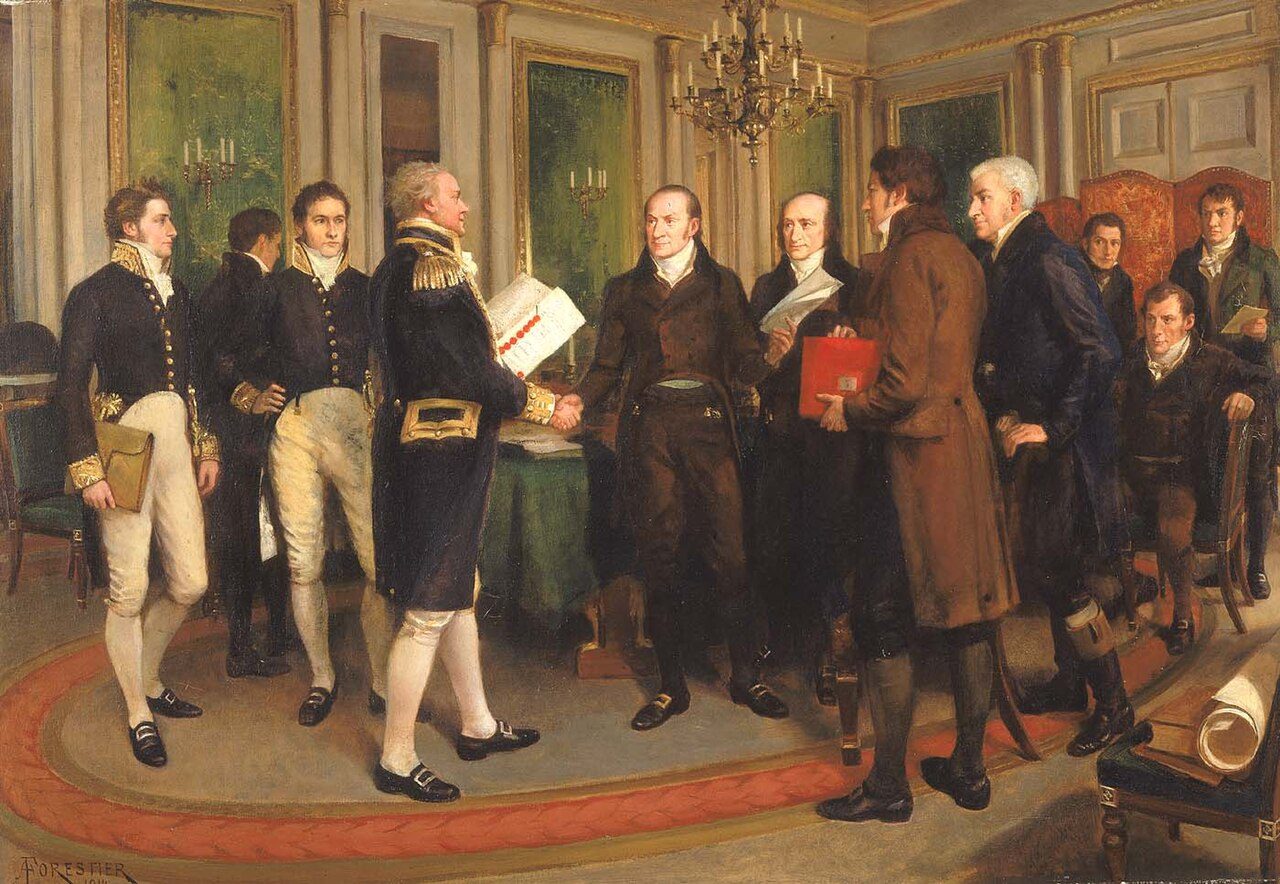
On Christmas Eve, 24 December 1814, British and American negotiators signed the Treaty of Ghent, ending the War of 1812 on terms of status quo ante bellum: all captured territory returned, boundaries restored, commissions appointed to settle disputed borders. The painting by Amédée Forestier shows the British leader Lord Gambier shaking hands with John Quincy Adams. Peace took effect only on ratification in February 1815 — which is why the war's famous battle of New Orleans was fought in January, after the treaty was signed. The last war between Britain and the United States was over, even if the news travelled slower than the armies.
Timeline of 1814
- 9 March
Taras Shevchenko, the foundational voice of modern Ukrainian literature, is born.
- 27 March
Andrew Jackson's forces destroy the Creek Red Sticks at the Battle of Horseshoe Bend in Alabama.
- 30 March
Allied armies enter Paris after defeating Napoleon; within days the emperor abdicates for the first time.
- 11 April
The Treaty of Fontainebleau is signed and Napoleon, having abdicated, is exiled to the island of Elba.
- 19 July
Samuel Colt, whose revolver and mass-production methods reshaped the firearms industry, is born.
- 24 August
British troops burn Washington, D.C., including the White House and the Capitol, during the War of 1812.
- 11 September
An American fleet under Thomas Macdonough defeats a British squadron on Lake Champlain at Plattsburgh.
- 14 September
Francis Scott Key, watching the flag over Fort McHenry at dawn, begins the poem that becomes 'The Star-Spangled Banner'.
- 17 October
The London Beer Flood: a bursting brewery vat sends a wave of porter through St Giles, killing eight people.
- 19 October
The young Franz Schubert composes 'Gretchen am Spinnrade', his first masterpiece of song.
- 28 November
The Times of London is printed for the first time by steam-powered presses.
- 24 December
The Treaty of Ghent is signed in Belgium, ending the War of 1812 between Britain and the United States.
Why 1814 still matters
Ghent matters because of what it left out and what it lasted. The treaty restored the pre-war map and settled the Anglo-American relationship so durably that 1814 marks the last war between Britain and the United States — the beginning of the long peace across the Atlantic and the Canadian border that still holds. Napoleon's fall the same spring ended, for a season, twenty years of European war, though his exile to Elba proved a pause rather than an ending: he would return in 1815 for the Hundred Days and Waterloo.
The year's symbols outlasted its settlements. Key's poem, printed within days as 'Defence of Fort M'Henry' and set to an existing tune, waited until 1931 to become the national anthem — but the flag it celebrates, 30 by 42 feet with 15 stars and 15 stripes, survives at the Smithsonian as the young republic's most treasured cloth. The burning of Washington, meant as a humiliation, became instead a founding story of resilience, and the rebuilt White House was supervised by James Hoban, its original designer from 1792.
Invention threaded the year as well: The Times printed by steam on 28 November began the mass production of newspapers; Adolphe Sax, born on 6 November, would invent the saxophone; Samuel Colt, born 19 July, would industrialise the revolver; and Schubert's 'Gretchen am Spinnrade' on 19 October opened the age of the art song. Even the London Beer Flood of 17 October, killing eight in the St Giles slums, belongs to the industrial city's new scale of accident.
1814 on The History Trail
Elba, a burned capital, an anthem and a Christmas Eve peace — 1814 day by day.
- December 24 in History — The Treaty of Ghent ends the War of 1812 — the featured story of the peace.
- September 14 in History — Francis Scott Key writes The Star-Spangled Banner.
- August 24 in History — British troops burn Washington, D.C.
- March 30 in History — Allied armies enter Paris and Napoleon falls.
- November 28 in History — The Times is printed by steam for the first time.
- October 17 in History — The London Beer Flood kills eight in St Giles.
Sources
- National Archives — Treaty of Ghent (1814)
- Encyclopaedia Britannica — On This Day: December 24
- HISTORY — What Happened on December 24
- Encyclopaedia Britannica — On This Day: September 14
- Smithsonian Magazine — The Real Story Behind the Star-Spangled Banner
- Encyclopaedia Britannica — On This Day: August 24
The facts on this page were checked against these sources on 19 November 2026. The History Trail's permanent pages are researched and written for this site; the live profiles elsewhere on The History Trail are assembled automatically from Wikipedia and Wikidata.
About the Author
Researched and written by the The History Trail Editorial Team — the accountable editorial function behind this site's permanent story pages. The team works from the published sources cited on each page; it does not invent historians, reviewers or credentials, and it corrects errors openly.
Fact Check
Every load-bearing fact on this page traces to one of the sources listed above, and significant claims link to their source in the text. Our checking method is described on the methodology page; errors can be reported via the corrections page.
Sources & Citations
Cite this page as: The History Trail Editorial Team, The History Trail — this article's title, publication and update dates are shown beneath its headline. The full source list appears under Sources above; the site's source standards are on the sources page.