
Vehicles
RMS Titanic — the ship that changed the rules
On 15 April 2027 it will be 115 years since RMS Titanic sank. She was the largest ship afloat when she sailed in April 1912, and she went down on her maiden voyage: about 1,500 of the 2,200 people aboard died, on the figures the 1912 inquiries recorded — and safety at sea was rewritten.
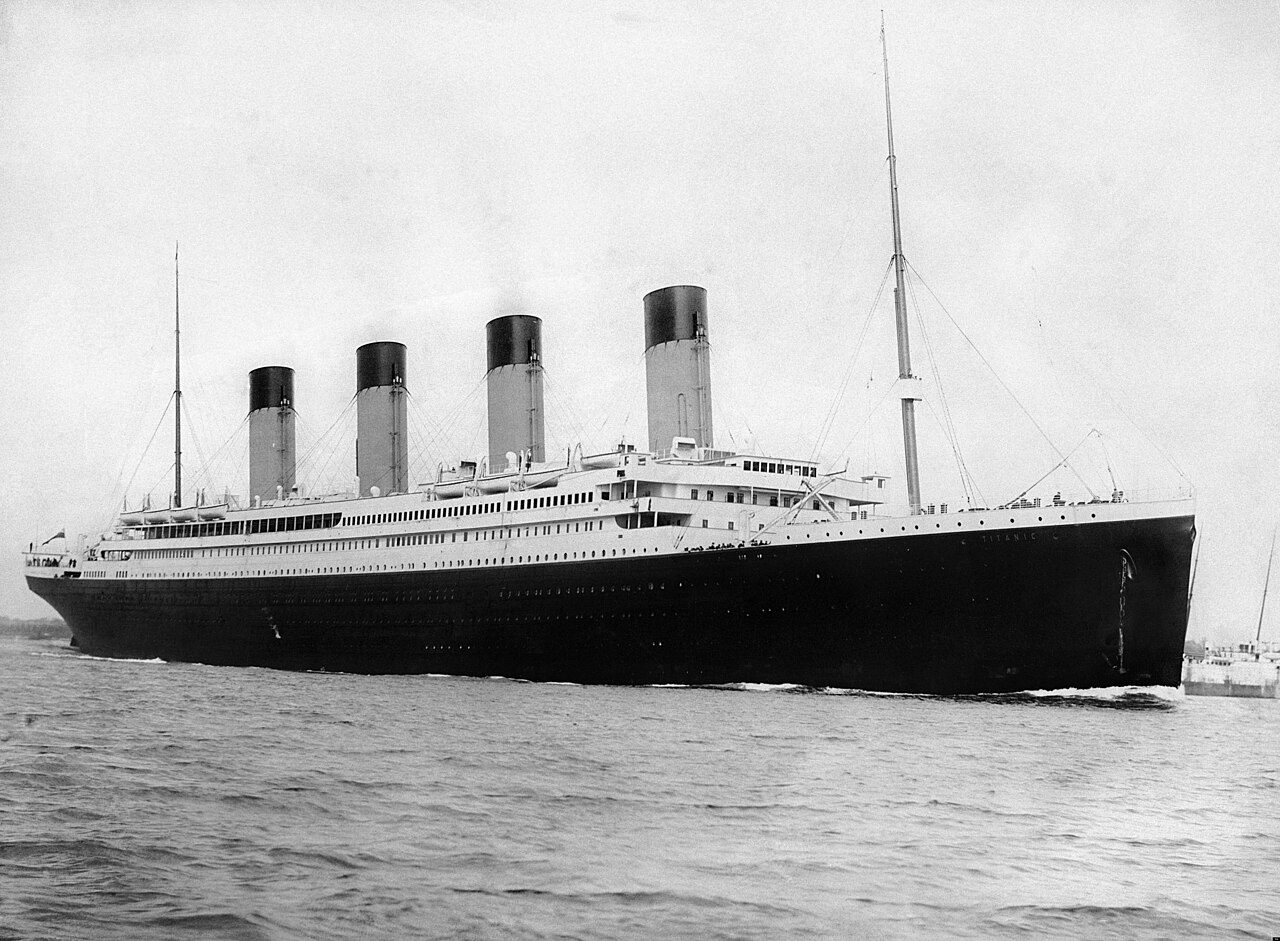
At a Glance
- Builder
- Harland and Wolff, Belfast, for the White Star Line
- Launched
- 31 May 1911
- Length
- About 882.5 feet (269 metres)
- Tonnage
- 46,328 gross registered tons
- Maiden voyage
- Southampton to New York, departing 10 April 1912
- Sank
- 15 April 1912, after striking an iceberg late on 14 April
- People aboard
- About 2,200; about 1,500 died and about 705 survived (figures are approximate — see sources)
- Wreck found
- 1 September 1985, about 12,500 feet (3,810 metres) down
One Voyage, a Century of Memory
No ship that completed so little has been remembered so much. Titanic made one voyage, never finished it, and yet her name has stood for more than a century as shorthand for confidence outrunning caution. She was, as Britannica puts it, one of the largest and most opulent ships in the world when she sailed — and she was gone within five days.
The bare facts still startle. Late on 14 April 1912, four days out of Southampton on her maiden voyage to New York, Titanic struck an iceberg in the North Atlantic. She sank at 2:20 in the morning of 15 April, two hours and forty minutes later. Of the approximately 2,200 passengers and crew aboard, about 1,500 died and about 705 survived. Exact totals were disputed from the start and remain approximate, because the original lists were imperfect; the figures here are the attributed inquiry-era figures, not a settled modern count.
What turned a disaster into a turning point was what happened next: inquiries on both sides of the Atlantic, and international rules — on lifeboats, radio watches and ice patrols — that still shape every passenger voyage today.
Ismay Answers Cunard With Scale
Titanic was built for a rivalry. In 1907 Cunard was preparing two fast new liners, Lusitania and Mauretania, and White Star's chairman J. Bruce Ismay answered not with speed but with scale and comfort: three enormous sister ships, Olympic, Titanic and Britannic, designed largely by Thomas Andrews of Harland and Wolff in Belfast. Titanic's keel was laid on 31 March 1909, beside Olympic in a gantry built for their size, and she was launched on 31 May 1911.
Her luxury was real — a first-class dining saloon, elevators, a swimming pool — but it was her safety system that fed the legend. The hull was divided into 16 compartments with doors closable from the bridge, and she was said to be able to stay afloat with any four flooded. The weakness was hidden: the bulkheads were not capped at the top, so once water rose high enough it could spill from one compartment into the next.
She also carried too few lifeboats — 20 boats with room for 1,178 people, fewer than the number aboard, though more than regulations required. The rules had not kept pace with the size of ships.
Timeline
- 31 March 1909
Titanic's keel is laid at Harland and Wolff in Belfast, beside her sister ship Olympic.
- 31 May 1911
The hull is launched; fitting out begins.
- 10 April 1912
The maiden voyage begins at Southampton, calling at Cherbourg and then Queenstown.
- 14 April 1912, 11:40 pm
After ice warnings during the day, lookouts sight an iceberg dead ahead; the ship's starboard side scrapes along it, opening at least five compartments to the sea.
- 15 April 1912, 2:20 am
Titanic sinks, having broken in two. Carpathia races to the scene and rescues the survivors in the lifeboats.
- April–July 1912
The United States Senate inquiry opens on 19 April and hears 82 witnesses; in Britain, the Wreck Commissioner's inquiry under Lord Mersey sits from May.
- 1914
The first International Convention for the Safety of Life at Sea (SOLAS) is adopted, and an International Ice Patrol is established.
- 1 September 1985
A joint French–American expedition led by Robert Ballard of Woods Hole and Jean-Louis Michel of IFREMER finds the wreck in two pieces about 12,500 feet down, using the camera system Argo.
- July 1986
Ballard returns in the submersible Alvin, and human eyes see the wreck directly for the first time since 1912.
- 15 April 2012
A century after the sinking, the wreck comes under the UNESCO convention protecting underwater heritage submerged for 100 years.
- 2019–20
The United Kingdom–United States agreement protecting the wreck as a memorial comes into force.
- 15 April 2027
The 115th anniversary.
The Reckoning: Lifeboats, Radio and Class
Titanic's significance lies less in the sinking than in the reckoning. The inquiries exposed a system in which lifeboat rules were tied to tonnage rather than the people aboard, radio rooms were not staffed around the clock, and survival depended heavily on class: Britannica notes that about 62 percent of first-class passengers survived, against about 25 percent in third class, while more than three-quarters of the crew died. The National Archives holds the Senate inquiry's 1,042 pages, in which 82 witnesses were questioned on lifeboats, steerage and the new wireless sets.
The reforms were concrete and lasting. SOLAS, first adopted in 1914 and updated ever since, still sets minimum safety standards for ships. Lifeboats had to have room for everyone aboard, drills and radio watches became mandatory, and the International Ice Patrol began tracking bergs in North Atlantic lanes. Every modern cruise passenger who musters for a drill follows a rule written in Titanic's shadow.
The Wreck, the Bacteria and the Memorial
The wreck itself has become a second story. For 73 years its location was unknown. The 1985 discovery was a joint French–American effort: the French ship Le Suroit, using Jean-Louis Michel's sonar SAR, eliminated most of the search area, and then Robert Ballard's team aboard Knorr, from the Woods Hole Oceanographic Institution, searched for the debris trail rather than the hull. Just after 1 a.m. on 1 September 1985 the camera sled Argo passed over one of Titanic's boilers, and the wreck was found. In 1986 Ballard returned in the submersible Alvin, with the robot Jason Jr., to look inside the hull.
What the cameras found is slowly disappearing. NOAA, which returned with Ballard in 2004 to map the site, describes the wreck as covered in rusticles — icicle-like formations that are in fact communities of bacteria consuming the ship's iron. In 2010 researchers named one such iron-eating bacterium Halomonas titanicae, after the ship. Decks have collapsed and fittings have fallen away. Protection is now legal as well as sentimental: UNESCO underwater heritage protection came in 2012, and the United Kingdom–United States treaty announced in 2020 treats the site as a memorial to be licensed and guarded, not salvaged at will.
Artefacts, exhibitions and Belfast's Titanic Quarter, built around the shipyard where she was constructed, keep the human stories — engineers, emigrants, musicians, millionaires — at the centre of the telling.
Myths and disputes
Was she really called unsinkable? Not in the unqualified form of legend. White Star did not advertise Titanic with the plain word unsinkable; the trade journal The Shipbuilder, describing the Olympic class in 1911, called the ships practically unsinkable, pointing to the watertight compartments. After the sinking the qualifier was dropped, and unsinkable became the ironic headline.
The most persistent conspiracy theory holds that Titanic was secretly swapped with her damaged sister Olympic and sunk for the insurance. There is no documentary evidence for a swap, and the evidence against it is physical: the wreck carries Titanic's own builder's number and fittings unique to her, the ships differed in hundreds of documented details no yard could have exchanged unnoticed, and Olympic served on, fully documented, until 1935. Historians treat the story as a myth.
The coal-bunker fire is a different case: a genuine debate. A fire in a coal bunker was mentioned at the 1912 inquiries, and in 2017 the journalist Senan Molony argued, in a Smithsonian Channel documentary reported by Smithsonian Magazine, that a black mark in photographs of the hull showed where the fire had weakened the steel before the iceberg struck the same area. Critics reply that bunker fires were common, that the mark has other explanations, and that a ship opened across five compartments would have sunk in any case. The fire is documented; its decisive role is not.
The Californian controversy is older than either. The Leyland liner Californian, stopped in ice for the night, saw white rockets — eight of them, her officers testified — and did not come. The Wreck Commissioner's report concluded that the ship seen from Californian was Titanic, that the rockets were her distress signals, and that she might have reached Titanic in time had her captain, Stanley Lord, acted; Lord maintained until his death that another vessel stood between them. The distance is still argued over, but the inquiries' framing stands.
Legacy
Titanic endures because she sits at the junction of modern themes: migration, class, technology, media and risk. But her most practical legacy is invisible — a safety culture, codified in international law, that treats the lessons of one April night as permanent.
Sources
- Encyclopaedia Britannica — Titanic
- US National Archives — They Said It Couldn't Sink (Prologue, Spring 2012)
- Woods Hole Oceanographic Institution — 1985 discovery of RMS Titanic
- NOAA Ocean Today — The Titanic Wrecksite
- Smithsonian Magazine — A Coal Fire May Have Helped Sink the Titanic
- British Wreck Commissioner's Inquiry — Report: Circumstances in Connection with the SS Californian (Titanic Inquiry Project)
- GOV.UK — RMS Titanic wreck to be protected under historic treaty with US
The facts on this page were checked against these sources on 18 November 2026. The History Trail's permanent pages are researched and written for this site; the live profiles elsewhere on The History Trail are assembled automatically from Wikipedia and Wikidata.
About the Author
Researched and written by the The History Trail Editorial Team — the accountable editorial function behind this site's permanent story pages. The team works from the published sources cited on each page; it does not invent historians, reviewers or credentials, and it corrects errors openly.
Fact Check
Every load-bearing fact on this page traces to one of the sources listed above, and significant claims link to their source in the text. Our checking method is described on the methodology page; errors can be reported via the corrections page.
Sources & Citations
Cite this page as: The History Trail Editorial Team, The History Trail — this article's title, publication and update dates are shown beneath its headline. The full source list appears under Sources above; the site's source standards are on the sources page.