
Things
Universal Declaration of Human Rights
The Universal Declaration of Human Rights is the United Nations' 1948 statement of the rights of every person. Adopted by the General Assembly in Paris on 10 December 1948, its 30 articles proclaim life, liberty, equality, free expression, work and education as universal rights - not legally binding, yet the foundation of modern international human rights law.
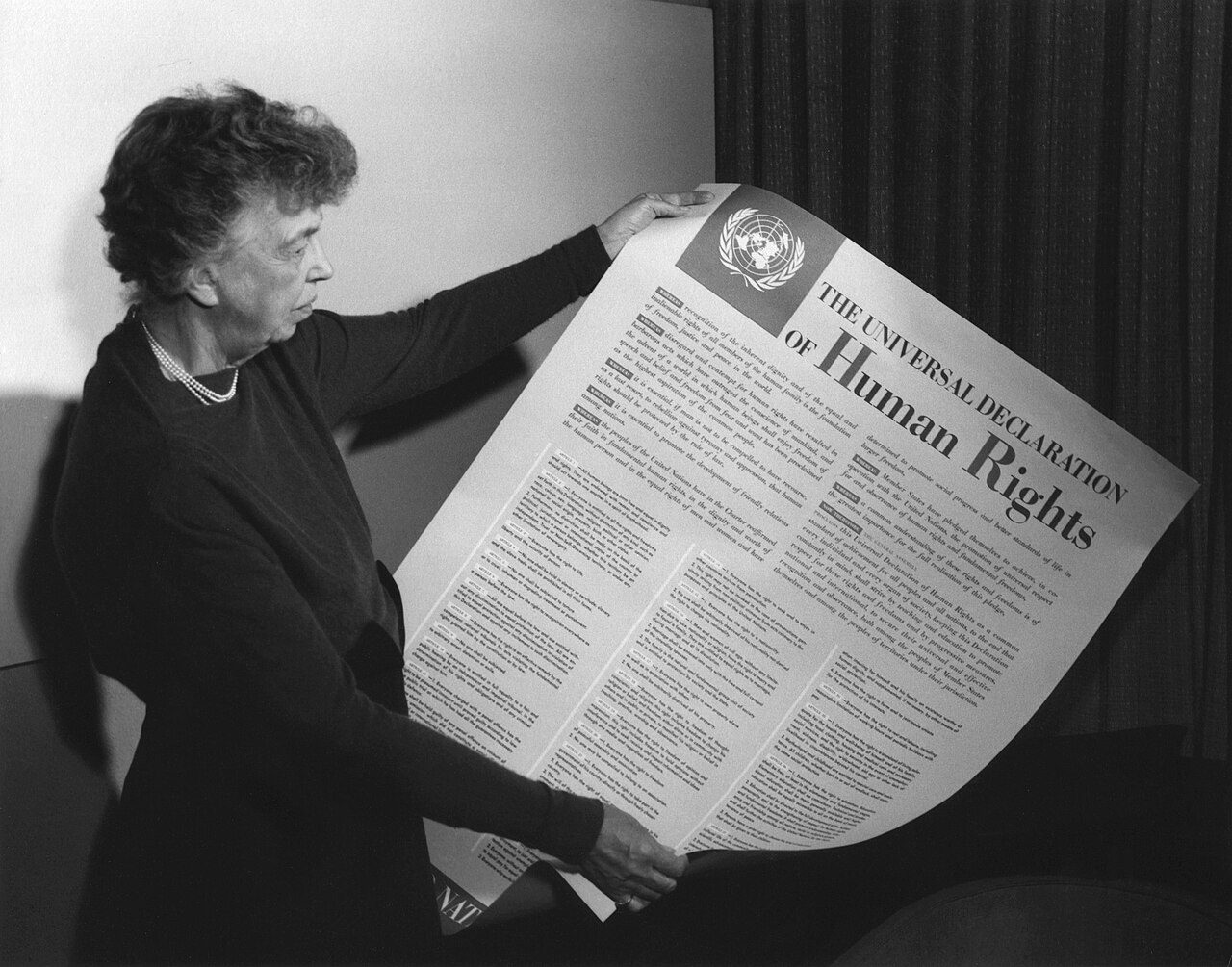
At a Glance
- What it is
- A declaration of the rights and freedoms of every human being, proclaimed as a common standard of achievement for all peoples and all nations
- Adopted
- 10 December 1948, by the UN General Assembly at the Palais de Chaillot, Paris, as resolution 217 A
- The vote
- 48 in favour, none against, eight abstentions, of the 58 UN member states of the time; two members did not vote
- Structure
- A preamble and 30 articles covering civil, political, economic, social and cultural rights
- Drafted by
- The UN Commission on Human Rights, chaired by Eleanor Roosevelt, with John Humphrey, Rene Cassin, Peng Chung Chang and Charles Malik central to the text
- Legal status
- Not a treaty and not legally binding in itself; its rights were given treaty form by the two international covenants completed in 1966
- Reach
- Translated into over 500 languages - the most translated document in the world - and credited by the UN with inspiring more than 70 human rights treaties
Introduction
Article 1 is one sentence: All human beings are born free and equal in dignity and rights. The Universal Declaration of Human Rights, proclaimed by the United Nations General Assembly in Paris on 10 December 1948 as resolution 217 A, set out for the first time - in the UN's own words - fundamental human rights to be universally protected, as a common standard of achievement for all peoples and all nations.
Its thirty articles move from life, liberty and equality before the law, through freedom of thought, expression and assembly, to work, rest, education and an adequate standard of living. It is not a treaty and binds no state directly. Yet the UN records that it inspired and paved the way for more than seventy human rights treaties, and it has been translated into over 500 languages - the most translated document in the world.
Origins: The Charter's Unfinished Promise
The Declaration was the result of the experience of the Second World War. The UN's history of the document records that with the war's end and the creation of the United Nations, the international community vowed never again to allow atrocities like those of that conflict, and world leaders decided to complement the UN Charter with a road map to guarantee the rights of every individual everywhere. The Charter itself, in force from October 1945, referred to human rights seven times but nowhere defined them.
The task of definition fell to the new Commission on Human Rights, whose eighteen members came from varied political, cultural and religious backgrounds. The General Assembly took the project up at its first session in 1946, and early in 1947 the Commission authorised its members to formulate a preliminary draft International Bill of Human Rights. The entire text of the Declaration was composed in less than two years - at a moment when the world was already dividing into Eastern and Western blocs, and finding common ground proved, in the UN's words, a colossal task.
The Drafters: Roosevelt, Humphrey, Cassin, Chang and Malik
Eleanor Roosevelt, widow of President Franklin D. Roosevelt and chair of the Commission, chaired the drafting committee and was recognised as the driving force for the Declaration's adoption. Around her, the UN's history names the core team: John Humphrey of Canada, director of the UN's Human Rights Division, who prepared the Declaration's blueprint from a study of the world's constitutions; Rene Cassin of France, who composed the first full draft from that blueprint; Peng Chung Chang of China, the committee's vice-chairman, who insisted the text reflect more than Western ideas; and Charles Malik of Lebanon, its rapporteur.
A formal drafting committee of eight states, chosen with regard to geographical distribution, carried the work forward. Cassin's draft went to the Commission meeting in Geneva and out to all member states for comment as the Geneva draft. In the autumn of 1948 the General Assembly's Third Committee, with over fifty member states participating, held 81 meetings on the text and resolved 168 proposals for amendment before sending it to the full Assembly.
Timeline
- 1945
The UN Charter enters into force referring to human rights seven times, but without defining them - the gap the Declaration would fill.
- 1946
The first session of the General Assembly takes up a draft declaration on fundamental human rights and freedoms and refers it towards the Commission on Human Rights.
- Early 1947
The Commission on Human Rights, chaired by Eleanor Roosevelt, authorises a preliminary draft International Bill of Human Rights.
- 1947
John Humphrey prepares the blueprint; Rene Cassin composes the first draft; the text circulated to member states becomes known as the Geneva draft.
- 18 June 1948
The Commission on Human Rights approves the proposed Declaration, by twelve votes to none with four abstentions.
- September-December 1948
The General Assembly's Third Committee debates the draft in 81 meetings and resolves 168 proposed amendments.
- 10 December 1948
The General Assembly, meeting at the Palais de Chaillot in Paris, adopts the Declaration as resolution 217 A: 48 votes in favour, none against, eight abstentions.
- 10 December
The anniversary of the adoption is now marked each year as Human Rights Day.
- 1966
The International Covenant on Civil and Political Rights and the International Covenant on Economic, Social and Cultural Rights are completed - with the Declaration, they form the International Bill of Human Rights.
- 1976
The two covenants enter into force, giving legal, treaty form to most of the rights the Declaration had proclaimed in 1948.
- 2016
The Declaration passes 500 translations, extending the record it had held since 1999 as the world's most translated document.
Significance
The Declaration's significance begins with its universality. Earlier rights documents - Magna Carta, the English Bill of Rights, the American Bill of Rights - had protected the subjects or citizens of one state. The 1948 text addressed everyone, everywhere, without distinction of any kind, and grounded its claims not in citizenship but in the inherent dignity of all members of the human family. Rights were no longer only a matter between a state and its own people; how a government treated its citizens became a legitimate concern of the world.
Its influence ran through law. Because it was a declaration and not a treaty, states could proclaim it in 1948 without accepting enforcement - and then found its articles quoted back at them for decades: written into new constitutions, elaborated into the more than seventy treaties the UN counts, and built into regional systems such as the European Convention on Human Rights. Eleanor Roosevelt, who had supported adopting it as a declaration rather than a treaty, predicted it might influence the world as the American Declaration of Independence had influenced the United States.
Questions readers ask
Is the Declaration legally binding? No - and this page flags the point because it is the most common misunderstanding of the document. It is a General Assembly declaration, a proclaimed common standard of achievement, not a treaty creating obligations a court can enforce. Its legal force arrived indirectly: through the binding covenants of 1966, through national constitutions and laws that copied it, and through the argument, made by many international lawyers, that some of its provisions now reflect customary international law. The United States Supreme Court, in Sosa v. Alvarez-Machain in 2004, held that the Declaration does not of its own force impose obligations as a matter of international law.
Who actually wrote it? No single author, and the credit is genuinely disputed. The UN's own history says Humphrey prepared the blueprint and Cassin composed the first draft; later scholarship has argued that Humphrey's draft was the substantive first text and Cassin's the restructuring of it. Roosevelt chaired, cajoled and carried the politics; Chang and Malik shaped its philosophy. The honest answer is a committee across four continents - which was the point.
Why did eight states abstain? For different reasons that reveal the text's tensions: the Soviet bloc objected that it did not go far enough against fascism and protected private property; Saudi Arabia objected to the articles on equal marriage rights and freedom to change religion; South Africa, then entrenching apartheid, could not accept its equality clauses. None voted against - a fact the drafters counted as the victory.
Legacy
The Declaration's legacy is measured in the system built on it: the two covenants and the treaty bodies that monitor them, the regional courts, the national constitutions drafted since 1948 that borrow its language, and the annual Human Rights Day on 10 December. Roosevelt called it humanity's Magna Carta; whatever the phrase's precision, the comparison captures its role - a short text, without armies or sanctions, that later generations use to judge power.
It survives also as a standard against which its own authors' world fell short: proclaimed by states that still held colonies and practised legal discrimination, its articles supplied the vocabulary with which the colonised and the excluded demanded what the text already said was theirs. That gap between proclamation and practice is not a refutation of the Declaration. It is the use to which it has been put ever since.
Sources
- United Nations - Universal Declaration of Human Rights
- United Nations - History of the Declaration
- United Nations - Human Rights Day, 2023 observance
- United Nations - Eleanor Roosevelt in the UN Chronicle (1946-1949): On the Making of the Universal Declaration of Human Rights
- Encyclopaedia Britannica - Universal Declaration of Human Rights
The facts on this page were checked against these sources on 19 November 2026. The History Trail's permanent pages are researched and written for this site; the live profiles elsewhere on The History Trail are assembled automatically from Wikipedia and Wikidata.
About the Author
Researched and written by the The History Trail Editorial Team — the accountable editorial function behind this site's permanent story pages. The team works from the published sources cited on each page; it does not invent historians, reviewers or credentials, and it corrects errors openly.
Fact Check
Every load-bearing fact on this page traces to one of the sources listed above, and significant claims link to their source in the text. Our checking method is described on the methodology page; errors can be reported via the corrections page.
Sources & Citations
Cite this page as: The History Trail Editorial Team, The History Trail — this article's title, publication and update dates are shown beneath its headline. The full source list appears under Sources above; the site's source standards are on the sources page.