
Things
Bill of Rights 1689
The Bill of Rights 1689 is an Act of the English Parliament that settled the Glorious Revolution. It declared that the Crown could not suspend laws, levy taxes or keep a standing army without Parliament's consent; it guaranteed free elections, freedom of speech in Parliament and frequent parliaments; it banned excessive bail, excessive fines and cruel and unusual punishments; and it settled the Crown on William III and Mary II. It received royal assent on 16 December 1689 and remains in force today.
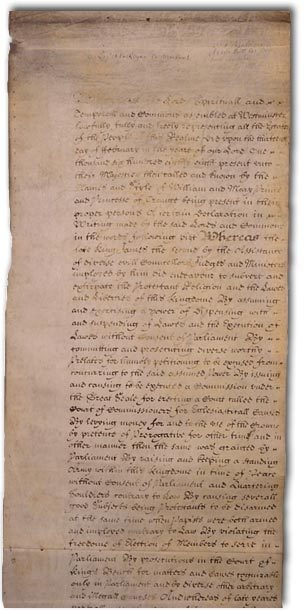
At a Glance
- Formal title
- An Act Declaring the Rights and Liberties of the Subject and Settling the Succession of the Crown (1 Will. & Mar. Sess. 2 c. 2)
- Royal assent
- 16 December 1689; the Act is the statutory form of the Declaration of Right presented to William and Mary on 13 February 1689
- What it made illegal
- Suspending or dispensing with laws by royal authority, levying money without Parliament's grant, and keeping a peacetime standing army without Parliament's consent
- Rights secured
- Petitioning the king, free elections, freedom of speech and debate in Parliament, frequent parliaments, and freedom from excessive bail, excessive fines and cruel and unusual punishments
- Succession
- William and Mary jointly, then the heirs of Mary, then Anne; Roman Catholics were barred from the throne
- The original
- An iron gall ink manuscript on parchment, held by the Parliamentary Archives in London
- Still law
- Still in force, as amended, and one of the models for the United States Bill of Rights of 1791
Introduction
The Bill of Rights is not, despite its name, a general charter of human rights. It is a statute of the English Parliament, born of a revolution, that did three things at once. It recited the misdeeds of a departed king, James II. It declared a list of rights and liberties that no future monarch could lawfully override. And it settled the succession to the Crown on William of Orange and his wife Mary, James's Protestant daughter. It is still in force today.
It was the settlement of the Glorious Revolution of 1688: James II had fled to France, and a Convention Parliament, assembled without a king's summons, had to decide who should rule and on what terms. Its answer - the Declaration of Right in February 1689, then this Act in December - shifted the balance of power for good: after 1689 no English monarch could make or unmake law, raise taxes or keep an army except through Parliament.
A Century of Conflict: Crown Against Parliament
The Bill presented itself not as an innovation but as a restoration - Parliament claimed to be vindicating its 'ancient rights and liberties'. The claim had a long pedigree. The Petition of Right of 1628 protested against Charles I's forced loans, arbitrary imprisonment and martial law. The Habeas Corpus Act of 1679 had strengthened protection against imprisonment without trial. Behind both stood Magna Carta and the idea that even a king is under the law. The Bill of Rights was the verdict in this century-long argument.
James II, who succeeded his brother Charles II in 1685, was a Roman Catholic ruling a Protestant kingdom. The Act's own preamble lists the charges against him: he suspended and dispensed with laws by royal authority alone; he erected a Court of Commissioners for Ecclesiastical Causes; he levied money by prerogative; he kept a standing army in peacetime; he disarmed Protestant subjects while Catholics were armed and employed; and he prosecuted seven bishops for petitioning him. The bishops were acquitted in June 1688, the month a son was born to James, promising a Catholic succession; leading politicians invited William of Orange, Mary's husband, to intervene.
The Convention and the Declaration of Right
William landed at Torbay on 5 November 1688. James's support melted away, and in December he fled to France. The Convention Parliament assembled on 22 January 1689 and argued for days: had James abdicated, as the Whigs claimed, or merely deserted the throne, as many Tories held? William cut the debate short by threatening to leave the country if he was not made king. On 6 February Parliament resolved that James had abdicated and that the Crown should be offered jointly to William and Mary.
When Parliament formally made that offer on 13 February, it also read aloud to the couple the Declaration of Right: a statement of the rights of the subject and the liberties of Parliament which the last Stuart kings were said to have infringed. At their coronation on 11 April, William and Mary swore a revised oath written by Parliament: to govern according to 'the statutes in Parliament agreed on', not by laws granted by kings. In December the Convention passed the Declaration as an Act of Parliament; assented to on 16 December 1689, it is the Bill of Rights.
Timeline
- 1628
The Petition of Right protests against Charles I's forced loans, arbitrary imprisonment and martial law.
- 1679
The Habeas Corpus Act strengthens protection against imprisonment without trial.
- 1685
James II, a Roman Catholic, succeeds his brother Charles II.
- June 1688
A son is born to James II, promising a Catholic succession; seven bishops prosecuted for petitioning him are acquitted, and leading politicians invite William of Orange to intervene.
- November-December 1688
William of Orange lands at Torbay on 5 November; James's support collapses and in December he flees to France - a departure Parliament later resolves was an abdication.
- 22 January 1689
The Convention Parliament assembles at Westminster, summoned without a king.
- 13 February 1689
The Declaration of Right is read aloud to William and Mary as the Crown is offered to them jointly.
- 11 April 1689
William and Mary are crowned, swearing a new oath to govern according to 'the statutes in Parliament agreed on'.
- 16 December 1689
The Declaration is enacted as the Bill of Rights, receiving royal assent.
- 1791
The United States Bill of Rights is ratified; its Eighth Amendment repeats the 1689 ban on excessive bail and fines and cruel and unusual punishments.
Significance
It made parliamentary consent the legal condition of taxation, legislation and a peacetime army, and it made Parliament itself a permanent, frequently meeting part of government whose elections must be free and whose debates cannot be questioned in any court. Its guarantee of freedom of speech in Parliament - Article 9 - is still the legal foundation of parliamentary privilege in Britain and across the Commonwealth. It is counted, with Magna Carta and the Habeas Corpus Act, among the basic documents of the uncodified constitution.
It also travelled. UK Parliament calls it a model for later, more general statements of rights, such as the Bill of Rights in the United States Constitution; its clause on bail, fines and punishments passed almost word for word into the American Eighth Amendment, and it has likewise been named among the models for the Universal Declaration of Human Rights of 1948 and the European Convention on Human Rights of 1950 - documents that generalised rights first asserted in 1689 against one king.
Myths and disputes
Was it 1688 or 1689? Both dates appear, and neither is a mistake. England's legal year then began on 25 March, so February 1689 by modern reckoning was still 1688 then - which is why the Act's own text dates the Declaration's presentation to February 'one thousand six hundred eighty eight', and why legislation.gov.uk catalogues the statute as the Bill of Rights [1688]. Modern usage calls it the Bill of Rights 1689, after the December royal assent.
Did William and Mary have to accept the Declaration as the price of the Crown? Contrary to common belief, no. UK Parliament's own history states plainly that Parliament did not present the Declaration to William and Mary as a condition which they had to accept to be made king and queen. The Declaration was read as the offer was made; its rights took legal force only when the Convention enacted them as a statute that December.
Nor was it a universal charter. As Parliament notes, the Bill is not a revolutionary statement of universal liberties: it is mostly concerned with the specific misdeeds of James II, and it claimed old rights rather than inventing new ones. Its arms clause, often quoted in American debates, is narrower than its reputation - it says that subjects 'which are Protestants may have Arms for their Defence suitable to their Conditions and as allowed by Law'. Scotland, a separate kingdom in 1689, settled its own terms in its Claim of Right Act of the same year.
Legacy
The Bill has never been repealed. Its succession rules were revised as recently as 2013, when the Succession to the Crown Act ended male-preference primogeniture and the bar on a monarch marrying a Roman Catholic, but its core articles remain law, as its own text demanded they should 'stand, remain and be the Law of this Realme for ever'. Article 9 is still cited whenever parliamentary privilege is argued in court, and every monarch's coronation oath still follows the form Parliament imposed in 1689.
Its deepest legacy may be a habit of mind. The Bill dressed a revolution as a restoration: Parliament insisted it was declaring ancient rights, not creating new ones, and bound the Crown by statute rather than by force. That settlement - government under law, taxation by consent, speech in Parliament beyond the reach of courts and kings - became the template later rights documents widened from a nation's inheritance into a claim for everyone.
Sources
- UK Parliament - The Convention and Bill of Rights
- legislation.gov.uk - Bill of Rights [1688]
- House of Commons Library - The Bill of Rights 1688-89 (Research Note SN/PC/293)
- Encyclopaedia Britannica - Bill of Rights (1689), primary source document
The facts on this page were checked against these sources on 19 November 2026. The History Trail's permanent pages are researched and written for this site; the live profiles elsewhere on The History Trail are assembled automatically from Wikipedia and Wikidata.
About the Author
Researched and written by the The History Trail Editorial Team — the accountable editorial function behind this site's permanent story pages. The team works from the published sources cited on each page; it does not invent historians, reviewers or credentials, and it corrects errors openly.
Fact Check
Every load-bearing fact on this page traces to one of the sources listed above, and significant claims link to their source in the text. Our checking method is described on the methodology page; errors can be reported via the corrections page.
Sources & Citations
Cite this page as: The History Trail Editorial Team, The History Trail — this article's title, publication and update dates are shown beneath its headline. The full source list appears under Sources above; the site's source standards are on the sources page.