
Things
Human rights
Human rights claim that every person, everywhere, holds protections no government granted and none may take away. The idea grew from Magna Carta and the bills of rights of 1689, 1789 and 1791 — and became a world system in Paris in December 1948.
At a Glance
- Definition
- Norms protecting all people everywhere from severe political, legal and social abuses
- Defining features
- They are rights, plural, universal and high-priority
- Historic forerunners
- Magna Carta (1215), English Bill of Rights (1689), French Declaration (1789), US Bill of Rights (1791)
- Central document
- Universal Declaration of Human Rights, adopted in Paris on 10 December 1948
- Drafting chair
- Eleanor Roosevelt, chair of the UN Commission on Human Rights
- Structure
- 30 articles spanning security, due process, liberty, political participation, equality and social rights
- Made binding by
- Treaties beginning with the Genocide Convention (1948) and the two UN Covenants (1966)
Introduction
Human rights are norms that protect all people everywhere from severe political, legal and social abuses. The Stanford Encyclopedia of Philosophy identifies four defining features: they are rights, imposing duties on governments and others; they are plural, covering many specific protections; they are universal, held by every living person regardless of nation or religion; and they are high-priority, meant to compete with powerful counter-claims such as national security. A right to a fair trial, freedom from slavery, access to education and protection from genocide all belong to the same family.
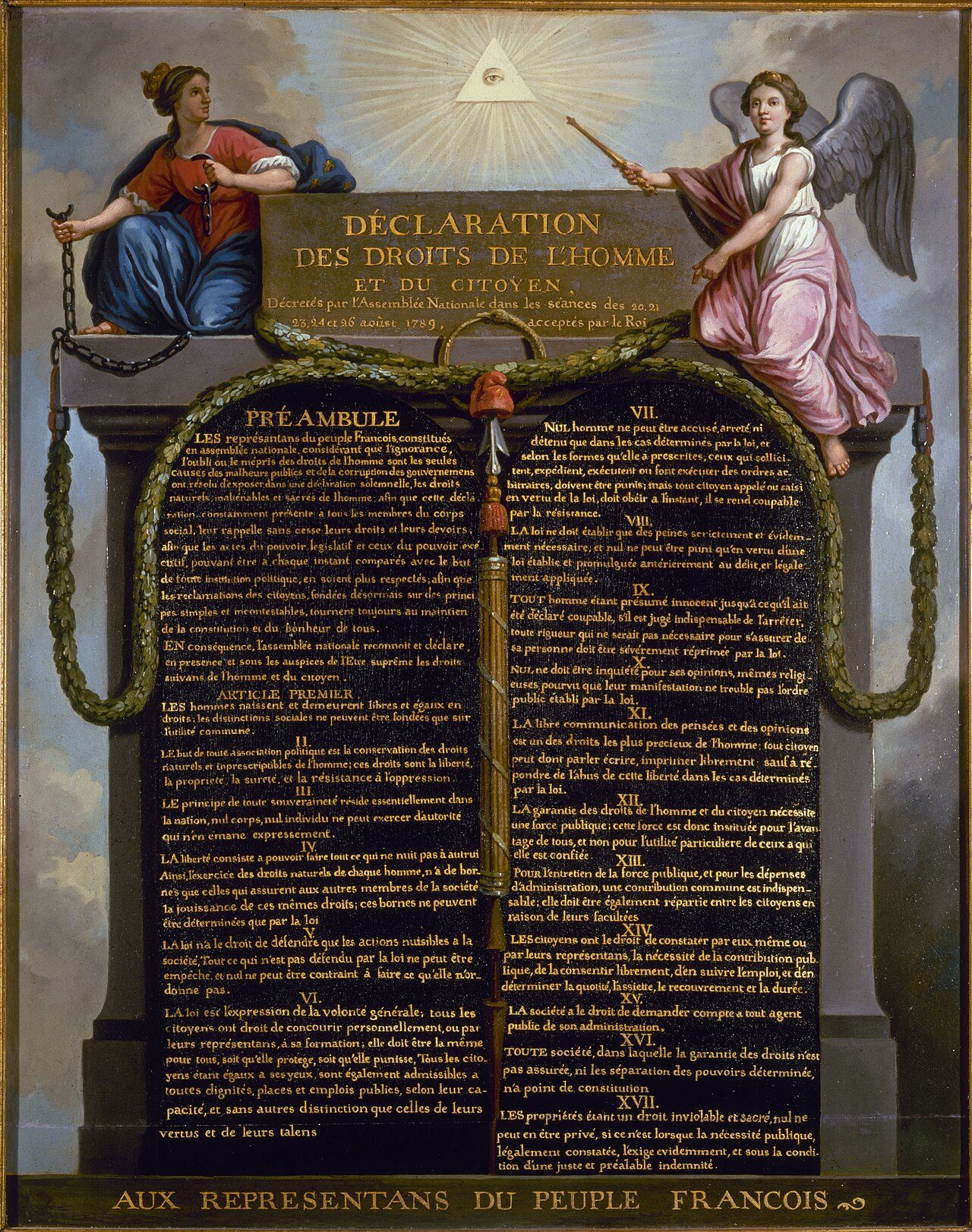
The contemporary conception has one main source: the Universal Declaration of Human Rights, adopted by the United Nations in 1948, and the treaties and constitutions that followed in its wake. But the idea had a long apprenticeship. Historic bills of rights — Magna Carta in 1215, the English Bill of Rights in 1689, the French Declaration of 1789 and the United States Bill of Rights in 1791 — had limited particular rulers for particular peoples. The achievement of 1948 was to claim the same protections for every person in every country.
Background
The philosophical roots run through early modern natural-rights thinkers such as Hugo Grotius, John Locke and Immanuel Kant, who argued that people hold some claims simply as human beings, before any government grants them. The American Declaration of Independence of 1776 put a version of that thought into politics, holding that people are endowed by their Creator with natural rights to life, liberty and the pursuit of happiness. Such rights could exist as shared moral norms, as constitutional rights, or as rights in international law — and advocates have usually wanted them in all these forms at once.
What turned philosophy into an international system was the Second World War. The United Nations was created in 1945, and world leaders, vowing that the war's atrocities should never recur, decided to complement the UN Charter with a road map guaranteeing the rights of every individual everywhere. The General Assembly took up a draft declaration in 1946 and referred it to the new Commission on Human Rights, which began work early in 1947.
Timeline
- 1215
Magna Carta limits the English king — later remembered as the first of the historic bills of rights.
- 1689
The English Bill of Rights constrains the monarchy after the Glorious Revolution.
- 1776
The United States Declaration of Independence claims people are endowed with natural rights to life, liberty and the pursuit of happiness.
- 1789
France adopts the Declaration of the Rights of Man and of the Citizen.
- 1945
The United Nations is founded; its Charter commits members to protecting future generations from the scourge of war.
- 1947
The UN Commission on Human Rights, chaired by Eleanor Roosevelt, begins drafting an international bill of rights; John Humphrey prepares the blueprint, René Cassin the first draft.
- 10 December 1948
The UN General Assembly, meeting in Paris, adopts the Universal Declaration of Human Rights — thirty articles covering security, due process, liberty, political participation, equality and social rights — with eight abstentions and none dissenting.
- 1948
One day before the Declaration, the UN approves the Genocide Convention, its first human rights treaty.
- 1966
The UN approves the International Covenant on Civil and Political Rights and the International Covenant on Economic, Social and Cultural Rights, turning declaration into binding treaty law.
Significance
The Declaration was a set of recommended standards rather than a binding treaty, yet it proved astoundingly successful: it set the pattern for subsequent treaties and persuaded country after country to write its list of rights into national constitutions. International treaties then converted the lists into binding obligations, beginning with the Genocide Convention and continuing through the two great covenants of 1966 and regional systems worldwide. Together, the Declaration and the treaties it spawned largely define what people today mean by human rights.
The concept also changed the terms of politics. Because human rights are universal and exist independently of any country's law or culture, they give outsiders standing to judge how a government treats its own people — and give insiders a vocabulary of complaint that no regime has issued and none can honestly withdraw. That is why many defenders keep them deliberately minimal: standards concerned with avoiding the worst rather than achieving the best, leaving most policy to democratic decision while placing a floor beneath it.
Legacy
Human rights now operate at every level: as moral claims anyone can make, as constitutional rights courts can enforce, and as international law monitored by UN bodies and regional courts. Their high priority is not absoluteness — rights conflict, and the right to life will generally outweigh the right to privacy when they collide — but they are designed to be resistant to trade-offs, hard to lose, and available to the vulnerable groups, from minorities to children.
The open questions are the philosophical ones the idea began with: whether rights exist before they are enacted, what grounds them, and how a universal list fits a world of diverse beliefs. The practice, meanwhile, keeps expanding from the 1948 core. Whatever their foundation, human rights remain the modern world's most widely shared answer to an ancient observation — that power, unchecked, abuses — and its most portable remedy.
Sources
- United Nations — History of the Declaration
- Stanford Encyclopedia of Philosophy — Human Rights
- Wikipedia — Human rights
The facts on this page were checked against these sources on 19 November 2026. The History Trail's permanent pages are researched and written for this site; the live profiles elsewhere on The History Trail are assembled automatically from Wikipedia and Wikidata.
About the Author
Researched and written by the The History Trail Editorial Team — the accountable editorial function behind this site's permanent story pages. The team works from the published sources cited on each page; it does not invent historians, reviewers or credentials, and it corrects errors openly.
Fact Check
Every load-bearing fact on this page traces to one of the sources listed above, and significant claims link to their source in the text. Our checking method is described on the methodology page; errors can be reported via the corrections page.
Sources & Citations
Cite this page as: The History Trail Editorial Team, The History Trail — this article's title, publication and update dates are shown beneath its headline. The full source list appears under Sources above; the site's source standards are on the sources page.