
Things
Thor
Thor is the thunder god of Norse mythology, a figure of belief and myth known from the medieval Icelandic Eddas and sagas - and, more directly than any other Norse god, from archaeology: around a thousand small hammer pendants, worn across the Viking-Age world, survive in graves, hoards and museums today. The god belongs to mythology; the worship, the texts and the pendants are documented history.
At a Glance
- Role
- God of thunder, storms and strength; defender of Asgard and of humankind against the giants
- Name
- From the Germanic word for thunder: Old Norse Thor, Old English Thunor, Old High German Donar
- Weapon
- Mjolnir, the short-handled hammer that returns to the thrower's hand; with it he fights giants and the world serpent Jormungand
- Family
- Son of Odin and Jord (Earth); husband of Sif, famed for her golden hair
- Archaeology
- Around 1,000 hammer-shaped pendants found across Scandinavia, Britain, the Baltic and Russia, most of them from the 10th century
- Day
- Thursday - 'Thor's day', from Old English Thunresdaeg with influence from Old Norse Thorsdagr
- Fate in myth
- At Ragnarok Thor kills the world serpent Jormungand and falls dead from its venom
Introduction
If Odin was the god of kings and poets, Thor was the god of everybody else. Britannica describes him as a great warrior, red-bearded and of enormous strength, an implacable foe of the harmful race of giants but benevolent toward humankind - and notes that in Iceland, and perhaps among all northern peoples except the royal families, he was apparently worshipped more than any other god. The evidence agrees: no other Norse deity left so much physical proof of devotion, or so many traces in names, places and the calendar.
His stories are the most cheerful in Norse mythology and often the funniest - the thunder god dressed as a bride, outwitted by illusions, fishing for the serpent that encircles the world. But behind the comedy stood a serious cult. Thor was invoked for protection in every kind of need: for weather and crops, for voyages, for marriages and contracts, and against hunger and disease, and his hammer was used to bless and consecrate.
The Sources: Eddas, Sagas and Skaldic Verse
Thor dominates the surviving poetry. In the Poetic Edda, the poem Thrymskvida tells how the giant Thrym stole the hammer Mjolnir and demanded the goddess Freyja in ransom, so Thor went to the wedding feast disguised as the bride to snatch it back. In Hymiskvida he rows out with the giant Hymir and fishes up the Midgard Serpent itself, only for Hymir, terrified, to cut the line. The Prose Edda adds the journey to Utgarda-Loki, where the travellers' contests are secretly rigged against wildfire, thought, the sea, the world serpent and old age itself - and Thor loses to all of them, honourably.
Skaldic poetry, the court verse of the Viking Age, invokes Thor constantly, and the Icelandic sagas - written, like the Eddas, in the thirteenth century and after - remember a landscape full of his worship, of temples and consecrations and settlers who trusted Thor above other gods. The Landnamabok, the Book of Settlements, tells of Helgi the Lean, who settled Iceland about 900: he believed in Christ, but invoked Thor when in distress at sea, and asked Thor to show him where to build his farm. It is a neat snapshot of the two religions overlapping.
The Hammer in the Ground
The pendants are the hard evidence. Hammer-shaped amulets, usually of silver, bronze or iron and only a few centimetres long, have been found in graves, hoards and settlements across Scandinavia and the wider Viking world; around a thousand are known. Most date from the tenth century, precisely when Christianity was arriving, and more of them date from the period when the two religions were in contention than from any other. Scholars have long read them as a pagan answer to the Christian cross - a badge of allegiance worn at the neck. A tenth-century soapstone mould from Trendgarden in Jutland, made to cast a Thor's hammer and Christian crosses side by side, captures that moment of competition exactly.
For a century, sceptics could object that the little hammers might be something else: their shafts are short, their heads oddly symmetrical. In 2014 a metal-detectorist on the Danish island of Lolland found a tenth-century bronze hammer pendant at Kobelev bearing the first runic inscription ever found on one. At the National Museum of Denmark, runologist Lisbeth Imer read the runes under a microscope: 'Hmar is' - 'this is a hammer'. The identification, as the museum's archaeologist Peter Pentz put it, vindicated the small hammers for what they are: hammers.
Names on the Map, a Day in the Week
Thor's popularity is written across the map. Place names containing his name occur all over Scandinavia - Torsaker, 'Thor's field', in Sweden, Torsberget, 'Thor's hill' - and research on Icelandic place names finds them rich in Thor and entirely empty of Odin. Personal names built on Thor - Thorstein, 'Thor-stone', Thorgils and dozens more - flourished from the Viking Age onward, and names stemming from the pagan period are still used in Scandinavia today. In England his older form, Thunor, survives in place names such as Thundersley and Thursley.
And every week he returns. The Romans had equated Thor with Jupiter, whose day, dies Jovis, fell where the Germanic peoples put Thor's: Thursday, from Old English Thunresdaeg, 'Thunor's day', with influence from Old Norse Thorsdagr, 'Thor's day'. German keeps the thunder name outright in Donnerstag, Donar's day.
Timeline
- Viking Age, c. 790-1100
Thor's popularity reaches its height; as Christianity enters Scandinavia from the 10th century, he is considered the greatest rival to Christ.
- 10th century
Hammer pendants multiply across the Viking world, most of all where the old and new religions contend.
- c. 1070s
Adam of Bremen places Thor's statue on the central throne at Uppsala, mightiest of the three gods, in his secondhand account of the temple.
- 12th century
Christianity has prevailed in Scandinavia, and the cult of Thor is gradually replaced by the new religion.
- c. 1220
Snorri Sturluson's Prose Edda retells Thor's journeys, his contests at Utgarda-Loki and his fishing for the world serpent.
- c. 1270
The Codex Regius manuscript of the Poetic Edda preserves Thrymskvida and Hymiskvida, Thor's great comic and heroic poems.
- 1872
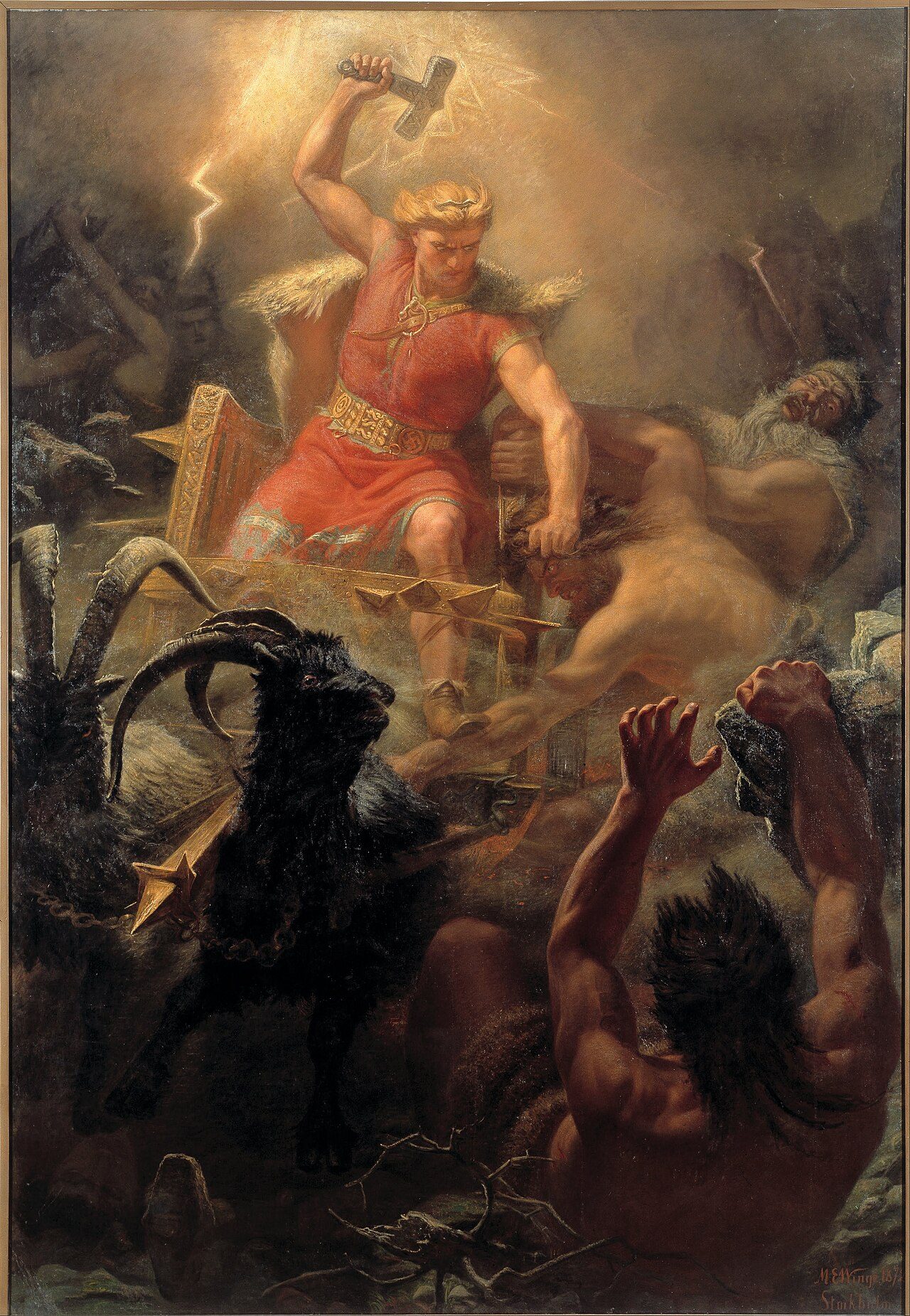
Marten Eskil Winge's painting Thor's Fight with the Giants, bought by King Charles XV of Sweden, becomes the defining Romantic image of the god.
- 1962
Thor debuts as a Marvel superhero in Journey into Mystery No. 83, created by Stan Lee, Larry Lieber and Jack Kirby.
- 2011
Marvel Studios' film Thor, starring Chris Hemsworth, opens the god's modern film career, with sequels following.
- 2014
The Kobelev pendant, found on Lolland in Denmark, gives the first runic inscription on a Thor's hammer: 'this is a hammer'.
Significance
Thor is the best evidence we have for what Viking-Age religion felt like from below. Kings left skaldic poems about Odin, but farmers, sailors and housewives left Thor's hammers in their graves. His cult also shows how that religion worked: it had no regular organisation like the Christian church, no separate institution with special temples and priests, but was part of ordinary life, maintained by individual members of society - in the phrase of the scholar Preben Meulengracht Sorensen, by yeomen and housewives, in the homes of farmers and chieftains. Thor, approachable and dependable, was its most called-upon god.
Myths and disputes
The Marvel Thor is a reinvention, and the sources prove it. The Thor of the Eddas is red-haired and red-bearded; the World History Encyclopedia notes that he is never depicted clean-shaven or blond except in one euhemerised passage of the Prose Edda, so the blond, clean-shaven superhero is a modern design. Nor is he Loki's brother in the old stories: that relationship was created by the comics and films, as was the enchantment that only the worthy may lift Mjolnir. In the myths the hammer can simply be stolen - and is, in Thrymskvida - and recovered by force or trickery.
The archaeology had its own dispute, now settled. Whether every hammer-shaped pendant represented Mjolnir was honestly debated - some are crude, and not every T-shaped object need be a hammer - until the inscribed Kobelev pendant of 2014 stated its own identity in runes. What the pendants meant to each individual wearer - protection, allegiance or fashion - the objects themselves cannot say.
Legacy
Thor never really left. Thursday and Donnerstag keep his name in weekly use, and Scandinavian children are still named for him. When nineteenth-century Scandinavia went looking for a national past, it found Thor early: Winge's 1872 giant-fighter was received as a picture of good battling evil, at a time when, as Google Arts and Culture puts it, Norse mythology and the gods were enjoying great popularity.
The Marvel reinvention completed the journey from cult god to global character. Jack Kirby said of the 1962 comics version: 'I knew the Thor legends very well, but I wanted to modernize them.' The films from 2011 onward made the thunderer of the Eddas - now blond, and in armour of a different kind - one of the most recognisable figures on earth. The god of the common people had become, again, the people's god.
Sources
- Encyclopaedia Britannica - Thor
- World History Encyclopedia - Thor
- Medieval Histories - Thor's Hammer
- Encyclopaedia Britannica - Odin
The facts on this page were checked against these sources on 19 November 2026. The History Trail's permanent pages are researched and written for this site; the live profiles elsewhere on The History Trail are assembled automatically from Wikipedia and Wikidata.
About the Author
Researched and written by the The History Trail Editorial Team — the accountable editorial function behind this site's permanent story pages. The team works from the published sources cited on each page; it does not invent historians, reviewers or credentials, and it corrects errors openly.
Fact Check
Every load-bearing fact on this page traces to one of the sources listed above, and significant claims link to their source in the text. Our checking method is described on the methodology page; errors can be reported via the corrections page.
Sources & Citations
Cite this page as: The History Trail Editorial Team, The History Trail — this article's title, publication and update dates are shown beneath its headline. The full source list appears under Sources above; the site's source standards are on the sources page.