
Things
Thanksgiving
Thanksgiving is North America's harvest holiday: a day of feasting and gratitude observed on the fourth Thursday in November in the United States and the second Monday in October in Canada. Its roots reach back to a 1621 harvest feast at Plymouth — but it took 242 years, and a civil war, to make it national.
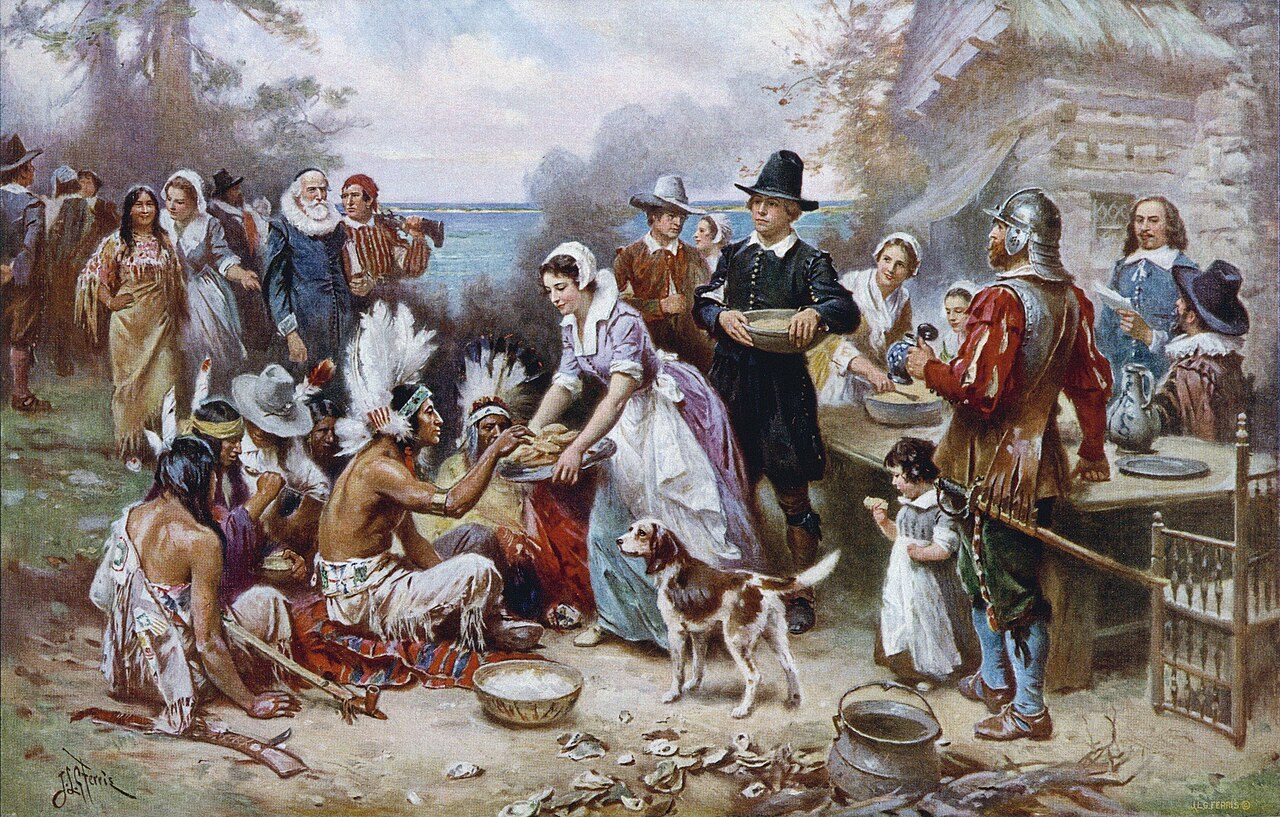
At a Glance
- United States
- Fourth Thursday in November
- Canada
- Second Monday in October
- Model event
- 1621 harvest feast at Plymouth, shared by English colonists and the Wampanoag people
- National proclamation
- 3 October 1863, by President Abraham Lincoln, for 26 November
- Fixed in US law
- 1941 joint resolution of Congress; proclaimed by Franklin D. Roosevelt in 1942
- Earliest Canadian celebration
- 1578, Martin Frobisher's expedition, in present-day Nunavut
- Campaigner
- Sarah Josepha Hale, editor of Godey's Lady's Book
Introduction
Thanksgiving Day is an annual national holiday in the United States and Canada celebrating the harvest and other blessings of the past year. Families and friends gather for a shared feast — traditionally turkey, bread stuffing, potatoes, cranberries and pumpkin pie — and to give thanks. In the United States it falls on the fourth Thursday in November; in Canada, with its earlier harvest, on the second Monday in October.
The American holiday is modelled on a harvest feast held at Plymouth, in present-day Massachusetts, in 1621, shared by the English colonists known as Pilgrims and the Wampanoag people. That much is tradition. The documented detail is thinner and stranger than the schoolbook version: the feast began with colonists going 'fowling' for birds, was joined unexpectedly by some 90 Wampanoag, and lasted for days of eating, drinking and games outdoors.
Background
Days of thanksgiving — prayerful observances for blessings such as safe journeys, military victories or the end of drought — were familiar in both colonial New England and Canada long before any single feast was singled out. Canada's earliest recorded celebration came in 1578, when an expedition led by Martin Frobisher held a ceremony in present-day Nunavut to give thanks for the safety of its fleet. Plymouth's colonists, for their part, held a second thanksgiving in 1623 after a drought broke.
For two centuries, thanksgiving in the United States remained regional and irregular: proclaimed by states, or occasionally by national leaders, but never fixed. After 1798 Congress left declarations to the states; some objected to federal involvement in a religious observance, and Southerners were slow to adopt what they saw as a New England custom. A national Thanksgiving looked, for decades, more like a source of controversy than a unifying force — which is precisely why its eventual champion campaigned for it as an instrument of unity.
Timeline
- 1578
Martin Frobisher's expedition holds a thanksgiving ceremony in present-day Nunavut — the earliest celebration in the Canadian tradition.
- 1621
English colonists at Plymouth share a harvest feast with the Wampanoag people; the Wampanoag contribute venison to the colonists' fowl, fish and vegetables.
- 1623
Plymouth holds a further thanksgiving after the end of a drought that had threatened the harvest.
- 1789 and after
National thanksgiving days are proclaimed occasionally, including by the Continental Congress and early presidents, but no annual national holiday takes hold.
- 3 October 1863
After Sarah Josepha Hale's long campaign, President Abraham Lincoln proclaims a national day of thanksgiving for Thursday 26 November, in the midst of the Civil War.
- 1876
Yale plays Princeton in a Thanksgiving football game, beginning the holiday's long association with the sport.
- 1924
Macy's stages its first Thanksgiving Day Parade in New York City; giant balloons join the procession from 1927.
- 1941–1942
Congress passes a joint resolution and President Franklin D. Roosevelt proclaims the fourth Thursday in November as Thanksgiving Day, ending years of date disputes.
- 1957
Canada fixes its Thanksgiving on the second Monday in October, where it remains.
- 1989
President George H. W. Bush formalises the 'turkey pardon' as an annual White House event, sparing a live turkey from the table.
Significance
Thanksgiving's significance lies in the use Lincoln and Hale made of it. Hale, editor of the popular magazine Godey's Lady's Book, campaigned for years for a national Thanksgiving to promote unity; Lincoln's proclamation of October 1863, issued while the Civil War divided the country, answered that campaign directly. The holiday was, from its national birth, an argument that Americans shared something worth gathering around — and every president after Lincoln proclaimed it annually.
As the country urbanised and families scattered, the day's centre of gravity shifted from church to home. Thanksgiving became a gathering festival that immigrants of every background could join, and it accumulated new rituals: football games, parades of costumed revellers that grew into Macy's balloon parade, charitable food drives, the wishbone snapped for luck, and the presidential turkey pardon. The holiday associated with Pilgrims and Native Americans came to symbolise home, family and the chance offered to newcomers.
Legacy
Thanksgiving endures as North America's great homecoming: in the United States it anchors a four-day weekend of travel, feasting, parades and football, and it opens the Christmas shopping season. In Canada it remains a quieter harvest festival in mid-October. Both versions preserve the same core act — a shared table and an explicit pause for gratitude — that colonial thanksgiving days of prayer first formalised.
The holiday also carries a contested memory. The treaty sealed at Plymouth in 1621 lasted until King Philip's War of 1675–76, in which hundreds of colonists and thousands of Native Americans died, and for many Native people the day prompts reflection on that history as much as celebration. Thanksgiving's legacy is therefore double: a national ritual of gratitude, and a standing invitation to remember the full story of the feast it commemorates.
Sources
- Encyclopaedia Britannica — Thanksgiving Day
- Encyclopaedia Britannica — Thanksgiving Day Facts
- Britannica Kids — Thanksgiving
The facts on this page were checked against these sources on 19 November 2026. The History Trail's permanent pages are researched and written for this site; the live profiles elsewhere on The History Trail are assembled automatically from Wikipedia and Wikidata.
About the Author
Researched and written by the The History Trail Editorial Team — the accountable editorial function behind this site's permanent story pages. The team works from the published sources cited on each page; it does not invent historians, reviewers or credentials, and it corrects errors openly.
Fact Check
Every load-bearing fact on this page traces to one of the sources listed above, and significant claims link to their source in the text. Our checking method is described on the methodology page; errors can be reported via the corrections page.
Sources & Citations
Cite this page as: The History Trail Editorial Team, The History Trail — this article's title, publication and update dates are shown beneath its headline. The full source list appears under Sources above; the site's source standards are on the sources page.