
Things
Saturn
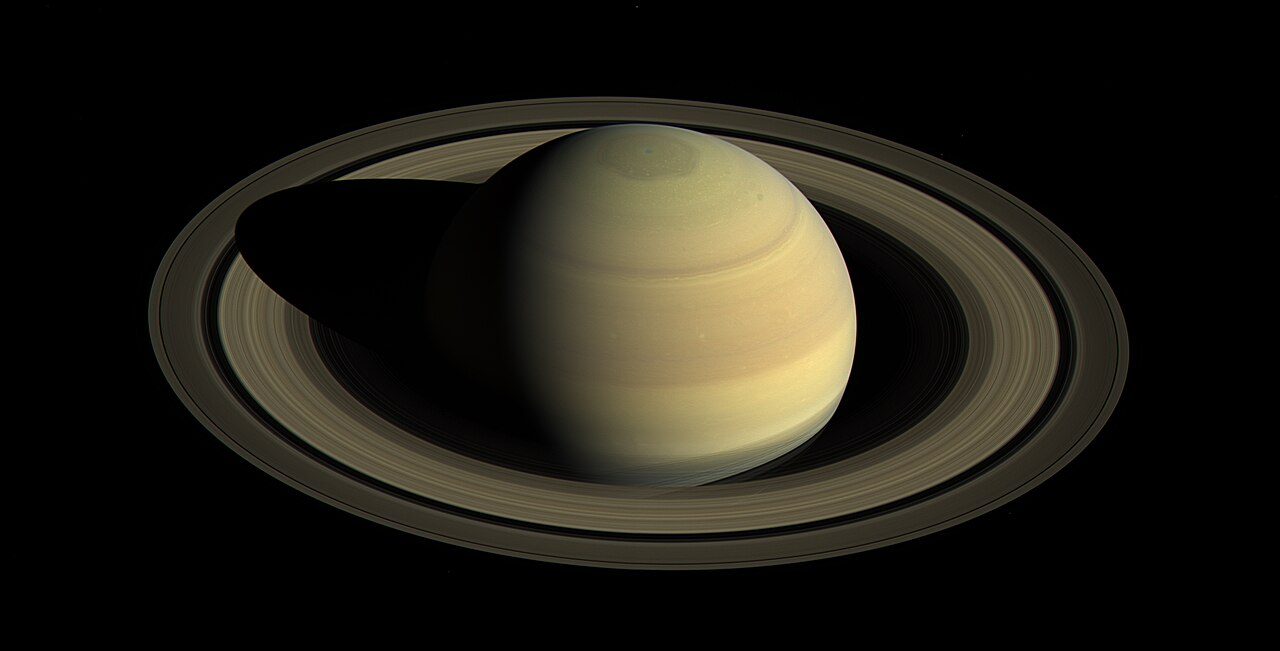
Saturn is the planet everyone can draw: a golden ball inside a shining ring. The reality outdoes the icon — rings wider than the distance from Earth most of the way to the Moon yet thinner than a house is tall, and a family of moons that includes the two most promising ocean worlds we know.
At a Glance
- Position
- Sixth planet from the Sun; the farthest visible to the naked eye
- Diameter
- About 120,500 km — 9 times wider than Earth
- Distance from the Sun
- 9.5 AU (about 1.4 billion km); sunlight takes 80 minutes to arrive
- Day / year
- 10.7 hours / about 29.4 Earth years
- Moons
- 274 confirmed as of March 2025 — far more than any other planet
- Rings
- Span up to 282,000 km from the planet, yet the main rings are typically only about 10 metres thick
- Density
- The only planet less dense than water on average — it would float in a large enough ocean
- Largest moon
- Titan — bigger than Mercury, with a thick atmosphere and lakes of liquid methane
Introduction
Saturn has been known since prehistory — the farthest planet the unaided eye can see, a slow, steady wanderer named for the Roman god of agriculture. Through a small telescope it becomes the most recognisable sight in astronomy: a pale gold globe of hydrogen and helium, second only to Jupiter in size, girdled by rings so bright and broad that they outshine the planet itself. No other planet's rings come close; the others are faint, dark threads beside Saturn's shining disk.
The rings are made of billions of chunks of ice and rock, from dust grains to house-sized boulders, each orbiting independently. The whole system reaches 282,000 kilometres from the planet — most of the way from Earth to the Moon — and yet in the main rings it is typically about ten metres thick. Proportional to its width, Saturn's ring system is far thinner than a sheet of paper is to a playing field.
Background
Saturn is the lightest of the giants: a ball of hydrogen and helium around a dense core of metal and rock, with an average density lower than water — in a large enough ocean, it would float. Its day is only 10.7 hours, and its axis tilts 26.7 degrees, so the rings open and close to our view over its 29.4-year year like a slowly nodding hat brim. Winds at the equator reach 500 metres per second, and at the north pole a six-sided jet stream — a geometric hexagon some 30,000 kilometres across — has persisted for decades around a central storm.
The moons are the system's second marvel. As of March 2025, Saturn has 274 confirmed moons, more than any other planet. Titan, the largest, is bigger than Mercury and wrapped in a thick nitrogen atmosphere, with rain, rivers and lakes of liquid methane. Enceladus, a small bright moon, vents plumes of water vapour and ice from a global ocean beneath its crust — plumes that feed the vast, faint E ring. Both moons are considered among the most promising places in the solar system to look for life.
Timeline
- 1610
Galileo turns his telescope on Saturn and reports strange appendages on either side of the planet — he has seen the rings, but his instrument cannot resolve what they are.
- 1650s
Christiaan Huygens recognises the appendages as a flat ring and discovers Saturn's largest moon, Titan.
- 1675
Giovanni Cassini discovers the wide dark gap splitting the rings — still called the Cassini Division — and several more moons.
- 1979
Pioneer 11 becomes the first spacecraft to reach Saturn, flying past and finding a further outer ring.
- 1980
Voyager 1 flies by, revealing the rings as thousands of fine ringlets and Titan's impenetrable orange haze; Voyager 2 follows in 1981.
- 1 July 2004
After a seven-year journey, the Cassini-Huygens spacecraft enters orbit around Saturn — the first spacecraft ever to orbit the planet.
- 14 January 2005
The European Huygens probe parachutes through Titan's atmosphere and lands on its surface — still the most distant landing ever made.
- 15 September 2017
Out of fuel after thirteen years and 294 orbits, Cassini makes 22 dives between the planet and its rings, then plunges into Saturn's atmosphere, transmitting to the end.
- March 2025
Saturn's confirmed moon count reaches 274 — a tally no other planet approaches.
Significance
Saturn is the solar system's laboratory for rings and moons. Its rings show, at enormous scale, the physics that built the planets themselves — a flat disk of orbiting debris, sorted by gravity into gaps, waves and braided strands, shepherded by small moons. Cassini watched moonlets carve channels, measured the rings' mass, and found them surprisingly young in geological terms: the shining icon may be a temporary feature, a shattered moon's remains spread thin, which will darken and rain onto the planet over time.
The moons widened the map of possible life. Before Cassini, the search for habitable environments stopped at the warm inner planets. Enceladus's ocean — global, salty, venting into space where a spacecraft could taste it — and Titan's alien chemistry moved the frontier to the cold outer system, and made Saturn's family the destination of the next generation: NASA's Dragonfly rotorcraft is being built to fly on Titan.
Legacy
Cassini's thirteen years transformed Saturn from a portrait into a place — seasons watched as they turned, storms that erupted and merged, rings weighed and dated, two ocean moons discovered in all but name. Its final dives through the gap between planet and rings, a region no spacecraft had entered, were both measurement and farewell: the mission ended by burning up in Saturn's sky so that its earthly microbes could never contaminate Enceladus or Titan.
The rings, meanwhile, go on opening and closing to Earth's telescopes on their 29-year rhythm, as they did for Galileo — who died puzzled by the planet's “ears”. We now know what he was looking at. Knowing has made it stranger: a world that would float, wearing a film of ice wider than a moon's orbit, attended by more moons than all the other planets' combined tally can match.
Sources
- NASA Science — Saturn: Facts
- NASA Science — Saturn Moons: Facts
- The Planetary Society — Saturn, planet of rings, moons and more
The facts on this page were checked against these sources on 19 November 2026. The History Trail's permanent pages are researched and written for this site; the live profiles elsewhere on The History Trail are assembled automatically from Wikipedia and Wikidata.
About the Author
Researched and written by the The History Trail Editorial Team — the accountable editorial function behind this site's permanent story pages. The team works from the published sources cited on each page; it does not invent historians, reviewers or credentials, and it corrects errors openly.
Fact Check
Every load-bearing fact on this page traces to one of the sources listed above, and significant claims link to their source in the text. Our checking method is described on the methodology page; errors can be reported via the corrections page.
Sources & Citations
Cite this page as: The History Trail Editorial Team, The History Trail — this article's title, publication and update dates are shown beneath its headline. The full source list appears under Sources above; the site's source standards are on the sources page.