
Things
Uranus
Uranus was the first planet discovered with a telescope, in a Bath garden in 1781. It is an ice giant tipped almost completely onto its side, ringed in the vertical, colder than Neptune, and in nearly two and a half centuries it has been visited by a spacecraft exactly once.
At a Glance
- Position
- Seventh planet from the Sun
- Discovered
- 13 March 1781, by William Herschel, Bath, England
- Type
- Ice giant; mostly water, ammonia and methane fluids over a rocky core
- Axial tilt
- 97.77 degrees: the planet rolls on its side
- Rings
- 13 known, narrow and dark; discovered in 1977
- Moons
- 28 known (NASA)
- Spacecraft visits
- One: Voyager 2 flyby, 24 January 1986
- Coldest reading
- About minus 224 degrees Celsius, the coldest planetary atmosphere measured
Introduction
Uranus is the seventh planet from the Sun and the first world in history to be found with a telescope. On 13 March 1781 the astronomer William Herschel, sweeping the sky from his garden in Bath, England, noticed a small disc that did not behave like a star. He first reported it as a comet; within two years its slow, near-circular orbit showed it to be a planet, and the known solar system doubled in width at a stroke. Every planet inside its orbit had been visible to ancient eyes. Uranus belonged to the telescopic age.
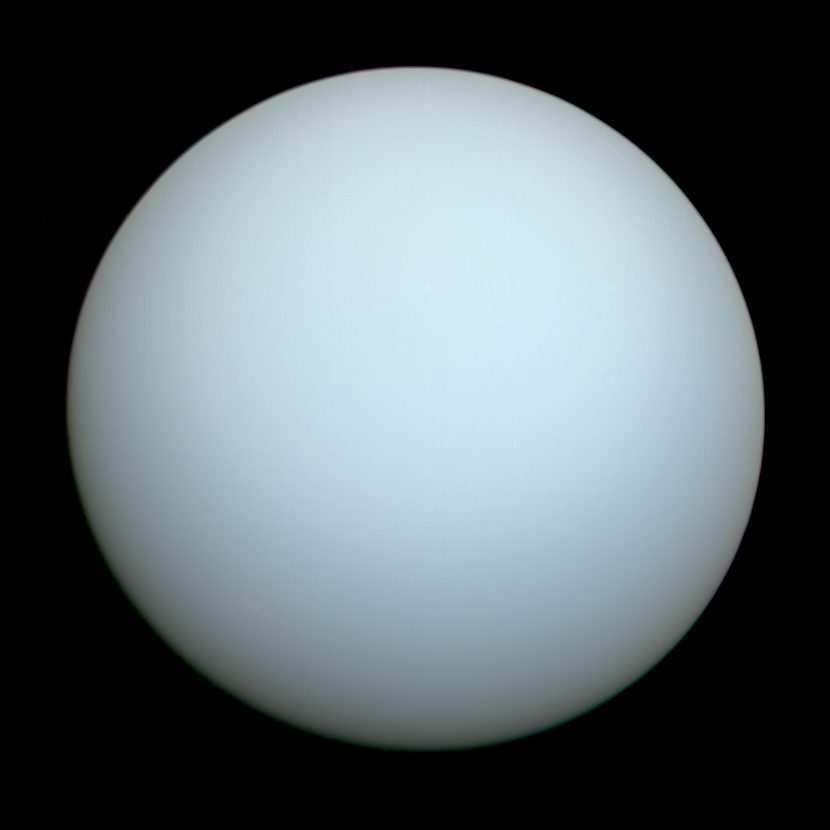
It is an ice giant, a world roughly four times wider than Earth whose mass is mostly a hot, dense fluid of water, ammonia and methane above a small rocky core. Methane high in its atmosphere absorbs red light and leaves the planet its calm pale blue-green colour. But its defining oddity is posture: Uranus is tipped almost completely onto its side, rolling around the Sun like a ball, and that single fact drives the strangest seasons, rings and magnetic field in the solar system.
Background
The tilt is extreme by any measure. Where Earth's axis leans about 23 degrees, Uranus leans 97.77 degrees, so its equator stands nearly at a right angle to its orbit. NASA notes the likely cause was a collision with an Earth-sized object long ago. The consequence is that for nearly a quarter of each 84-year Uranian year, the Sun shines directly over one pole, giving each pole decades of continuous light followed by decades of darkness. No other planet distributes its sunlight so unevenly or for so long.
For almost two centuries after Herschel, Uranus remained a nearly featureless disc even in good telescopes, and most of what we know still comes from a single visit. Its rings, narrow and dark, escaped notice until 10 March 1977, when astronomers watching the planet pass in front of a distant star saw the star blink several times on each side of the disc: something thin and unseen was crossing the light first. The rings were confirmed and photographed when a spacecraft finally arrived nine years later.
Timeline
- 13 March 1781
William Herschel discovers Uranus from Bath, England, the first planet found with a telescope; he first takes it for a comet.
- 1783
The object's orbit is recognised as planetary, and the new world is universally accepted as the seventh planet.
- 1787
Herschel discovers the two largest Uranian moons, Titania and Oberon, the first of a family now known to number more than two dozen.
- 10 March 1977
Astronomers led by James Elliot discover Uranus's rings as a star's light blinks repeatedly while the planet passes in front of it.
- 24 January 1986
NASA's Voyager 2 makes the only spacecraft visit to Uranus, passing about 81,500 kilometres above the cloud tops and finding new moons and rings.
- 2005
The Hubble Space Telescope photographs a pair of previously unknown outer rings, extending the known ring system.
- 2023
The James Webb Space Telescope returns detailed infrared views of Uranus, its rings and its polar cap, renewing the case for a return mission.
Significance
Uranus matters first as a proof of method. Its discovery showed that the solar system was not a finished, ancient inventory but a place still capable of surprising observers with better instruments, and its naming settled into mythology's family order: Uranus, the Greek sky god, father of Saturn and grandfather of Jupiter. The planet's stubborn refusal to follow its predicted orbit afterwards became a clue in its own right, leading astronomers to calculate the position of an eighth planet, Neptune, from Uranus's straying path.
The planet is also the type specimen of a class. Uranus and Neptune are ice giants, built differently from the gas giants Jupiter and Saturn, and planets of similar size appear to be among the most common worlds around other stars. Understanding how an ice giant forms, why it radiates so little internal heat, and how its magnetic field can sit tilted some sixty degrees from its spin axis and offset from its centre, is therefore a question about planetary systems in general, not one odd world.
Legacy
Everything close-up that humanity knows about Uranus still rests on a few hours in January 1986, when Voyager 2 swept past and raced on to Neptune. The spacecraft measured the planet's day, mapped its lopsided magnetosphere, studied its rings and largest moons, and then left. No orbiter has ever been sent, which makes Uranus the least-explored planet relative to how much it could teach: its moons include Miranda, whose patchwork surface looks assembled from spare parts, and several may hide subsurface oceans.
That gap is now an argument rather than an oversight. Planetary scientists have ranked a Uranus orbiter and probe among the highest priorities for flagship exploration, precisely because a world tipped on its side, ringed vertically, and visited once is a standing challenge to tidy theories of how solar systems form. Until a mission is flown, Herschel's planet keeps its title: the sideways world we have seen clearly exactly once.
Sources
The facts on this page were checked against these sources on 19 November 2026. The History Trail's permanent pages are researched and written for this site; the live profiles elsewhere on The History Trail are assembled automatically from Wikipedia and Wikidata.
About the Author
Researched and written by the The History Trail Editorial Team — the accountable editorial function behind this site's permanent story pages. The team works from the published sources cited on each page; it does not invent historians, reviewers or credentials, and it corrects errors openly.
Fact Check
Every load-bearing fact on this page traces to one of the sources listed above, and significant claims link to their source in the text. Our checking method is described on the methodology page; errors can be reported via the corrections page.
Sources & Citations
Cite this page as: The History Trail Editorial Team, The History Trail — this article's title, publication and update dates are shown beneath its headline. The full source list appears under Sources above; the site's source standards are on the sources page.