
Things
Jupiter
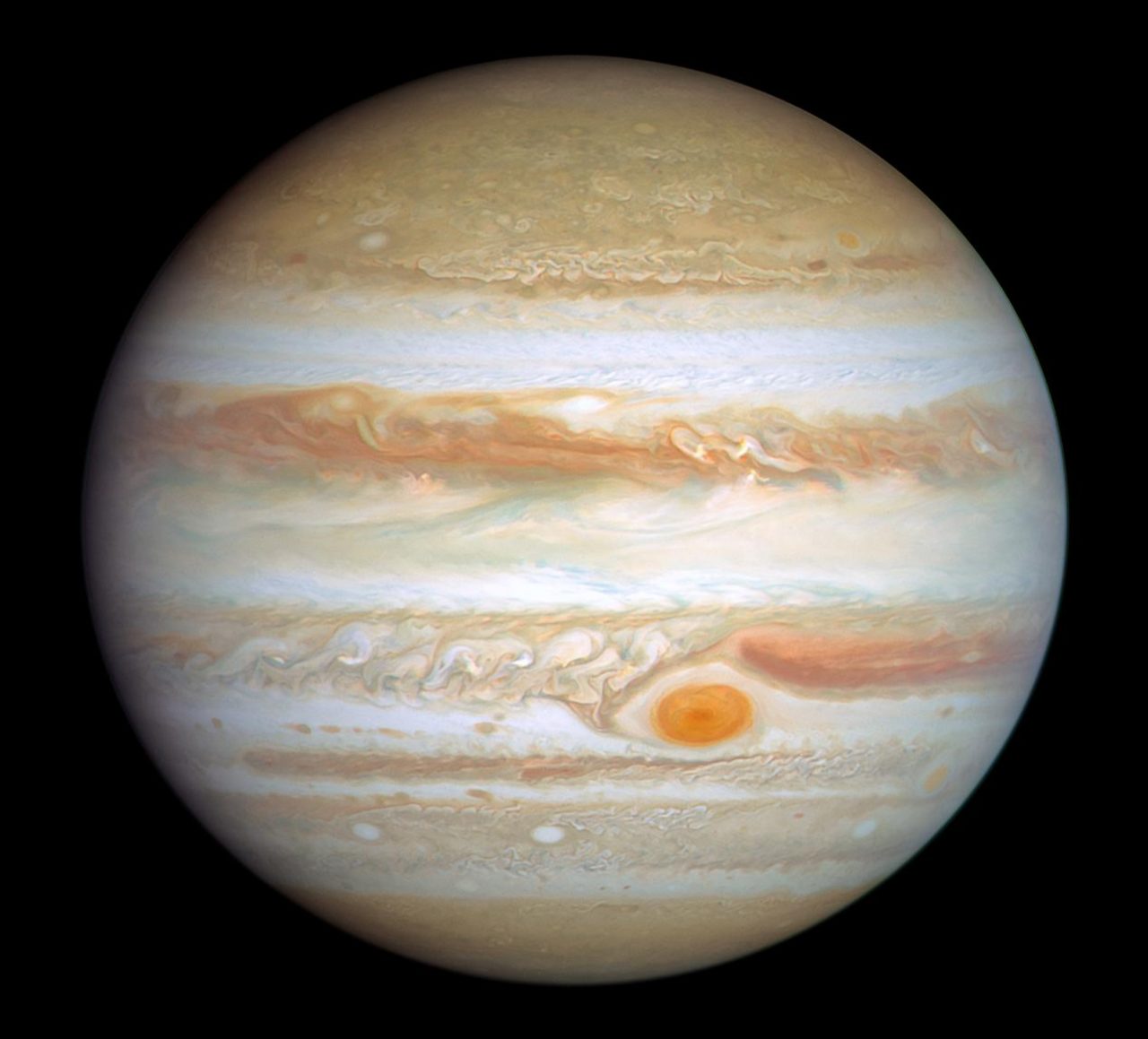
Jupiter is so large that all the other planets could not match it combined — more than twice the mass of everything else orbiting the Sun. It formed first, spins fastest, and carries a storm that has been raging since before the telescope was invented.
At a Glance
- Position
- Fifth planet from the Sun
- Radius
- 69,911 km — 11 times wider than Earth; 1,000 Earths could fit inside
- Distance from the Sun
- 5.2 AU (about 778 million km); sunlight takes 43 minutes to arrive
- Day / year
- 9.9 hours — the shortest day of any planet / about 12 Earth years
- Composition
- Mostly hydrogen and helium, like the Sun
- Moons
- 115 officially recognised, including Io, Europa, Ganymede and Callisto
- Great Red Spot
- A storm wider than Earth, observed for more than 300 years; Juno measured it extending about 500 km below the cloud tops
- Magnetic field
- 16 to 54 times more powerful than Earth's
Introduction
Jupiter took most of what was left over when the Sun formed. Out of the gas and dust remaining 4.6 billion years ago, it gathered more than twice the material of all the other planets combined — the same ingredients as a star, hydrogen and helium, though never quite enough mass to ignite. The result is a world 11 times wider than Earth, in which a thousand Earths could fit, spinning once every 9.9 hours, the fastest rotation of any planet.
It has no surface to stand on. What we see are the tops of cold, windy clouds of ammonia and water floating in that hydrogen-helium atmosphere, drawn by the planet's spin into dark belts and bright zones that flow in opposite directions. Embedded in them is the Great Red Spot, a swirling oval of cloud wider than Earth that astronomers have watched for more than three hundred years. Sunlight takes 43 minutes to reach this distant world, and a single year there lasts almost twelve of ours.
Background
Beneath the clouds, pressure crushes hydrogen first into a liquid ocean — the largest ocean in the solar system, made of hydrogen rather than water — and deeper still into an electrically conducting metallic fluid. Jupiter's rapid spin drives currents in that metallic layer like a dynamo, generating a magnetic field up to 54 times more powerful than Earth's, whose tail reaches as far as Saturn's orbit. At the centre, Juno's gravity measurements suggest the core is not a neat solid ball but a large, partially dissolved “fuzzy” region with no clear boundary.
Around the planet orbits a miniature solar system: 115 officially recognised moons. The four largest — Io, Europa, Ganymede and Callisto — were the first objects ever seen to orbit another world. They are worlds in their own right: Io is the most volcanically active body known, Ganymede is larger than the planet Mercury, and Europa hides a liquid-water ocean beneath its ice, making it one of the most promising places to search for life. A faint ring system, found by Voyager 1 in 1979, completes the retinue.
Timeline
- 7 January 1610
Galileo Galilei records four small “stars” beside Jupiter — Io, Europa, Ganymede and Callisto — the first proof that not everything in the sky orbits Earth.
- 1973
Pioneer 10 becomes the first spacecraft to cross the asteroid belt and fly past Jupiter, returning the first close-up images.
- 1979
Voyager 1 and 2 sweep past, discovering Jupiter's faint rings and volcanoes erupting on Io.
- July 1994
Fragments of the broken comet Shoemaker-Levy 9 slam into Jupiter's southern hemisphere over several days — the first collision between solar-system bodies ever watched as it happened.
- December 1995
The Galileo spacecraft enters orbit — the first Jupiter orbiter — and drops the only probe ever sent into the giant's atmosphere.
- 4 July 2016
NASA's Juno arrives in polar orbit to map Jupiter's gravity, magnetic field and deep atmosphere.
- April 2023
ESA launches JUICE, the Jupiter Icy Moons Explorer, bound for Ganymede, Callisto and Europa; it arrives in 2031.
- 14 October 2024
NASA launches Europa Clipper, which will make nearly fifty close flybys of Europa after reaching Jupiter in 2030.
Significance
Jupiter changed astronomy before it was ever visited. Galileo's four moons were the visible crack in the Earth-centred universe: here were bodies plainly circling something other than Earth. Ever since, the Jovian system has served as the test case for how planetary systems form — a star that failed, with its own retinue of worlds arranged like a solar system in miniature, preserving in its composition a sample of the original nebula from which everything formed.
Its gravity still runs the outer solar system's traffic. Jupiter's mass shepherds the asteroid belt, captures comets — Shoemaker-Levy 9 was torn apart by its tides before it fell in — and its enormous magnetosphere creates the most intense radiation environment of any planet, a hazard every visiting spacecraft must be armoured against. To understand Jupiter is to understand the conditions under which Earth-sized worlds get to exist at all.
Legacy
Exploration has moved from flybys to long sieges: Juno's polar orbits rewrote the picture of the deep atmosphere and poles, where cyclones sit in stable polygonal rings, and two great ocean-moon missions — Europa Clipper and JUICE — are now in flight toward the system. Jupiter's moons, not the planet itself, are where the search for life has gone.
The giant's own story is still being read. Its bands reach thousands of kilometres deep, its great storm is slowly shrinking, and its fuzzy core hints at a violent youth — possibly a head-on collision with another young planet. Jupiter is less a finished world than the solar system's largest surviving piece of evidence.
Sources
- NASA Science — Jupiter Facts
- NASA Space Place — All About Jupiter
- The Planetary Society — Jupiter, the planet with a planetary system of its own
The facts on this page were checked against these sources on 19 November 2026. The History Trail's permanent pages are researched and written for this site; the live profiles elsewhere on The History Trail are assembled automatically from Wikipedia and Wikidata.
About the Author
Researched and written by the The History Trail Editorial Team — the accountable editorial function behind this site's permanent story pages. The team works from the published sources cited on each page; it does not invent historians, reviewers or credentials, and it corrects errors openly.
Fact Check
Every load-bearing fact on this page traces to one of the sources listed above, and significant claims link to their source in the text. Our checking method is described on the methodology page; errors can be reported via the corrections page.
Sources & Citations
Cite this page as: The History Trail Editorial Team, The History Trail — this article's title, publication and update dates are shown beneath its headline. The full source list appears under Sources above; the site's source standards are on the sources page.