
Things
Sandwich
A sandwich is food placed between slices of bread, and it takes its name from John Montagu, 4th Earl of Sandwich, in 1760s London. But he did not invent it: filled bread is centuries older, and the famous story that he devised it at a gambling table in 1762 rests on one French travel book and is widely thought to be apocryphal. The word is first recorded in Edward Gibbon's diary that same year.
At a Glance
- What it is
- In its basic form, slices of meat, cheese or other food placed between two slices of bread
- Named for
- John Montagu, 4th Earl of Sandwich (1718-1792), First Lord of the Admiralty during the American Revolutionary War
- First written sighting
- Edward Gibbon's diary, November 1762, recording London gentlemen supping on cold meat, or a Sandwich
- The gambling story
- From Pierre-Jean Grosley's travel book (French 1770, English 1772); Britannica calls the 24-hour gaming-table tale widely thought to be apocryphal
- The likelier setting
- His desk: Britannica and his biographer N. A. M. Rodger suggest he more plausibly ate sandwiches while working
- Before the name
- Filled bread is far older - from Hillel's Passover combination in the 1st century BCE to medieval trenchers
- America's additions
- The club sandwich and the Reuben, and the peanut butter and jelly sandwich of the American schoolchild
Introduction
The sandwich did not need inventing, and this page will not pretend otherwise. People had put food between pieces of bread for centuries before an English earl's name became attached to the combination in the 1760s. What John Montagu, 4th Earl of Sandwich, gave the world was not the idea but the word, and the fashion that carried it. The famous story of why - that he refused to leave a gambling table and ordered meat between bread so he could play on - is tradition, not proven fact, and the evidence for it is examined honestly below.
Filled Bread Before the Earl
Britannica puts it plainly: this mode of eating must be as old as meat and bread. The clearest early example with a name attached is the Hillel sandwich of the Passover seder, attributed to the sage Hillel the Elder in the first century BCE, who combined the paschal lamb, bitter herbs and unleavened matzah in a single mouthful to fulfil several commandments at once. Medieval diners ate off trenchers, thick slices of bread that served as edible plates. Across the Mediterranean, flatbreads were folded and filled as a matter of course. None of these is quite the modern sandwich - two slices of leavened bread around a filling, eaten by hand as a meal in itself - but together they show that the earl's supposed invention was, as an idea, ancient and obvious.
The Earl and the 1760s
John Montagu (1718-1792) succeeded as 4th Earl of Sandwich at the age of ten in 1729. He became a serious figure in the state: postmaster general, secretary of state, and First Lord of the Admiralty, including through the American Revolutionary War, when critics accused him of corruption and of leaving the fleet unprepared. His support for exploration led Captain James Cook to name the Sandwich Islands - now Hawaii - after him in 1778. Britannica also records, without varnish, that in private life he was a profligate gambler and a rake.
In the early 1760s the word sandwich appears in London society, attached to his title. The earliest firm sighting is not at a card table but in a diary: in November 1762 the historian Edward Gibbon recorded twenty or thirty leading men supping in a coffee-room on a bit of cold meat, or a Sandwich, with a glass of punch. By then the word was already current enough to need no explanation. What Montagu himself was doing when he ate his - cards or paperwork - is the question taken up below.
Timeline
- 1st century BCE
The sage Hillel the Elder is credited with the Passover combination of lamb, bitter herbs and matzah - the Hillel sandwich.
- Medieval period
Diners eat from trenchers, thick bread slices used as edible plates - bread as the base of a meal, if not yet a sandwich.
- 1718
John Montagu, the future 4th Earl of Sandwich, is born; he succeeds to the earldom aged ten in 1729.
- November 1762
Edward Gibbon records in his diary London gentlemen supping on cold meat, or a Sandwich - the word's first firm written sighting.
- 1772
Pierre-Jean Grosley's A Tour to London appears in English, printing the gambling-table origin story of an unnamed minister of state.
- 1778
Captain James Cook names the Sandwich Islands, now Hawaii, after the earl, his patron at the Admiralty.
- 30 April 1792
John Montagu dies in London, having served as First Lord of the Admiralty through the American Revolutionary War.
- 18 November 1889
New York's Evening World describes a Union Club sandwich of turkey or chicken and ham between toasted bread - an early club sandwich reference.
- 7 July 1928
Pre-sliced bread is first sold, at Chillicothe, Missouri, using Otto Rohwedder's slicing machine - sandwich-making becomes a no-knife task.
- 2012
The Kent town of Sandwich celebrates 250 years since the word's first written record, with re-enactments of the earl's supposed order.
The Sandwich Goes Public
Once named, the sandwich spread with the speed of a fashionable idea. Britannica notes that the earl's title lent the preparation cachet, that it soon became fashionable to serve sandwiches on the European continent, and that the word was taken into French. Through the 19th century it travelled down the social scale as readily as across borders: a portable, cutlery-free meal fitted the industrial age of factory breaks, railway journeys and picnics exactly. America then elaborated it. Britannica credits the United States with elaborate formulas of its own - the club sandwich of chicken or turkey, bacon, lettuce and tomato, whose own origin is disputed between New York clubs of the 1880s and 1890s, and the Reuben of corned beef, Swiss cheese, sauerkraut and dressing, grilled on dark bread - as well as the peanut butter and jelly sandwich, the mainstay of the American schoolchild.
Significance
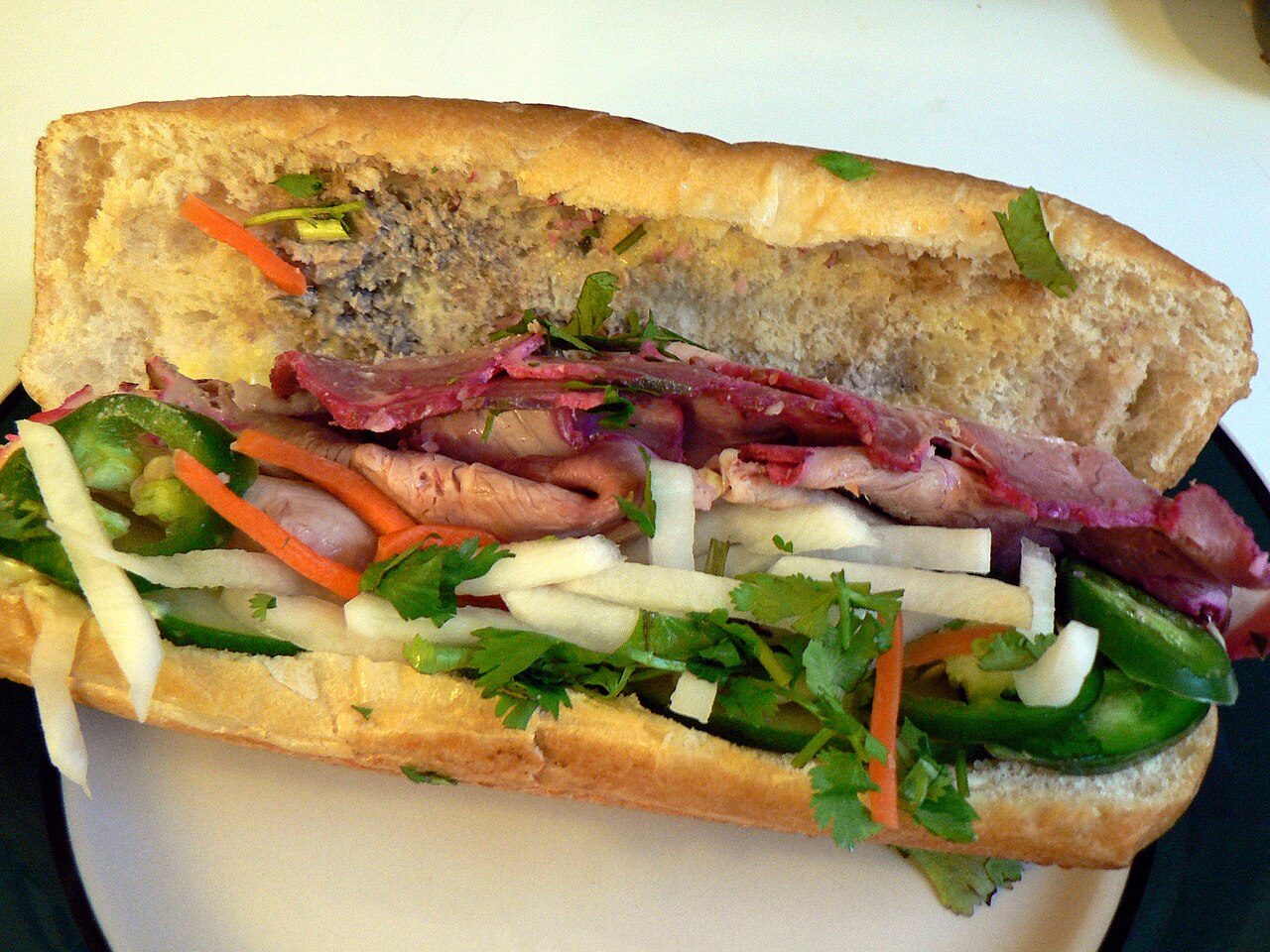
The sandwich's significance is that it is less a dish than a format - a portable architecture of bread around filling that every cuisine can rebuild in its own materials, from the Vietnamese banh mi to the Scandinavian open-faced smorrebrod, which Britannica lists alongside the British tea sandwich and the French filled roll. Because the format asks nothing but bread and something to put in it, it has absorbed local ingredients everywhere it has landed, and it scales from a child's lunchbox to a delicatessen counter without changing its nature.
It also marks a change in how people eat: a complete meal that needs no plate, no cutlery, no table and no pause in the day's business. Whether the earl ate his at a desk or a card table, the sandwich is the food of people in the middle of something else - which is to say, of modern life. That an aristocrat's title became the universal word for it is one of language's jokes: the name of a lord now labels the most democratic meal on earth.
Myths and disputes
Did the Earl of Sandwich invent the sandwich at a gambling table in 1762? This page flags that story as legend, not established fact. Britannica's verdict on the specific tale - that in 1762 Sandwich spent 24 hours at a gaming table with no other food, as told in a French travel book - is that it is widely thought to be apocryphal. The travel book is Pierre-Jean Grosley's: his account, published in French in 1770 and in English as A Tour to London in 1772, describes a minister of state who passed four and twenty hours at a public gaming table living on beef between two slices of toasted bread, and says the dish took the minister's name. Grosley named no one, was not describing something he had witnessed at first hand, and wrote years after the word was already in use - Gibbon's diary entry is from 1762.
Britannica's sandwich entry offers the soberer alternative: it seems more likely that Montagu ate these sandwiches while working at his desk, or that society simply became aware of them when he requested them in London. His modern biographer N. A. M. Rodger has argued the same. The honest summary is this: the name is his, the fashion was his, the food was everyone's, and the gambling scene that supposedly started it all cannot be verified and is probably a story improved in the telling - possibly by political enemies happy to paint a controversial minister as a gambler who would not leave the table.
Legacy
Montagu's legacy is a word used billions of times a year by people who have never heard of him. The town of Sandwich still trades on the connection, and his actual career - the Admiralty, the American war, the Wilkes affair - is read today mainly by historians. The sandwich outlasted all of it because it was never really his: he lent a name and a moment of fashion to the most obvious good idea in food, and the idea did the rest. Every filled roll, wrap and banh mi on earth is, in the only sense that can be proved, a bit of cold meat, or a Sandwich.
Sources
- Encyclopaedia Britannica - Sandwich
- Encyclopaedia Britannica - John Montagu, 4th Earl of Sandwich
- BBC History Magazine (HistoryExtra) - Did the Earl of Sandwich invent the sandwich?
- The Food Timeline - History notes: sandwiches
- Sandwich Tribunal - An Edible History of the Club Sandwich
- Missouri State Library - Beyond the Stacks: Chillicothe Introduces Sliced Bread
The facts on this page were checked against these sources on 19 November 2026. The History Trail's permanent pages are researched and written for this site; the live profiles elsewhere on The History Trail are assembled automatically from Wikipedia and Wikidata.
About the Author
Researched and written by the The History Trail Editorial Team — the accountable editorial function behind this site's permanent story pages. The team works from the published sources cited on each page; it does not invent historians, reviewers or credentials, and it corrects errors openly.
Fact Check
Every load-bearing fact on this page traces to one of the sources listed above, and significant claims link to their source in the text. Our checking method is described on the methodology page; errors can be reported via the corrections page.
Sources & Citations
Cite this page as: The History Trail Editorial Team, The History Trail — this article's title, publication and update dates are shown beneath its headline. The full source list appears under Sources above; the site's source standards are on the sources page.