
Things
Hamburger
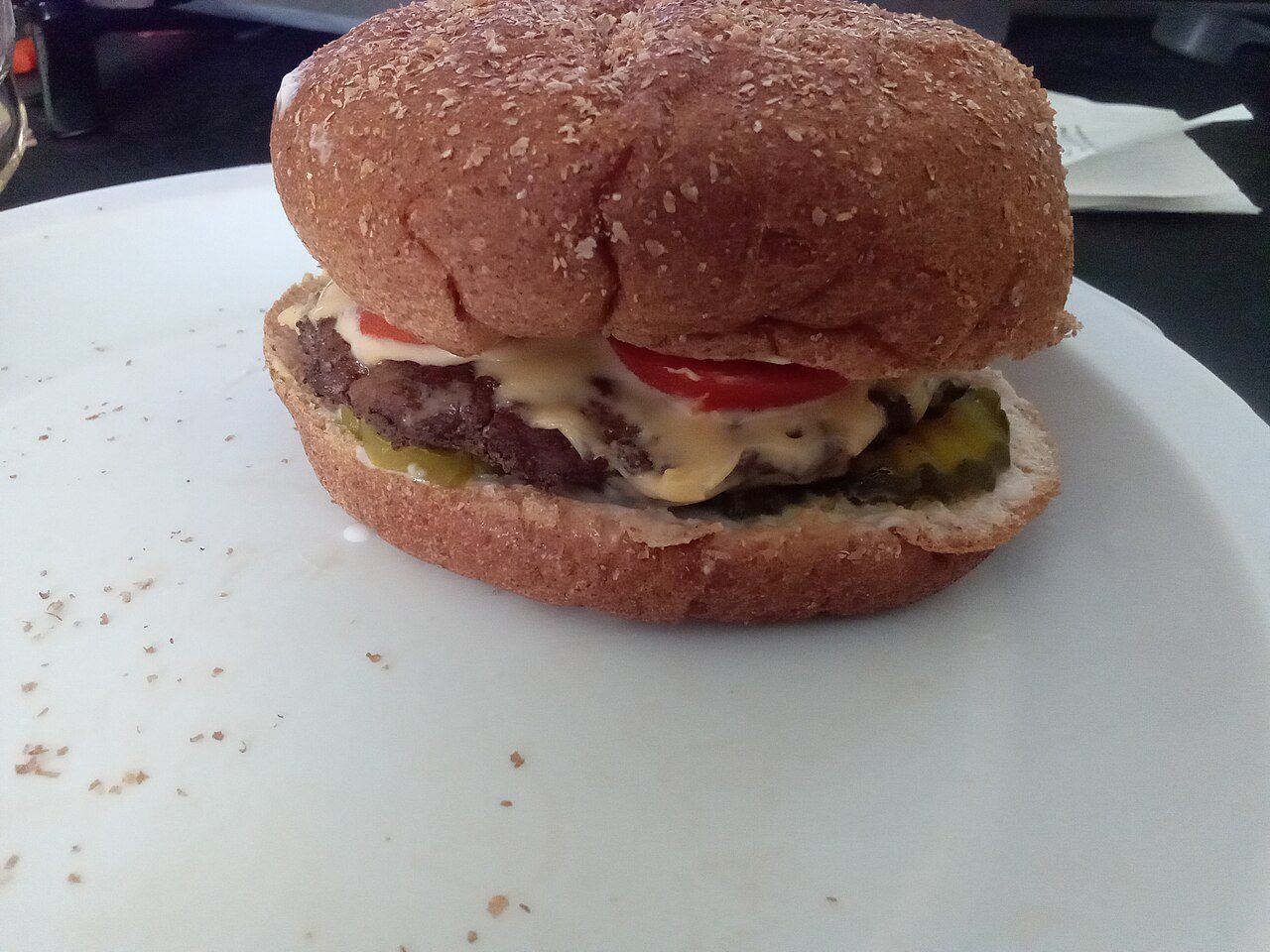
The hamburger is a cooked ground-beef patty served as a sandwich. Its patty descends from the Hamburg steak German emigrants brought to America, but who first put it in bread is genuinely disputed - claimants in Wisconsin, New York state, Connecticut and Texas all have their stories, and none has proof. What is documented is its rise: the 1904 St. Louis World's Fair, White Castle in 1921, and McDonald's after 1948.
At a Glance
- The name
- From Hamburg, Germany, and the Hamburg steak emigrants brought to America - it contains no ham
- The inventor
- Disputed: claims include Charlie Nagreen (1885), the Menches brothers (1885), Louis Lassen (1900) and Fletcher Davis (by 1904); none is proven
- Popularised
- At the St. Louis World's Fair of 1904, where hamburgers reached a national audience
- First chain
- White Castle, founded in Wichita, Kansas, in 1921 by Walter Anderson and Billy Ingram, selling five-cent sliders
- The system
- The McDonald brothers' Speedee Service System (1948) applied assembly-line production to the burger kitchen
- The expansion
- Ray Kroc opened his first McDonald's in Des Plaines, Illinois, in 1955 and bought out the brothers in 1961
Introduction
No food is more closely identified with the United States, and none has a murkier birth certificate. The patty is German, the sandwich is American, the name is a place name that wandered, and at least four men have been credited with the decisive act of putting cooked ground beef into bread. Unlike most famous foods, the hamburger's origin is not a mystery awaiting one answer; the evidence suggests it was probably invented more than once, in more than one place, within about twenty years.
What is documented is the second half of the story: how a fairground and lunch-counter sandwich was standardised by White Castle in 1921, industrialised by the McDonald brothers in 1948, and franchised across the planet by Ray Kroc after 1955, until the hamburger became a global symbol - admired, imitated and argued about in equal measure.
Hamburg Steak: The Patty Before the Sandwich
The name has nothing to do with ham. It refers to Hamburg, Germany's great port, and to the Hamburg steak: minced or ground beef, seasoned and formed into a patty, served cooked on a plate. German emigrants carried the dish to the United States in the nineteenth century, and it appeared on American menus as an inexpensive, familiar food associated with German restaurants and lunch stands. By the 1880s and 1890s Hamburg steak was a standard item, eaten with a knife and fork.
Two popular decorations on this stage of the story should be treated with care. The tale that Tartar horsemen tenderised meat under their saddles, passing it eventually to Hamburg, is a much-repeated legend without solid evidence. And the claim that New York's Delmonico's served a hamburger in 1834 rests on a menu that food historians have shown to be a later fabrication. The documented foundation is simpler: a German-named beef patty, widely eaten in America by the late nineteenth century, waiting for someone to make it portable.
The Sandwich: Four Claimants
In 1885, according to Seymour, Wisconsin, a fifteen-year-old vendor named Charlie Nagreen was selling meatballs at the Outagamie County Fair. Fairgoers wanted to walk while they ate, so Nagreen flattened a meatball and put it between slices of bread, calling the result a hamburger. Seymour still celebrates him as Hamburger Charlie, though the claim rests on later local tradition rather than records from 1885.
The same year, and the same problem, produced the Menches brothers' claim. Frank and Charles Menches, travelling fair vendors from Ohio, said they ran out of pork sausage at a fair in Hamburg, New York, substituted ground beef, and named the sandwich after the town. Louis Lassen's claim is dated 1900: at Louis' Lunch in New Haven, Connecticut, a customer in a hurry supposedly asked for something to eat on the run, and Lassen put ground steak trimmings between two slices of toast. The restaurant still serves burgers on toast, and in 2000 the Library of Congress recorded the Louis' Lunch story in its Local Legacies project - documenting the tradition, not ruling on its truth. The fourth claimant, Fletcher Davis of Athens, Texas, is said to have sold ground-beef sandwiches at his cafe in the late 1880s and taken them to the 1904 St. Louis World's Fair.
World's Fair, White Castle and the Slider
Whatever happened in the 1880s, the hamburger's national breakthrough is well documented: the Louisiana Purchase Exposition, the St. Louis World's Fair of 1904, where hamburger sandwiches reached an enormous audience and newspaper coverage - the New York Tribune among it - treated the hamburger as a notable new food. In the fair's crowds the sandwich found its natural habitat: cheap, quick, eaten standing up.
The next step was trust and repetition. In 1921 Walter Anderson and Edgar Waldo Ingram founded White Castle in Wichita, Kansas, generally regarded as the first fast-food hamburger chain. At a time when ground beef was viewed with suspicion, White Castle sold cleanliness as hard as food: white porcelain buildings, stainless steel, visible grinding of meat, and small square burgers - later nicknamed sliders - at five cents each, sold by the sack. The chain proved a hamburger could be identical in every outlet, every day. That, more than any single invention claim, is the modern hamburger's real beginning.
Timeline
- 19th century
German emigrants bring Hamburg steak - a seasoned ground-beef patty served on a plate - to the United States.
- 1885
Charlie Nagreen of Seymour, Wisconsin, is said to sell a flattened meatball between bread slices at the county fair.
- 1885
The Menches brothers claim they substituted ground beef for pork sausage at a fair in Hamburg, New York, and named the sandwich for the town.
- 1900
Louis Lassen is said to serve a ground-beef sandwich on toast at Louis' Lunch in New Haven, Connecticut.
- 1904
Hamburgers reach a mass audience at the St. Louis World's Fair; national newspapers take notice.
- 1921
Walter Anderson and Billy Ingram found White Castle in Wichita, Kansas, selling small square five-cent burgers.
- 1940
Richard and Maurice McDonald open their first restaurant in San Bernardino, California.
- 1948
The McDonald brothers relaunch with the Speedee Service System: a nine-item menu and an assembly-line kitchen.
- 15 April 1955
Ray Kroc opens his first McDonald's restaurant in Des Plaines, Illinois, and begins franchising the system.
- 1961
Kroc buys out the McDonald brothers for 2.7 million dollars and expands the chain worldwide.
Significance
The hamburger's significance is industrial as much as culinary. The McDonald brothers' Speedee Service System of 1948 applied assembly-line thinking to a kitchen: a menu cut to nine items, each worker at a fixed station, a hamburger ready in about a minute for fifteen cents. Ray Kroc, a milkshake-mixer salesman who visited San Bernardino in 1954, saw the system's potential, opened his Des Plaines restaurant in 1955 and franchised it with fanatical standardisation. The hamburger became the test case for a new kind of business, and its spread tracked America's own: cars, suburbs, highways and then the world. Economists even adopted The Economist's Big Mac Index, comparing burger prices between countries as a rough guide to purchasing power.
Myths and disputes
The invention dispute is the hamburger's defining myth, and this page presents all four leading claims as claims. Nagreen and the Menches brothers both point to 1885 but left no contemporary documentation; Lassen's 1900 sandwich, the most widely repeated claim, was on toast rather than a bun, and the Library of Congress recognition often quoted for it recorded a local tradition rather than verifying a first. Davis's Texas claim depends on later recollection too. Food historians such as Josh Ozersky have argued that the bun itself is the real dividing line, and that ground beef on bread was likely served in several places before any claimant's date. The honest conclusion is that no inventor can be proved, and several probably deserve shared credit.
Smaller myths fall with it: there is no ham in a hamburger; the name is Hamburg, the city. Ray Kroc did not found the original McDonald's restaurant - the brothers did, in 1940 - nor did he invent its service system. And the romantic Tartar horseman story, like the 1834 Delmonico's menu, dissolves under scrutiny.
Legacy
The hamburger's legacy is double. On one side stands an extraordinary democratisation of eating out: a hot, filling meal, identical everywhere, at a price almost anyone could pay, exported so successfully that the burger now appears in local forms on every continent. On the other stands the criticism that followed the same success: concerns about industrial meat production, nutrition and obesity, waste, and the flattening of local food cultures, all of which made the hamburger a symbol in arguments about globalisation itself.
Both readings are part of the record. A German patty, an American sandwich, a Kansas chain and a California system combined into the world's most recognisable meal - and into a standing argument about what modern food costs and what it gives. Few inventions, disputed or not, have carried that much meaning between two halves of a bun.
Sources
- Wikipedia - History of the hamburger
- Wikipedia - Louis' Lunch
- AmazingRibs - The History Of The Hamburger
- TheStreet - History of McDonald's: Company timeline and facts
- Whats Cooking America - History of Hamburgers
The facts on this page were checked against these sources on 19 November 2026. The History Trail's permanent pages are researched and written for this site; the live profiles elsewhere on The History Trail are assembled automatically from Wikipedia and Wikidata.
About the Author
Researched and written by the The History Trail Editorial Team — the accountable editorial function behind this site's permanent story pages. The team works from the published sources cited on each page; it does not invent historians, reviewers or credentials, and it corrects errors openly.
Fact Check
Every load-bearing fact on this page traces to one of the sources listed above, and significant claims link to their source in the text. Our checking method is described on the methodology page; errors can be reported via the corrections page.
Sources & Citations
Cite this page as: The History Trail Editorial Team, The History Trail — this article's title, publication and update dates are shown beneath its headline. The full source list appears under Sources above; the site's source standards are on the sources page.