
Things
Mona Lisa
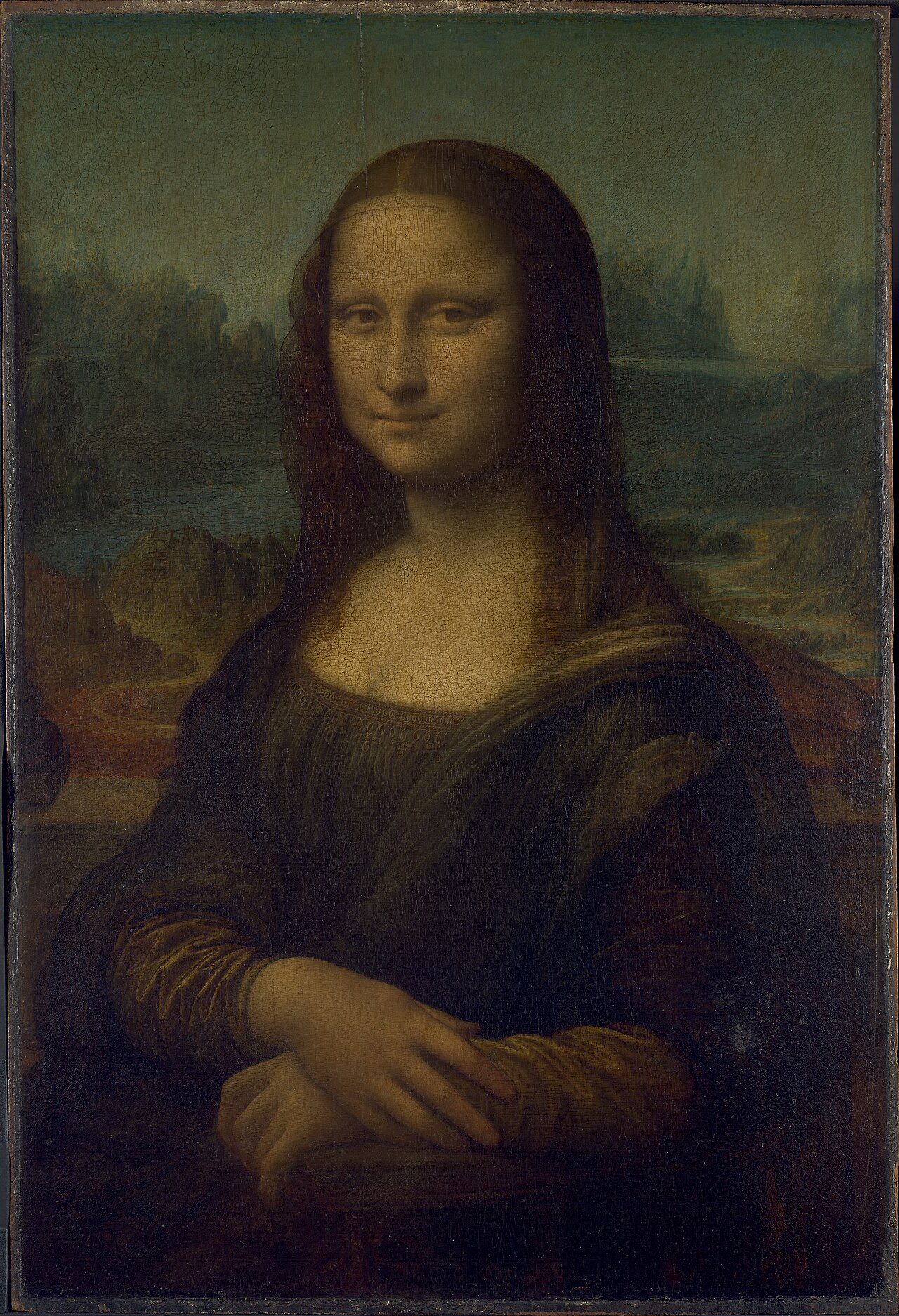
The Mona Lisa is an oil painting on a poplar panel by Leonardo da Vinci, begun in Florence about 1503 and still in his studio when he died in 1519. Probably the world's most famous painting, it is identified by the Louvre as Lisa Gherardini, wife of Francesco del Giocondo, and its modern celebrity was sealed by its theft from the Louvre in 1911 and recovery in Florence in 1913.
At a Glance
- Artist
- Leonardo da Vinci (1452-1519), Italian painter, engineer and anatomist
- What it is
- Oil on a poplar wood panel, about 77 by 53 centimetres - a small, half-length portrait, not a monumental canvas
- Dates
- Begun about 1503 in Florence and worked on intermittently until Leonardo's death in 1519
- The sitter
- Identified by the Louvre as Lisa Gherardini (1479-1542), wife of the Florentine silk merchant Francesco del Giocondo - hence La Gioconda
- Where it is
- The Louvre Museum, Paris, where it hangs behind protective glass; French national collection, inventory INV 779
- The theft
- Stolen from the Louvre on 21 August 1911 by Vincenzo Peruggia; recovered in Florence in December 1913
- The technique
- Sfumato - thin, translucent oil glazes that blur outlines and model the face in soft gradations of light and shadow
Introduction
It is, by the usual measure, a modest object: a half-length portrait of a woman on a poplar panel about 77 centimetres tall, her hands folded, a distant landscape behind her. Yet Britannica calls the Mona Lisa probably the world's most famous painting, and the Louvre, where it hangs behind protective glass, treats it as the centrepiece of the most visited museum on earth.
Its fame rests on more than the painting: on Leonardo's handling of paint, on an identity argued over for five centuries, and above all on a crime. From August 1911 to December 1913 the portrait lay hidden in the false bottom of a trunk in a Paris boarding house, while the world learned its face from newspapers reporting it missing.
A Portrait Kept, Not Delivered
Leonardo began the portrait in Florence about 1503. The Louvre's formal title states its position plainly: Portrait of Lisa Gherardini, wife of Francesco del Giocondo, known as La Gioconda or Mona Lisa. A note written in October 1503 by the Florentine official Agostino Vespucci, rediscovered at Heidelberg in 2005, records Leonardo at work on the head of Lisa del Giocondo, and Giorgio Vasari, writing in 1550, said Francesco commissioned a portrait of his wife.
What Leonardo did with the commission was unusual: he kept it. He worked on the panel intermittently for years, building the face from thin, translucent layers of oil glaze - the technique called sfumato, which blurs hard outlines so form seems to emerge through haze - and he never handed the portrait over. The three-quarter pose, turned partly toward the viewer, broke with the profile portrait then standard in Italy and set the pattern for portraiture for centuries. When Leonardo left Italy in 1516 for the court of Francis I of France, the painting travelled with him, and it was still in his studio when he died in 1519.
From Royal Palaces to the Louvre
Francis I acquired the painting after Leonardo's death, and it entered the French royal collection. For centuries it lived the quiet life of a palace picture, seen by few. The French Revolution changed its status: the royal collection was claimed as the property of the people, and after a period in Napoleon's bedroom the portrait was installed in the Louvre at the turn of the nineteenth century, where it has remained, in Britannica's words, an object of pilgrimage.
Through the nineteenth century its reputation grew among artists and writers, who praised its realism and puzzled over the sitter's faint, shifting smile. But it was admired within the art world rather than famous beyond it: when it was stolen in 1911, guidebooks gave it less space than the Venus de Milo. That was about to change completely.
The Theft That Made It Famous
On Monday 21 August 1911, with the museum closed, the painting was taken from the wall of the Salon Carre. The thief was Vincenzo Peruggia, an Italian workman who had been employed at the Louvre fitting protective glass over prized paintings, including this one. He and, on Britannica's account, possibly two others had hidden in a storeroom overnight; in the morning, in workmen's smocks, they lifted the panel from its hooks, stripped away its frame and case on a service stair, and walked out. It was 26 hours before anyone noticed.
The disappearance caused an immediate media sensation. Crowds queued to stare at the empty wall and its four iron hooks, and the museum's director of paintings resigned. Police questioned Peruggia as a former employee and accepted his story that he had overslept; the painting sat in his trunk while suspicion fell elsewhere - the poet Guillaume Apollinaire and the artist Pablo Picasso were both arrested in connection with a separate theft of statuettes, and released. In December 1913 Peruggia took the panel to Florence and offered it to the dealer Alfredo Geri, who alerted the authorities. Peruggia was arrested and imprisoned, and the painting toured Italy to huge crowds before returning to Paris, where more than 100,000 people saw it in its first two days back on the wall.
Timeline
- October 1503
Vespucci notes Leonardo at work on the head of Lisa del Giocondo in Florence.
- 1550
Vasari's life of Leonardo identifies the sitter as Lisa del Giocondo - the first published identification.
- 1516-1519
Leonardo takes the painting to France; it is in his studio at his death in 1519 and is acquired by Francis I.
- Turn of the 19th century
After the Revolution claims the royal collection, the portrait is installed in the Louvre.
- 21 August 1911
Peruggia, who had fitted the painting's protective glass, steals it from the Salon Carre.
- December 1913
Peruggia offers the painting to dealer Alfredo Geri in Florence and is arrested.
- January 1914
After exhibitions in Italy, the painting returns to the Louvre; over 100,000 people view it in two days.
- 1939-1945
Evacuated to refuges in the French countryside during the Second World War, the painting returns in 1945.
- 1963
The painting tours the United States, drawing about 40,000 visitors a day; it tours Tokyo and Moscow in 1974.
- 2005
Vespucci's 1503 note naming Lisa del Giocondo is rediscovered, strengthening the traditional identification.
Significance
As a painting, the Mona Lisa matters because it changed what a portrait could do. Britannica notes that it set the standard for all future portraits: the relaxed three-quarter pose, the hands composed in the foreground, the sitter psychologically present rather than stiffly recorded, and a landscape whose curves echo the folds of her veil and hair. Its sfumato was the fruit of Leonardo's studies of anatomy and optics, and contemporaries were already copying the new pose while he worked.
As a cultural object, it matters for a different reason: it is the clearest case of fame feeding on itself. The theft converted an admired Renaissance portrait into a mass-media image, reproduced on postcards, in cartoons and in advertisements, and every reproduction since has deepened the pilgrimage to see the small original behind glass.
Myths and disputes
Who is the sitter, really? This page follows the Louvre, whose title names Lisa Gherardini del Giocondo, supported by Vasari's 1550 account and Vespucci's contemporary 1503 note. But honesty requires the caveat Britannica gives: the identity has not been definitively proven, and no record of Francesco's commission survives. Alternatives proposed over the past century include Leonardo's mother Caterina, an idea associated with Sigmund Freud; a disguised self-portrait by Leonardo himself; and claims for a separate earlier version, promoted by a private foundation. None has displaced the Lisa del Giocondo identification in mainstream scholarship - but they are recorded here as alternatives, not as fact.
Why did Peruggia steal it? He presented himself as a patriot returning an Italian masterpiece to Italy, and that story is often repeated as settled. His own history points to a muddier motive: on the Smithsonian's account he had hoped to sell or barter the painting, and found it too famous to dispose of. Which motive weighed more is unknowable, and this page does not pretend otherwise.
Finally, the theft bred conspiracy stories from the start - that the Louvre had faked it, or that a swindler had commissioned copies to sell as the original. The most repeated version, published in 1932, has no supporting historical evidence.
Legacy
The Mona Lisa today is less a picture than a rendezvous. It hangs in the Louvre's largest gallery, in a climate-controlled case, before a permanent crowd held at a distance. It has been evacuated in wartime, attacked with stones, mugs, cake and soup, and protected ever more heavily after each attempt; it has toured three continents and drawn the largest museum crowds in history. It is priceless in the strict sense: national property that will never be sold.
Its deeper legacy is in the art that followed it. The pose it pioneered became the default grammar of Western portraiture, and its smile - a technical effect of soft modelling at the corners of the mouth and eyes - became the standing example of how a painting can seem to change as you look at it.
Sources
- Encyclopaedia Britannica - Mona Lisa
- Encyclopaedia Britannica - Why Is the Mona Lisa So Famous?
- Smithsonian Magazine - Stolen: How the Mona Lisa Became the World's Most Famous Painting
- Encyclopaedia Britannica - Leonardo da Vinci
The facts on this page were checked against these sources on 19 November 2026. The History Trail's permanent pages are researched and written for this site; the live profiles elsewhere on The History Trail are assembled automatically from Wikipedia and Wikidata.
About the Author
Researched and written by the The History Trail Editorial Team — the accountable editorial function behind this site's permanent story pages. The team works from the published sources cited on each page; it does not invent historians, reviewers or credentials, and it corrects errors openly.
Fact Check
Every load-bearing fact on this page traces to one of the sources listed above, and significant claims link to their source in the text. Our checking method is described on the methodology page; errors can be reported via the corrections page.
Sources & Citations
Cite this page as: The History Trail Editorial Team, The History Trail — this article's title, publication and update dates are shown beneath its headline. The full source list appears under Sources above; the site's source standards are on the sources page.