
Things
The Starry Night
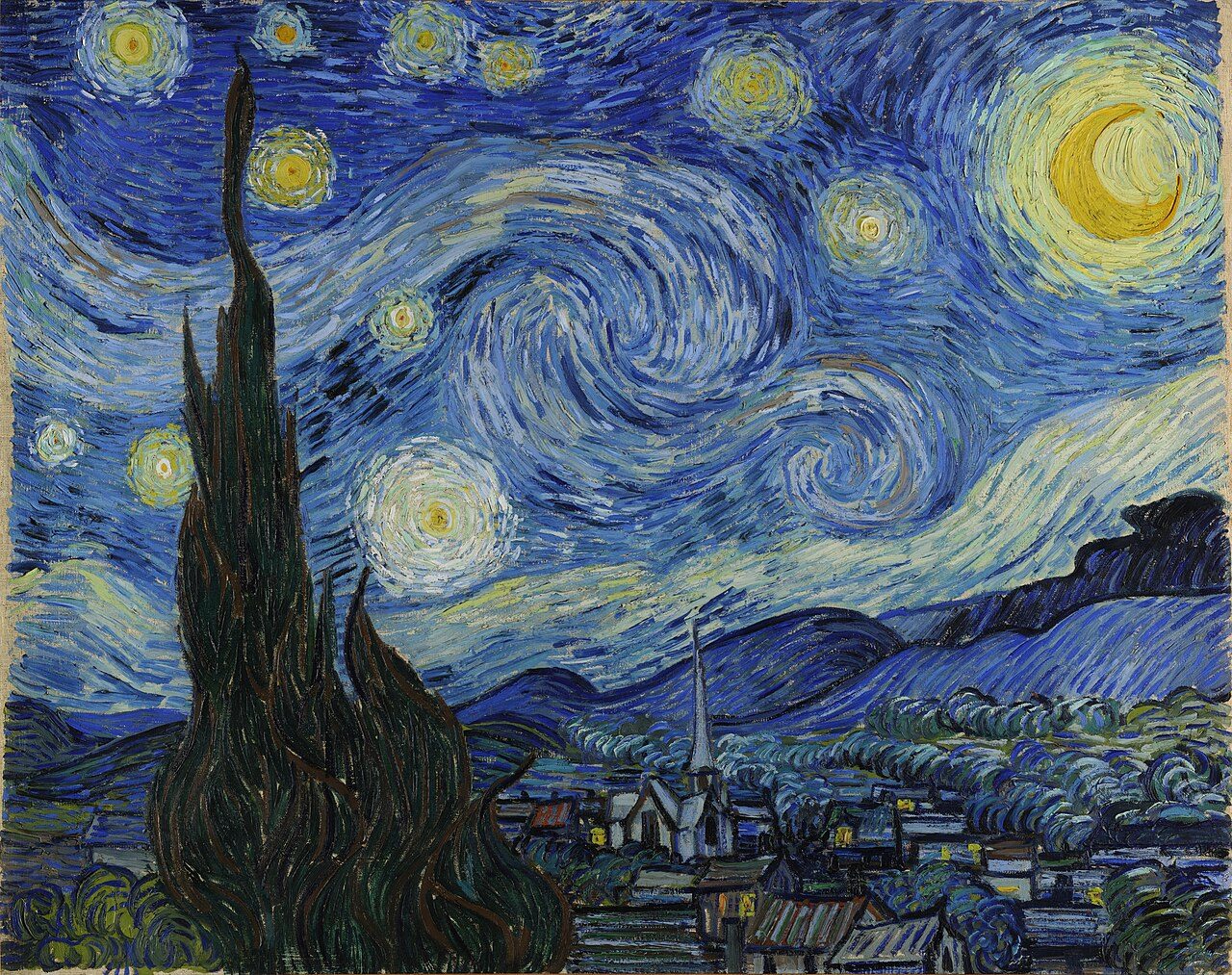
The Starry Night is an oil-on-canvas painting by Vincent van Gogh, painted in June 1889 while he was a voluntary patient at the Saint-Paul-de-Mausole asylum at Saint-Remy-de-Provence in southern France. It shows a swirling, star-filled night sky over an imagined village, and since 1941 it has belonged to the Museum of Modern Art in New York, which acquired it through the Lillie P. Bliss Bequest.
At a Glance
- Artist
- Vincent van Gogh (1853-1890), Dutch Post-Impressionist painter
- Date and place
- June 1889, Saint-Remy-de-Provence, France, during Van Gogh's stay at the Saint-Paul-de-Mausole asylum
- Medium and size
- Oil on canvas, 73.7 x 92.1 cm (29 x 36 1/4 in), according to MoMA
- What it shows
- A moon- and star-filled night sky over a quiet village, with a large dark cypress in the left foreground
- The morning star
- The bright star to the right of the cypress is identified by art historians and astronomers with Venus, the morning star Van Gogh described in a letter to Theo
- Where it is now
- Museum of Modern Art (MoMA), New York, acquired in 1941 through the Lillie P. Bliss Bequest (by exchange); object 472.1941
- Van Gogh's verdict
- He was ambivalent about the picture and later counted its large stars among his failures, in a letter to Emile Bernard
Introduction
Few paintings are as instantly recognised: a night sky rolled into great blue spirals, glowing stars, a crescent moon, and below it a village sleeping under a church spire, with a cypress rising black and flame-like at the left edge. Yet its fame is entirely posthumous. Van Gogh sold very little in his lifetime, as Britannica notes, doubted this canvas himself, and died thirteen months after painting it, at 37.
MoMA, which owns the painting, describes it as both an exercise in observation and a departure from it. That double character is the key to its history. Part of the sky was watched from an asylum window before dawn; the rest - the village, the spirals, the crescent - was remembered or invented in the studio, in daylight.
Saint-Remy: The Asylum and the Window
On 23 December 1888, after a quarrel with Paul Gauguin in Arles, Van Gogh mutilated part of his own ear, in the breakdown that ended his hopes of an artists' colony in the south. After further episodes, he entered the Saint-Paul-de-Mausole asylum at Saint-Remy voluntarily on 8 May 1889. He had a bedroom with an east-facing, barred window and a ground-floor room as a studio, and between attacks of illness he worked with extraordinary discipline, painting the asylum garden, olive groves, cypresses and wheat fields, and the view from his window in version after version.
He was not permitted to paint in his bedroom, and he did not paint outdoors at night. The Starry Night was therefore made indoors, by day, over several sessions, from drawings, memory and imagination - a method that troubled a painter who preferred to work directly before his motif, and one reason for his later ambivalence about the result. What he could do was watch. In a letter to his brother Theo written between about 31 May and 6 June 1889, he recorded the observation at the painting's heart: this morning I saw the countryside from my window a long time before sunrise, with nothing but the morning star, which looked very big.
Painting the Night: Observation and Invention
On or about 18 June 1889 Van Gogh told Theo, almost in passing, that he had at last a new study of a starry sky. The canvas, 73.7 by 92.1 centimetres, is dominated by the sky, which fills the upper two-thirds of the picture in thick, rhythmic strokes of deep blue, set off by vivid yellows. MoMA counts ten dazzling stars besides the moon; the village below, with its sharply rising church steeple, resembles no view from the asylum - MoMA notes that it bears no resemblance to the real Saint-Remy and draws instead on memories of Van Gogh's native Holland. The great cypress in the foreground, a tree he was painting repeatedly that June and praised to Theo for its line and proportion, anchors the invented village to the observed Provençal landscape.
The swirls themselves remain the most argued-over passage in the picture. Art historian Richard Thomson, writing for MoMA, considered the likeliest source to be banks of cloud driven by the mistral, the strong regional wind; others have compared the spirals to contemporary astronomical drawings of nebulae, without proof that Van Gogh saw such an image. MoMA's own framing is the safest: the painting is based on direct observation as well as imagination, memory and emotion, and no single source explains it.
Timeline
- 30 March 1853
Vincent van Gogh is born at Zundert in the Netherlands, the son of a Protestant pastor.
- 1880-1890
Van Gogh's entire artistic career lasts a single decade, producing some 900 paintings, as Britannica records.
- 23 December 1888
After a quarrel with Gauguin in Arles, Van Gogh mutilates part of his ear during a breakdown.
- 8 May 1889
Van Gogh enters the Saint-Paul-de-Mausole asylum at Saint-Remy-de-Provence voluntarily.
- Late May - early June 1889
He writes to Theo of seeing the countryside before sunrise with nothing but the morning star, which looked very big.
- On or about 18 June 1889
He reports a new study of a starry sky to Theo - the painting now known as The Starry Night.
- September 1889
Writing to Theo, he omits The Starry Night from the works he counts as a little good; he later calls its oversized stars a failure to Emile Bernard.
- 29 July 1890
Van Gogh dies at Auvers-sur-Oise, two days after shooting himself, with Theo at his side.
- 1901 onwards
Posthumous exhibitions in Paris and Amsterdam build Van Gogh's reputation; the painting passes through European collections and dealers.
- 1941
MoMA in New York acquires The Starry Night through the Lillie P. Bliss Bequest, by exchange - the first Van Gogh canvas to enter a New York museum collection.
- Today
The painting hangs in MoMA's fifth-floor galleries (Gallery 501) and is among the most visited works in the museum.
Significance
The Starry Night is the fullest statement of the style Britannica identifies as Van Gogh's achievement: striking colour, emphatic brushwork and contoured forms, realised in the last three years of a ten-year career. Painted a year before his death, it turned landscape into a vehicle for intense feeling without abandoning observation, and became a founding example for the expressive painting that followed.
When MoMA acquired the canvas in 1941, it was still a young museum building a canon of modern art; The Starry Night became one of that canon's central objects, reproduced so widely that for much of the world it now simply is Van Gogh, and for many visitors it is the single work they come to MoMA to see.
Myths and disputes
Was the bright star Venus? Art historians and astronomers have long identified the large haloed star just to the right of the cypress with Venus, and this page attributes that identification rather than stating it as certainty. The evidence is strong but circumstantial: Van Gogh's own letter describes the morning star looking very big before sunrise in the weeks the picture was made; the editors of his letters identify that morning star as Venus; and astronomical reconstruction confirms Venus was prominent in the dawn sky over Provence in the spring of 1889, near its brightest. Against a literal reading, the painting's moon is a crescent, whereas the moon over Saint-Remy in mid-June 1889 was waning and past full - Van Gogh adjusted the sky to suit the picture. A 2026 study proposing a precise July date for the painted sky has been disputed by Van Gogh Museum researchers, who stress that the canvas was painted from imagination and memory, not transcribed from one night; the June dating from the letters remains the accepted one.
Two popular claims need equal care. The village is not Saint-Remy seen from the window: it is an invented, partly Dutch village, as MoMA states. And the painting was not treasured by its maker as a masterpiece: Van Gogh left it out of the works he praised to Theo in September 1889, held it back from a shipment partly to save postage, and wrote to Bernard that reaching for stars that were too big had been another failure. Its masterpiece status is posterity's verdict, not the artist's.
Legacy
The painting's legacy is double. In art history, it stands with the Sunflowers and the self-portraits as the work by which Van Gogh's late style is known. In wider culture, it has become perhaps the most reproduced painting of the modern era - an image so familiar that it signifies night, longing and creativity itself, far beyond the asylum in Provence where its maker's window faced the dawn.
There is an irony the record makes plain. The canvas its painter counted a failure, painted indoors by a man who could not go out at night, in the last year of a life that brought him almost no recognition, now draws crowds daily in New York. Its history is also a history of how reputations are made after death - by a brother's widow who published the letters, by dealers and exhibitions, and by a museum that in 1941 placed this swirling sky at the centre of modern art.
Sources
- Museum of Modern Art - Vincent van Gogh. The Starry Night. Saint Remy, June 1889
- Museum of Modern Art - Vincent van Gogh: The Starry Night (1889)
- Encyclopaedia Britannica - Vincent van Gogh
- Museum of Modern Art - Press release: Museum of Modern Art acquires important Van Gogh (1941)
The facts on this page were checked against these sources on 19 November 2026. The History Trail's permanent pages are researched and written for this site; the live profiles elsewhere on The History Trail are assembled automatically from Wikipedia and Wikidata.
About the Author
Researched and written by the The History Trail Editorial Team — the accountable editorial function behind this site's permanent story pages. The team works from the published sources cited on each page; it does not invent historians, reviewers or credentials, and it corrects errors openly.
Fact Check
Every load-bearing fact on this page traces to one of the sources listed above, and significant claims link to their source in the text. Our checking method is described on the methodology page; errors can be reported via the corrections page.
Sources & Citations
Cite this page as: The History Trail Editorial Team, The History Trail — this article's title, publication and update dates are shown beneath its headline. The full source list appears under Sources above; the site's source standards are on the sources page.