
Things
Candy Canes
The candy cane began as a plain white sugar stick in seventeenth-century Europe. Its famous origin story — a Cologne choirmaster bending sticks into shepherds' crooks in 1670 — is legend with no contemporary evidence; the stripes, the peppermint and the hook's mass production all arrived much later, and are documented.
At a Glance
- Documented origin
- Straight white sugar sticks in seventeenth-century Europe; no inventor is recorded
- The 1670 story
- The Cologne choirmaster bending sticks into shepherds' crooks is legend — no contemporary evidence, and no reference before the mid-20th century
- First American record
- 1847, Wooster, Ohio: immigrant August Imgard is credited with hanging candy canes on a tree, though a 1938 account of his tree omits them
- The stripes
- Red-and-white stripes appear only around 1900; Christmas cards before then show plain white canes
- The flavour
- Peppermint became the standard flavour at the same turn of the century, alongside the stripes
- Mass production
- Bob McCormack's Albany, Georgia company from 1919; his brother-in-law Gregory Keller's patented machine of 1957 automated the crook
Introduction
The candy cane is older than its stripes, its flavour and possibly its hook. What can be documented is modest: hard sugar sticks were a common sweet in seventeenth-century Europe, white candy sticks were hung at Christmas, and somewhere between the straight stick and the modern cane, the crook, the red stripes and the peppermint arrived — in that order, over about two centuries. Almost everything more specific than that, including the charming story of the Cologne choirmaster, is legend, and this page labels it as such.
That honesty is the candy cane's real history. Unlike the Christmas card, whose inventor and date are known, the candy cane has no documented inventor. What it has is a well-evidenced second act: an American industry, built in Georgia in the twentieth century, that turned a handmade seasonal sweet into a mass-produced one — with the help of a machine invented by a Catholic priest.
Sugar Sticks, Then a Hook Somewhere in Germany
In the seventeenth century, European confectioners made pulled sugar — hard candy drawn into sticks. Candy historian Susan Benjamin told HISTORY that pulled sugars, the parent of today's sugar sticks, were all the rage in seventeenth-century Europe, and that somewhere in Germany a crook was added to the stick at that time. White sticks were a familiar Christmas sweet, easy to hang among the cookies, fruit and other treats with which trees were then decorated.
The American record begins, by the usual account, in 1847, when August Imgard, a German-Swedish immigrant in Wooster, Ohio, decorated a small blue spruce with paper ornaments and candy canes. Smithsonian Magazine adds a caution even here: a 1938 article honouring Imgard's contribution describes paper chains, cookies and gilded nuts on his tree, and does not mention candy canes at all. The Imgard story is plausible and widely repeated, but the contemporary paper trail is thinner than the retellings suggest. What is certain is that through the nineteenth century the cane, where it appeared, was plain white.
Stripes, Peppermint and the Georgia Factory
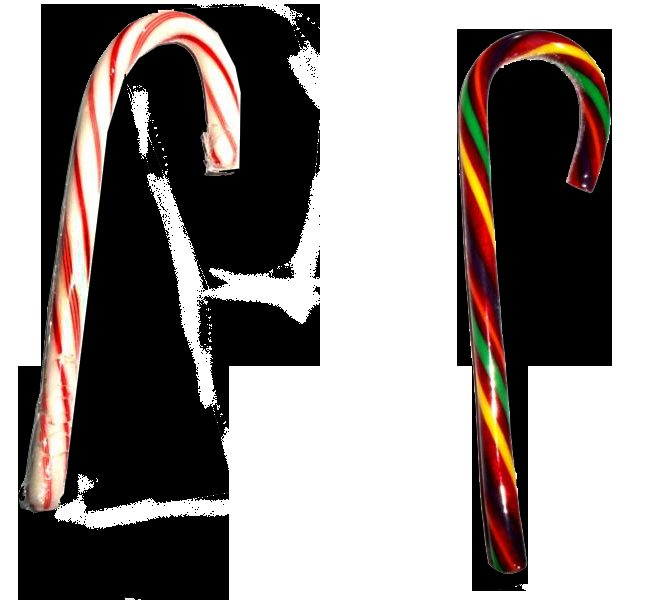
The red-and-white cane is a twentieth-century creation. For 200 years, HISTORY notes, candy canes came in just one colour: white. Red-and-white-striped candy did not start showing up until around the turn of the century, and the evidence is visual: Christmas cards and illustrations from before about 1900 show only white canes, while striped canes appear in the years that follow. At the same turn of the century, the red stripes and peppermint flavour emerged as the most popular choice — Benjamin attributes the stripes, in part, to good marketing. Peppermint, already the flavour of striped stick candy, became the cane's standard taste, with wintergreen as its main early rival.
Mass production came from Albany, Georgia. In 1919 Robert McCormack — Bob — began making candy canes there for local children, and built the business, through the Famous Candy Company, into Bobs Candies, by mid-century one of the world's leading candy cane producers. Every cane was bent by hand, hot from the pulling, and the process was wasteful: Smithsonian Magazine, quoting the account of McCormack's own circle, puts breakage at about 22 percent of production — canes snapped in the bending and ended in the bin. The cane's fragility, not its recipe, was the industry's bottleneck.
Timeline
- 17th century
Hard sugar sticks — pulled sugars — are a common sweet in Europe; somewhere in Germany a crook is added to the stick.
- 1670 (legend)
The Cologne choirmaster story is set in this year. It is a legend with no contemporary evidence, first recorded in the twentieth century.
- 1847
August Imgard, a German-Swedish immigrant in Wooster, Ohio, is credited with decorating a tree with candy canes — the usual first American record.
- Before c. 1900
Christmas cards and illustrations show candy canes only in plain white; no striped cane is documented.
- Around 1900
Red-and-white-striped canes begin to appear, and peppermint emerges as the standard flavour.
- 1919
Bob McCormack begins making candy canes in Albany, Georgia, the start of the business that becomes Bobs Candies.
- 1920s
McCormack's company grows through the decade, still bending every cane by hand and losing many to breakage.
- 1952
Gregory Keller, McCormack's brother-in-law, invents a machine to twist soft candy into spirals and cut it to length.
- 1957
Keller patents the machine that adds the crook automatically — the Keller Machine — and files the candy cane forming patent.
- Mid-20th century
Automated production makes Bobs Candies one of the world's leading candy cane producers and the striped cane a mass-market sweet.
Significance
Gregory Harding Keller was an unlikely industrial inventor: a Roman Catholic priest of the Diocese of Little Rock, and McCormack's brother-in-law, who had worked summers in the Georgia factory while a seminarian in Rome. His twisting and cutting machine of 1952, and the crook-forming machine he patented in 1957, automated the two steps hand labour did worst. Bob McCormack's daughter Bee put the result bluntly, in a verdict quoted in accounts of the family firm: there was no such thing as a candy-cane industry before the Keller Machine — only little shops selling handmade canes from jars.
The Keller Machine is also the candy cane's one firmly documented Christian connection, and it is a machine, not a symbol. Smithsonian Magazine's Rose Eveleth, reviewing the origin stories, concludes that while Christians almost certainly did not invent the candy cane, a Christian priest may have perfected it. Automation plus cellophane wrapping turned a fragile local sweet into a shippable national product, standardised in the form everyone now recognises: white, red-striped, peppermint, hooked.
Myths and disputes
The Cologne choirmaster story, stated fairly, runs as follows. In 1670, the choirmaster of Cologne Cathedral, wanting to keep children quiet during the long Living Creche ceremony, asked a local candy maker for sugar sticks — and, to justify sweets in church, had a crook added to each stick to recall the shepherds who visited the infant Jesus. It is a good story. It is also, on the evidence, a legend: no contemporary record of it exists, no reference to it predates the mid-twentieth century, and Smithsonian Magazine states flatly that there is no evidence it is true. This page presents it only as legend.
The fuller symbolism sometimes attached to the cane — the J for Jesus, white for purity, red stripes for blood, three stripes for the Trinity, hardness for the solid rock of the church — comes from a later tale about an Indiana candymaker designing the cane as a Christian witness. Eveleth dismantles it: candy sticks predate Indiana by well over a century, and none of the symbolism is documented before the modern era. The stories of canes as secret identification signs among persecuted Christians fail on the same ground: the cane appears in a Europe that was almost entirely Christian.
Who added the stripes, and why red? Nobody knows. Striped stick candy existed in recipe books as early as 1844, and Sweden's red-and-white polkagris, a straight peppermint stick dating from 1859, is a plausible relative. But no document names the person who first put red stripes on a hooked cane, or records their reason. Marketing is the best-supported explanation — and the least romantic.
Legacy
The candy cane's legacy is a shape so successful it became a flavour and a colour scheme: peppermint-red-and-white now signifies Christmas on everything from coffee drinks to wrapping paper, and the cane itself is hung on trees exactly as the white sticks were in the nineteenth century. Its production is industrial and seasonal, concentrated in the run-up to December, though this page cites no modern production total, because the figures in circulation trace to weak sources.
The honest history is more interesting than the legend it replaces. A plain European sugar stick crossed the Atlantic in immigrant luggage, acquired its stripes and its peppermint in America's new candy industry around 1900, and was rescued from its own fragility by a priest with a patent. The choirmaster of Cologne, if he existed, handed out white sticks. Everything that makes a candy cane a candy cane happened later — and most of it is documented.
Sources
- Smithsonian Magazine — We Don't Know the Origins of the Candy Cane, But They Almost Certainly Were Not Christian
- HISTORY — Who Invented the Candy Cane?
- National Confectioners Association — A Candy Cane Story
- The Catholic Sun — Priest's 'sweet secret': He invented machine that 'hooked' the candy cane
The facts on this page were checked against these sources on 19 November 2026. The History Trail's permanent pages are researched and written for this site; the live profiles elsewhere on The History Trail are assembled automatically from Wikipedia and Wikidata.
About the Author
Researched and written by the The History Trail Editorial Team — the accountable editorial function behind this site's permanent story pages. The team works from the published sources cited on each page; it does not invent historians, reviewers or credentials, and it corrects errors openly.
Fact Check
Every load-bearing fact on this page traces to one of the sources listed above, and significant claims link to their source in the text. Our checking method is described on the methodology page; errors can be reported via the corrections page.
Sources & Citations
Cite this page as: The History Trail Editorial Team, The History Trail — this article's title, publication and update dates are shown beneath its headline. The full source list appears under Sources above; the site's source standards are on the sources page.