
Things
Christmas Traditions Around the World
Christmas is one festival kept a dozen different ways: brought by the Christkind in Germany, walked through nine nights of Las Posadas in Mexico, begun in September in the Philippines, eaten as cake and fried chicken in Japan, flooded with books in Iceland, kept on 7 January in Ethiopia, sung by candlelight in Australian midsummer, and opened by St Lucia's candles in Sweden.
At a Glance
- Longest season
- The Philippines, where Christmas begins with the 'ber months' in September and runs into January
- Latest date
- Ethiopia's Genna, on 7 January, following the Julian calendar
- Strangest menu
- Japan: Christmas cake and fried chicken, after KFC's 1974 'Kentucky for Christmas' campaign
- Most books
- Iceland's Jólabókaflóð, the Christmas book flood, when books are the nation's great gift
- Brightest streets
- The Philippines' parol star lanterns, lit through the whole long season
- Most endangered
- Sweden's Gävle goat, a giant straw goat built every year since 1966 and burned down in most years since
Introduction
There is no single way to keep Christmas. The festival travelled with missionaries, migrants and merchants, and everywhere it landed it married local weather, local food and local saints — so thoroughly that a German, a Mexican and a Filipino Christmas share a date and a story but almost nothing on the table. What follows is a tour of eight versions, each recognisably Christmas and each unmistakably its own country's invention.
Some are ancient, and some are younger than the aeroplane. One of the most famous began as an advertising campaign in 1974; another has been burning down, on and off, since 1966.
Germany
In much of Germany the presents are brought not by Santa Claus but by the Christkind, the Christ Child — a radiant, angel-like figure strongest in the Catholic south and west, who slips gifts into homes on Christmas Eve unseen. The season builds through Advent in the great Christmas markets: Dresden's Striezelmarkt dates to 1434, and Nuremberg's Christkindlesmarkt, opened by the Christkind herself, draws crowds from around the world. Before all that, on the night of 5 December, children leave boots out for St Nicholas, and wake on his feast day to find them filled with nuts, fruit and chocolate.
Mexico
Mexico walks to Christmas. From 16 to 24 December, Las Posadas — 'the inns' — re-enact Mary and Joseph's search for lodging: processions of neighbours and children carry the holy figures from house to house, sing the request for shelter, are refused, and are finally welcomed in to prayer, food and a piñata for the children. The season's flower is the poinsettia, Mexico's flor de nochebuena, the Christmas Eve flower; the plant reached the United States through Joel Poinsett, the first American minister to Mexico, who encountered it while serving there — and the Aztecs before him had used it for red dye and as a remedy for fevers.
The Philippines
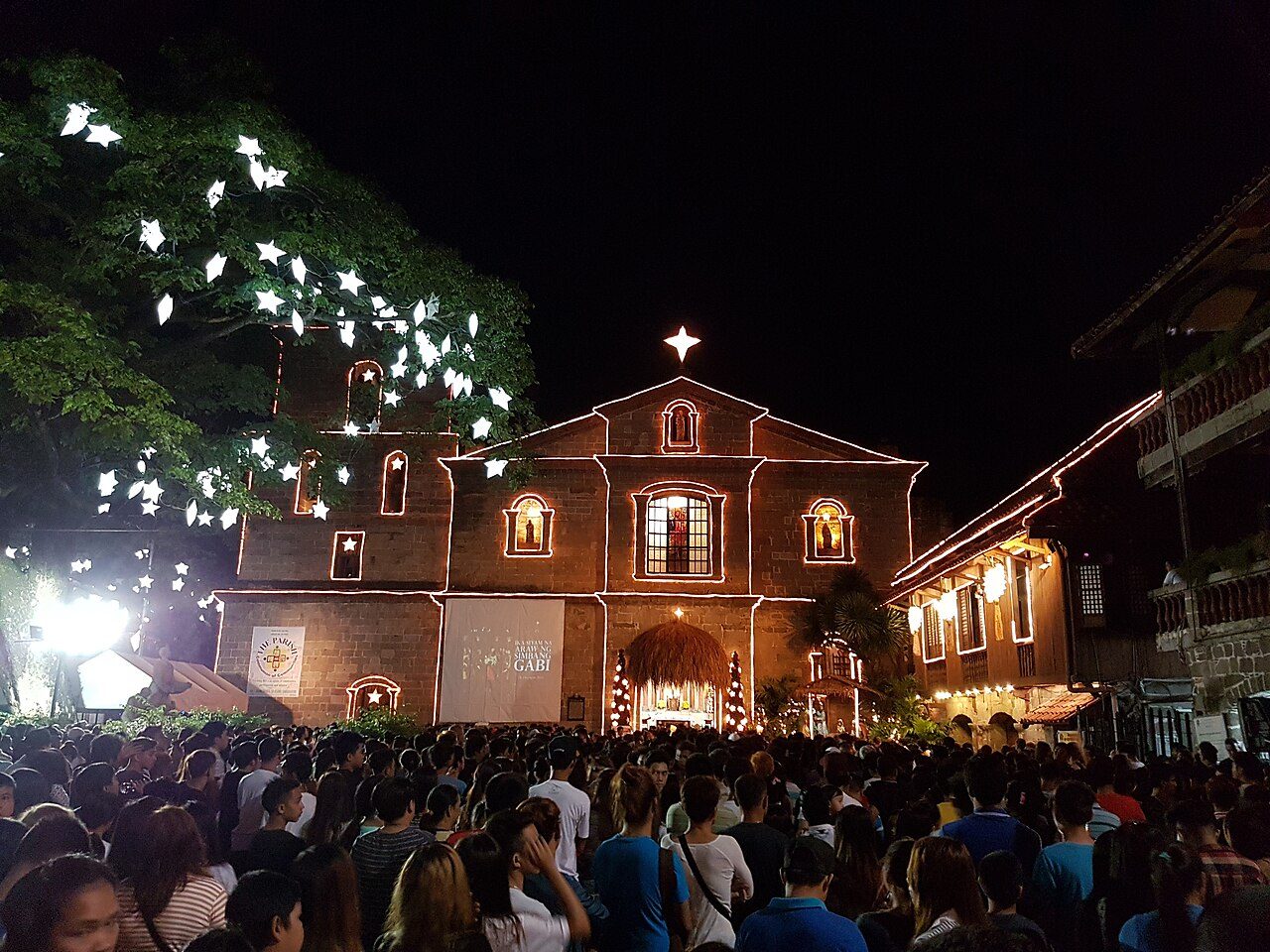
Nowhere starts earlier. In the Philippines the season opens with the 'ber months' — September — and runs for a quarter of the year, in what is often called the world's longest Christmas. Its emblem is the parol, a star-shaped lantern hung in windows and along streets, and its devotion is Simbang Gabi: nine dawn Masses from 16 to 24 December, a tradition fitted to farmers who had to be in the fields by sunrise. The city of San Fernando, the country's Christmas capital, holds a Giant Lantern Festival of enormous illuminated parols, each one a neighbourhood's year of work.
Japan
Japan keeps Christmas without the Christianity: only about one per cent of Japanese are Christian, and 25 December is not a public holiday, yet the season is everywhere — as romance, cake and chicken. Christmas Eve is a couples' night, and the dinner is strawberry-topped Christmas cake and fried chicken. The chicken is a marketing miracle: in 1974, after a group of foreigners in Japan could not find turkey and settled for fried chicken instead, KFC launched its 'Kurisumasu ni wa kentakkii!' — Kentucky for Christmas — campaign. It worked so completely that KFC Japan now records its highest sales of the year on Christmas Eve, with orders placed well in advance.
Iceland
Iceland's Christmas is thirteen nights long and full of trolls. The thirteen Yule Lads — mischievous sons of the ogress Grýla — come down from the mountains one by one on the thirteen nights before Christmas, leaving small gifts in the shoes children set in their windows, or a rotting potato for the naughty. And on Christmas Eve the country performs its best-loved modern ritual, Jólabókaflóð, the Christmas book flood: books are the nation's great gift, exchanged on Christmas Eve and read through the night. The habit is rooted in the war years, when imports were restricted but paper was not rationed — and since 1944 a national catalogue of new books has been sent to every household in the country.
Ethiopia
Ethiopia keeps a different calendar and so a different date. The Ethiopian Orthodox Church follows the Julian calendar, and its Christmas, Genna, falls on 7 January. After a fast of forty-three days, worshippers in white netela shawls gather for services that begin before dawn, and the fast is broken with feasts of doro wat, a spiced chicken stew eaten with injera. Genna is a church festival first: its centre is the liturgy and the shared meal that ends the fast, not the tree and the gift-wrap of the Western season.
Australia
Australia keeps Christmas in high summer, and has rebuilt it accordingly: the feast moves outdoors, to beaches and back gardens, with cold meats, seafood and pavlova where the northern hemisphere puts roast and pudding, and Santa may appear in red swimming trunks. Its defining institution is Carols by Candlelight, begun in Melbourne in 1938 by radio announcer Norman Banks, who the previous Christmas Eve had seen an elderly woman singing a carol alone by candlelight. The first concert drew some 10,000 people to Alexandra Gardens; in 1959 it moved to the Sidney Myer Music Bowl, and the tradition has since spread across the country.
Sweden
Sweden's Christmas season opens in the dark. On 13 December, St Lucia's Day, towns choose a Lucia who leads a procession in white, wearing a crown of candles, in the darkest weeks of the year; at home, tradition gives the role to the eldest daughter, who serves the family saffron buns — lussekatter — and ginger biscuits. And since 1966 the town of Gävle has raised a giant straw Yule goat in its castle square — and watched, in most years since, as arsonists burn it down before Christmas, a second tradition the town has never quite managed to stop.
Significance
Taken together, the eight versions show what Christmas has become: a frame strong enough to hold almost any content. The date, the child and the lights survive everywhere; everything else — the gift-bringer, the menu, the season's length, even the calendar — is negotiable. A festival that began as a church feast now works as a national folk season, kept by Christians and non-Christians alike, in midwinter darkness and midsummer heat.
They also show the two ways traditions are made. Some of these customs are centuries deep — Lucia's candles, Ethiopia's fast, Mexico's posadas walked from door to door. Others were invented within living memory and stuck instantly: a fried-chicken campaign, a straw goat, a book flood born of wartime rationing. Antiquity, it turns out, is not what makes a tradition real. Repetition is.
Sources
- Smithsonian Magazine — Why Japan Is Obsessed With Kentucky Fried Chicken on Christmas
- Encyclopaedia Britannica — Christmas
- Encyclopaedia Britannica — St. Lucia's Day
- State Library of Victoria — Carols by Candlelight (Ask a Librarian)
- Smithsonian Magazine — A Smithsonian Holiday Story: Joel Poinsett and the Poinsettia
The facts on this page were checked against these sources on 19 November 2026. The History Trail's permanent pages are researched and written for this site; the live profiles elsewhere on The History Trail are assembled automatically from Wikipedia and Wikidata.
About the Author
Researched and written by the The History Trail Editorial Team — the accountable editorial function behind this site's permanent story pages. The team works from the published sources cited on each page; it does not invent historians, reviewers or credentials, and it corrects errors openly.
Fact Check
Every load-bearing fact on this page traces to one of the sources listed above, and significant claims link to their source in the text. Our checking method is described on the methodology page; errors can be reported via the corrections page.
Sources & Citations
Cite this page as: The History Trail Editorial Team, The History Trail — this article's title, publication and update dates are shown beneath its headline. The full source list appears under Sources above; the site's source standards are on the sources page.