
People
Ada Lovelace
Ada Lovelace has been called the first computer programmer, for a program written in 1843 for a computer that existed only as drawings. Her notes on Charles Babbage's Analytical Engine saw what the machine's own designer had not fully stated: that it could work with far more than numbers.
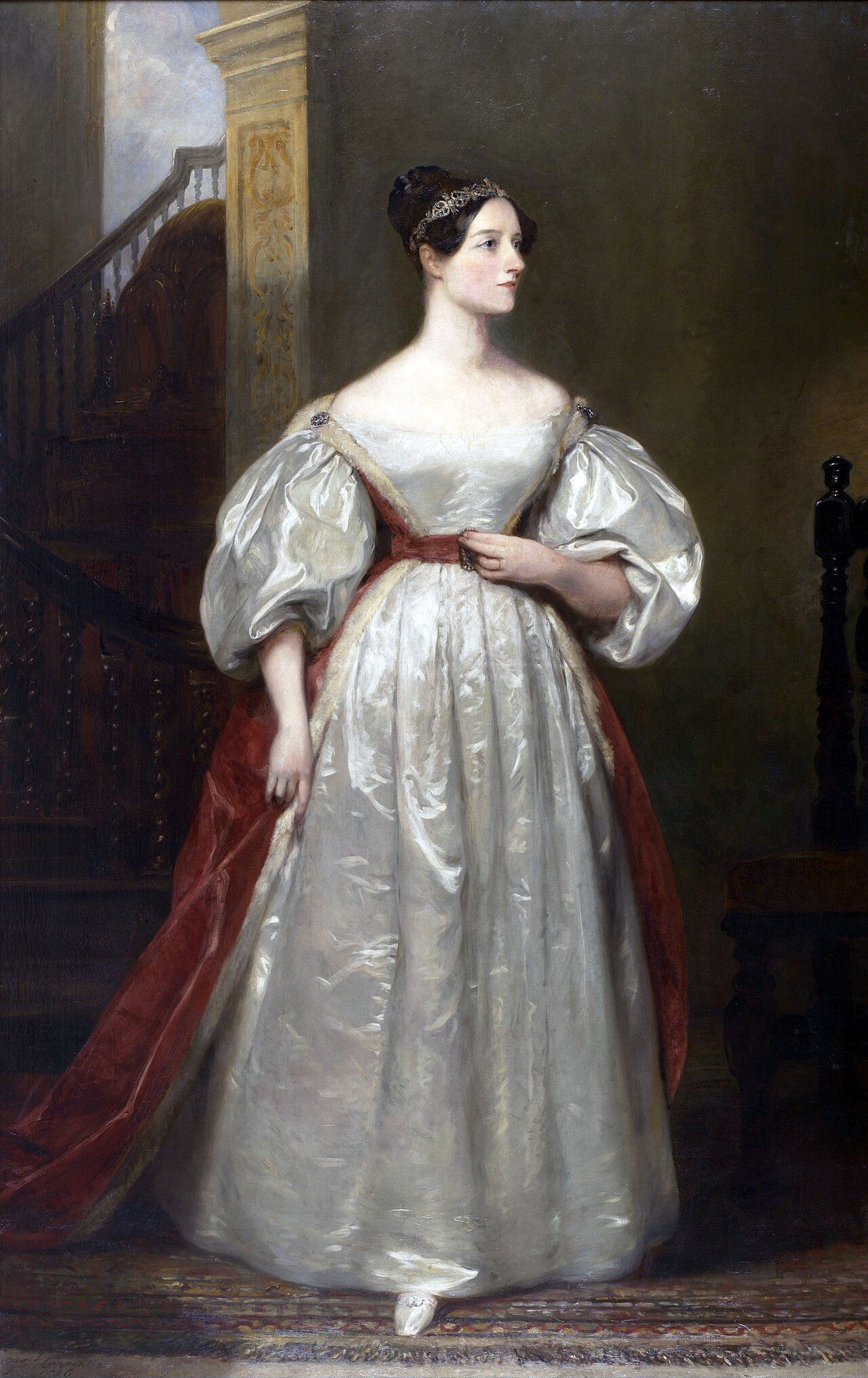
At a Glance
- Born
- 10 December 1815, London, England
- Died
- 27 November 1852, London, aged 36
- Parents
- The poet Lord Byron and Annabella Milbanke Byron; she never knew her father
- Key work
- Her 1843 translation and notes on Luigi Menabrea's article about the Analytical Engine
- The program
- Her description of how the Engine could compute Bernoulli numbers — regarded as the first computer program
- Commemoration
- Ada Lovelace Day, the second Tuesday of October, honours women in science and technology
Introduction
Ada Lovelace was an English mathematician who worked with Charles Babbage on his proposed Analytical Engine, a design for a programmable mechanical computer. In 1843 she published a translation of an article about the Engine by the Italian mathematician Luigi Federico Menabrea — and added notes of her own that ran to about three times the length of the article itself. Those notes contain her description of how the Engine could be programmed to compute Bernoulli numbers, which computer historians regard as the first computer program.
The strange part is the machine. Babbage built only a small part of the Analytical Engine, and it was never completed, so Lovelace's program was never run. Her fame rests on understanding, in writing, what a general-purpose computer would be — roughly a century before anyone succeeded in building one.
Background
She was born Augusta Ada Byron in London in 1815, the daughter of the poet Lord Byron and Annabella Milbanke Byron. Her parents legally separated two months after her birth, Byron left Britain forever, and his daughter never knew him personally. She was educated privately by tutors and then largely self-educated, helped in her advanced studies by Augustus De Morgan, the first professor of mathematics at the University of London. In 1835 she married William King; when he was created an earl in 1838, she became Countess of Lovelace.
She had become interested in Babbage's machines as early as 1833, when she was introduced to him by their mutual friend, the author and scientist Mary Somerville. Babbage had already designed a calculating machine, the Difference Engine, and was developing the far more ambitious Analytical Engine — a machine that could follow a sequence of instructions to carry out complex calculations. Lovelace grasped its possibilities quickly, and a decade after they met, the chance came to explain it to the world.
Timeline
- 10 December 1815
Born in London, the only legitimate child of Lord Byron and Annabella Milbanke Byron.
- 1833
Introduced to Charles Babbage by Mary Somerville and becomes interested in his calculating machines.
- 8 July 1835
Marries William King; she becomes Countess of Lovelace when he is made an earl in 1838.
- 1842
Luigi Federico Menabrea publishes his article on Babbage's Analytical Engine, based on Babbage's Turin lectures.
- 1843
Lovelace's translation of Menabrea's article appears with her own extensive notes, including the Bernoulli numbers method — the first computer program.
- 27 November 1852
Dies in London of uterine cancer, aged 36, and is buried next to the father she never knew.
- 1980s and after
The early programming language Ada is named for her, and Ada Lovelace Day is celebrated each October.
Significance
Lovelace's discovery, as Britannica puts it, was that a computer could follow a sequence of instructions — a program. Menabrea's article described the Engine's machinery; her notes described what it meant. She showed that the machine could follow a series of steps to make complex calculations, and she speculated that such programs could work with other things besides number. The Engine, she wrote, weaves algebraical patterns just as the Jacquard loom weaves flowers and leaves. Her additions were organised as a series of notes, lettered A to G and appended to the translation, and they grew until the commentary was roughly three times the length of the article it was meant merely to explain — an extraordinary proportion for a translator, and a sign that Lovelace understood she was writing something more than a translation.
That speculation is the leap that still startles readers. Lovelace noted that the Analytical Engine could manipulate symbols, such as musical notes and letters, as well as numbers — expanding the scope of the machine beyond mere calculation to something recognisably like a general-purpose computer. Babbage had designed a calculator of unprecedented power; Lovelace described, in print, the idea of software, and of computing as a medium rather than an arithmetic tool.
Legacy
Lovelace died at 36, and only a small part of the Engine was ever built, so her work slept for a century. The notes themselves had appeared under her initials, A.A.L., rather than her full name. When electronic computing arrived, her notes were recognised for what they were: the first published account of programming, written for a machine that existed only on paper. The programming language Ada carries her name, and Ada Lovelace Day, held on the second Tuesday of October, honours women's contributions to science, technology, engineering and mathematics — a fitting memorial for a woman who did her defining work in the margins of someone else's article. That a program written for an unbuilt machine should still be read, argued over and taught today is a measure of how far ahead of her instruments her thinking ran.
Sources
- Encyclopaedia Britannica — Ada Lovelace
- Encyclopaedia Britannica — Ada Lovelace: The First Computer Programmer
- The Victorian Web — Ada Lovelace: Pioneering Computer Programmer?
The facts on this page were checked against these sources on 19 November 2026. The History Trail's permanent pages are researched and written for this site; the live profiles elsewhere on The History Trail are assembled automatically from Wikipedia and Wikidata.
About the Author
Researched and written by the The History Trail Editorial Team — the accountable editorial function behind this site's permanent story pages. The team works from the published sources cited on each page; it does not invent historians, reviewers or credentials, and it corrects errors openly.
Fact Check
Every load-bearing fact on this page traces to one of the sources listed above, and significant claims link to their source in the text. Our checking method is described on the methodology page; errors can be reported via the corrections page.
Sources & Citations
Cite this page as: The History Trail Editorial Team, The History Trail — this article's title, publication and update dates are shown beneath its headline. The full source list appears under Sources above; the site's source standards are on the sources page.