
On This Day
September 4 in History
On 4 September 476 the Germanic leader Odoacer deposed Romulus Augustus, the teenage emperor of the West, at Ravenna — the act traditionally taken as the fall of the Roman Empire in the West and the end of ancient history in Europe. September 4 is also the day Geronimo surrendered in 1886, Edison switched on the first commercial power station in 1882, and Google was founded in 1998.
Choose another date: open the On This Day calendar to browse events, births and deaths for any day of the year.
At a Glance
- The emperor
- Romulus Augustus, nicknamed 'Augustulus' — little Augustus — had reigned less than a year and was still a teenager
- The deposition
- On 4 September 476 Odoacer forced Romulus to abdicate at Ravenna and sent the imperial regalia to Constantinople
- The victor
- Odoacer, leader of the empire's Germanic federate troops, proclaimed himself king of Italy rather than taking the imperial title
- The pension
- Romulus was pensioned off with an annual allowance of gold solidi and retired to Campania; he was still alive in 507
- The meaning
- No emperor replaced him in the West; the Eastern Roman Empire, ruled from Constantinople, endured for almost another thousand years
- The date's status
- 476 is the conventional date for the fall of Rome, popularised by Gibbon, though historians note the western empire had been shrinking for generations
Events on this day
- 476Romulus Augustus, the last emperor of the Western Roman Empire, is deposed by Odoacer, who proclaims himself king of Italy — the featured story above.
- 626Li Shimin, posthumously known as Emperor Taizong, takes the throne of Tang China, beginning one of its most celebrated reigns.
- 1781Spanish settlers found El Pueblo de Los Angeles in California, the seed of the second-largest city in the United States.
- 1870Emperor Napoleon III of France is deposed after his capture at Sedan, and the Third Republic is proclaimed in Paris.
- 1882Thomas Edison switches on the Pearl Street power station in New York, the first commercial electric power plant, lighting a square mile of Manhattan.
- 1886Apache leader Geronimo surrenders to U.S. troops in Arizona, ending the last major phase of the Indian Wars in the Southwest.
- 1888George Eastman patents his roll-film camera and registers the trademark 'Kodak'.
- 1951President Harry Truman's speech in San Francisco becomes the first live transcontinental television broadcast in the United States.
- 1972American swimmer Mark Spitz wins his seventh gold medal of the Munich Olympics, a record haul for a single Games.
- 1998Google is founded in California by Stanford students Larry Page and Sergey Brin.
- 2016Mother Teresa is canonised by Pope Francis in Rome, nineteen years after her death, becoming Saint Teresa of Calcutta.
Born on this day
- 1768Francois-Rene de Chateaubriand — French writer and diplomat, a founder of literary Romanticism.
- 1824Anton Bruckner — Austrian composer of nine vast symphonies and sacred choral works.
- 1908Richard Wright — American novelist of Native Son and author of Black Boy.
- 1981Beyonce — American singer-songwriter and one of the best-selling performers of her era.
Died on this day
- 1907Edvard Grieg — Norwegian composer of Peer Gynt and the Lyric Pieces.
- 1989Georges Simenon — Belgian novelist who created Inspector Maigret.
- 2006Steve Irwin — Australian wildlife presenter, 'the Crocodile Hunter', killed by a stingray while filming.
- 2014Joan Rivers — American comedian and television host, dead at 81 a week after a medical procedure.
The featured story: Romulus Augustus is deposed, 4 September 476
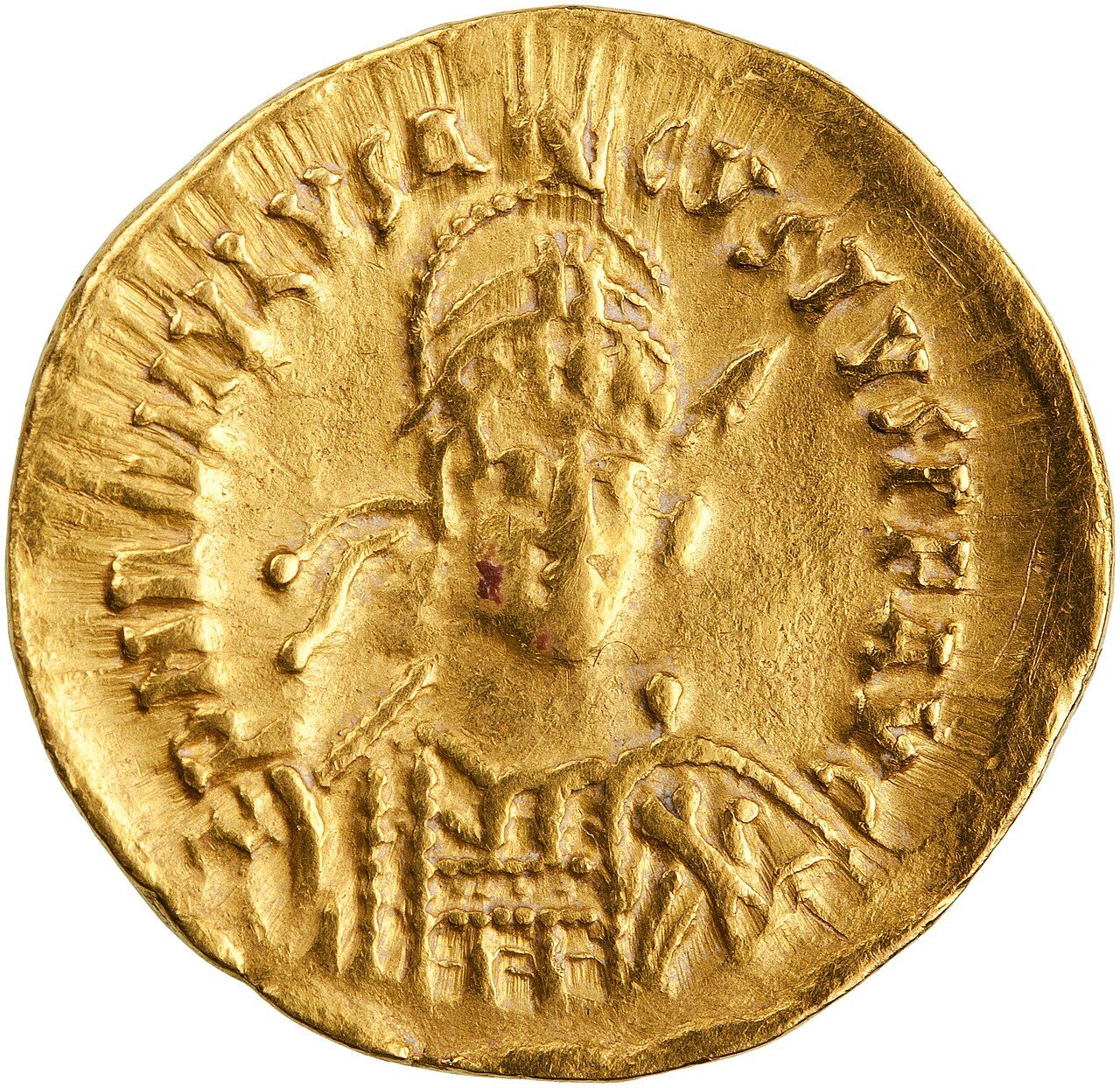
The Roman Empire in the West did not fall in a day, but if it has a closing date it is 4 September 476. The emperor who lost the throne that day was barely an emperor at all: Romulus Augustus, a teenager put on the throne of Ravenna less than a year earlier by his father Orestes, a Roman officer who had once served Attila the Hun. The boy's very name was an irony his contemporaries noticed — Romulus, the founder of Rome, joined to Augustus, its first emperor — and they diminished him for it, calling him Augustulus, the little Augustus. His gold solidi, like the one pictured here, are almost the only evidence his reign left behind.
The real power struggle was over pay and land. The western army was by now largely made up of Germanic federate soldiers, and their leader Odoacer demanded that his men be granted a third of the land of Italy to settle on. Orestes refused. Odoacer's troops mutinied, proclaimed him their king, and marched. Orestes was defeated and executed at Placentia in August; Ravenna, ringed by marshes and reckoned impregnable, opened its gates within days. On 4 September 476 Romulus was brought before Odoacer and made to formally abdicate, laying aside the diadem, purple cloak and sceptre of an emperor of Rome.
What Odoacer did next defines the moment. He did not take the imperial title himself, and he allowed no successor to be appointed in the West. Instead the imperial regalia were packed up and sent east to the Emperor Zeno at Constantinople, with a message that the West needed no separate emperor — one ruler sufficed. Odoacer would govern Italy as its king, nominally under Constantinople's authority. The Senate in Rome, which had outlasted kings and republic, went on meeting; Roman law, Roman taxation and Roman administration continued. Almost nobody in 476 announced that an empire had fallen.
Yet the symbolism proved irresistible to later ages. Edward Gibbon fixed 476 in the imagination as the fall of Rome, and the date still serves as the conventional boundary between the ancient and medieval worlds in Europe. The reality is double. In the East, the Roman Empire — Greek-speaking, wealthy and durable — continued for nearly a thousand years, until 1453. In the West, Romulus himself outlived his empire quietly: pensioned with an annual allowance of 6,000 gold solidi, he retired to a fortress-monastery in Campania, and a letter survives showing him still alive in 507, three decades after the day the West's last emperor handed back the purple.
Why this date matters
September 4 specialises in regimes changing hands and ages turning. An emperor is pensioned off in 476 and another is deposed in 1870; a Tang emperor takes China's throne in 626 and a republic is proclaimed in Paris; Geronimo's surrender in 1886 closes one American era while Edison's dynamos in 1882 switch on another, and in 1998 two students found the company that would reorganise the world's information. Few dates hold both the end of the ancient world and the start of the search-engine age.
Sources
- Encyclopaedia Britannica — On This Day: September 4
- HISTORY — This Day in History: September 4
- Wikipedia — September 4
- Wikimedia — On This Day feed: September 4
The facts on this page were checked against these sources on 19 November 2026. The History Trail's permanent pages are researched and written for this site; the live profiles elsewhere on The History Trail are assembled automatically from Wikipedia and Wikidata.
About the Author
Researched and written by the The History Trail Editorial Team — the accountable editorial function behind this site's permanent story pages. The team works from the published sources cited on each page; it does not invent historians, reviewers or credentials, and it corrects errors openly.
Fact Check
Every load-bearing fact on this page traces to one of the sources listed above, and significant claims link to their source in the text. Our checking method is described on the methodology page; errors can be reported via the corrections page.
Sources & Citations
Cite this page as: The History Trail Editorial Team, The History Trail — this article's title, publication and update dates are shown beneath its headline. The full source list appears under Sources above; the site's source standards are on the sources page.