
On This Day
September 2 in History
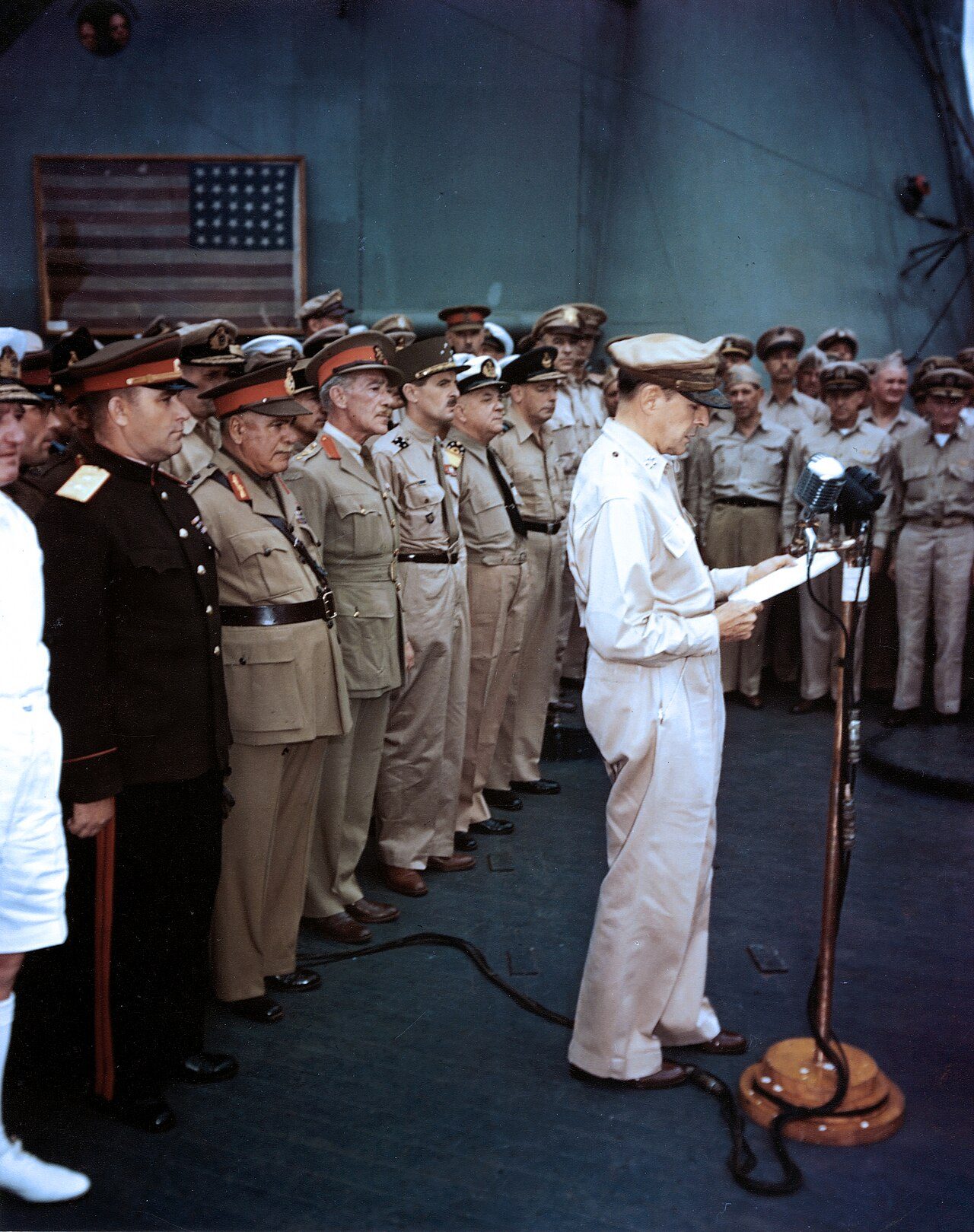
On 2 September 1945, on the deck of the battleship USS Missouri in Tokyo Bay, Japanese envoys signed the Instrument of Surrender, and the Second World War formally ended — six years and a day after it had begun with the invasion of Poland. September 2 is also the day the Great Fire of London started in 1666, Vietnam declared independence in 1945, and the first American cash machine opened in 1969.
Choose another date: open the On This Day calendar to browse events, births and deaths for any day of the year.
At a Glance
- The ceremony
- Held aboard USS Missouri in Tokyo Bay on the morning of 2 September 1945, and over in about half an hour
- Who signed
- Foreign Minister Mamoru Shigemitsu signed for the Japanese government and General Yoshijiro Umezu for the Imperial General Headquarters; General Douglas MacArthur signed for the Allied powers
- The other signatories
- Representatives of the United States, China, the United Kingdom, the Soviet Union, Australia, Canada, France, the Netherlands and New Zealand
- The setting
- Hundreds of Allied warships filled Tokyo Bay, and hundreds of aircraft flew over the Missouri at the ceremony's close
- What preceded it
- Japan had accepted the Potsdam Declaration's terms on 14 August, and Emperor Hirohito's surrender broadcast followed on 15 August
- The document
- The Instrument of Surrender was later presented to President Truman and accessioned into the U.S. National Archives on 1 October 1945
Events on this day
- 31 BCAt the Battle of Actium off the Greek coast, Octavian defeats Mark Antony and Cleopatra, deciding the future of the Roman world; both flee to Egypt.
- 1666The Great Fire of London breaks out in the king's baker's house in Pudding Lane; it burns for days and destroys some 13,000 houses and Old St Paul's Cathedral.
- 1789The United States Congress founds the Department of the Treasury, the new republic's financial engine room.
- 1862President Abraham Lincoln reluctantly restores General George B. McClellan to full command of the Union armies after the defeat at Second Bull Run.
- 1885White miners attack their Chinese co-workers at Rock Springs, Wyoming Territory, killing 28 and driving several hundred from the town.
- 1944Future president George H. W. Bush, a 20-year-old naval aviator, is shot down over the Pacific and rescued by a submarine after bailing out.
- 1945Japan signs the Instrument of Surrender aboard USS Missouri, formally ending the Second World War — the featured story above.
- 1945Hours later in Hanoi, Ho Chi Minh proclaims the independence of the Democratic Republic of Vietnam from France, quoting the American Declaration of Independence.
- 1967Former major Paddy Roy Bates declares the sea fort of Roughs Tower off Suffolk the Principality of Sealand, a self-proclaimed micronation.
- 1969America's first automatic teller machine opens to the public at a Chemical Bank branch in Rockville Centre, New York.
- 1998Swissair Flight 111 crashes into the sea off Nova Scotia after an in-flight fire, killing all 229 people on board.
- 2013Diana Nyad, aged 64, completes the first swim from Cuba to Florida without a shark cage, some 110 miles in about 53 hours.
Born on this day
- 1928Horace Silver — American jazz pianist and composer, a founder of the hard bop style.
- 1948Christa McAuliffe — American schoolteacher chosen as the first teacher in space; she died aboard Challenger in 1986.
- 1952Jimmy Connors — American tennis champion, winner of eight Grand Slam singles titles.
- 1964Keanu Reeves — Canadian actor of Speed, The Matrix and John Wick.
- 1966Salma Hayek — Mexican-American actress and producer, star of Frida.
Died on this day
- 1969Ho Chi Minh — founder of the Democratic Republic of Vietnam, who had proclaimed its independence on this day in 1945; his death is announced a day later.
- 1973J. R. R. Tolkien — English author of The Hobbit and The Lord of the Rings.
- 1992Barbara McClintock — American geneticist and Nobel laureate who discovered jumping genes.
- 2016Islam Karimov — first president of Uzbekistan, whose death in office is officially announced on this day.
The featured story: Japan signs its surrender aboard USS Missouri, 2 September 1945
Six years and one day after Germany invaded Poland, the war that invasion began was formally closed in Tokyo Bay. The battleship USS Missouri, named for President Truman's home state and christened by his daughter, lay at anchor among hundreds of Allied warships. Shortly after nine o'clock on the morning of 2 September 1945, the Japanese delegation — eleven men in formal dress and uniform, led by Foreign Minister Mamoru Shigemitsu — came up the side and took their places before a table on the veranda deck, facing rows of Allied officers and the cameras of the world's press.
General of the Army Douglas MacArthur, Supreme Commander for the Allied Powers, opened the proceedings with a short speech. He declared it his earnest hope that 'a better world shall emerge out of the blood and carnage of the past — a world founded upon faith and understanding, a world dedicated to the dignity of man and the fulfillment of his most cherished wish for freedom, tolerance and justice.' Then the signing began. Shigemitsu, who had lost a leg to an assassin's bomb in 1932, signed for the Emperor and the Japanese government; General Yoshijiro Umezu, chief of the army staff, signed for the Imperial General Headquarters; MacArthur signed for all the Allied nations, using, by tradition, several pens and giving them away to generals who had endured captivity.
Behind MacArthur the Navy had arranged a deliberate piece of theatre. Framed on the bulkhead hung the 31-star American flag that Commodore Matthew Perry's flagship had flown when it entered the same bay in 1853 to open Japan to the world — a reminder, ninety-two years on, of how the story of modern Japan and America had begun. One by one the representatives of the United States, China, Britain, the Soviet Union, Australia, Canada, France, the Netherlands and New Zealand added their signatures. The whole ceremony took about half an hour. As it ended, hundreds of carrier aircraft and B-29 bombers roared over the fleet in a final demonstration of the power that had won the war.
The signing made official what had been decided in mid-August, when Japan accepted the Potsdam terms after the atomic bombings of Hiroshima and Nagasaki and the Soviet entry into the war, and the Emperor's recorded voice told his subjects on 15 August that the war was over. But formality mattered: the Instrument of Surrender was the legal act that ended the state of war, began the Allied occupation of Japan and fixed the date the world still marks as the war's true end. The document itself was flown to Washington, presented to President Truman on 7 September, and placed in the National Archives. MacArthur's closing words on the Missouri were simpler: 'Today the guns are silent. A great tragedy has ended.'
Why this date matters
September 2 is a day of endings that become beginnings. Rome's civil wars close at Actium and an empire is conceived; London burns and a modern city rises from the ashes; and in 1945 the day carries both the formal end of the Second World War in Tokyo Bay and, within hours, the proclamation of a new nation in Hanoi — one empire's surrender and one people's independence sharing a date. Even its lighter entries are thresholds: a treasury founded for a young republic, a cash machine opening a new age of banking, a sea fort declaring itself a country.
Sources
- Encyclopaedia Britannica — On This Day: September 2
- HISTORY — This Day in History: September 2
- Naval History and Heritage Command — Surrender of Japan, Tokyo Bay, 2 September 1945
- Wikipedia — September 2
The facts on this page were checked against these sources on 19 November 2026. The History Trail's permanent pages are researched and written for this site; the live profiles elsewhere on The History Trail are assembled automatically from Wikipedia and Wikidata.
About the Author
Researched and written by the The History Trail Editorial Team — the accountable editorial function behind this site's permanent story pages. The team works from the published sources cited on each page; it does not invent historians, reviewers or credentials, and it corrects errors openly.
Fact Check
Every load-bearing fact on this page traces to one of the sources listed above, and significant claims link to their source in the text. Our checking method is described on the methodology page; errors can be reported via the corrections page.
Sources & Citations
Cite this page as: The History Trail Editorial Team, The History Trail — this article's title, publication and update dates are shown beneath its headline. The full source list appears under Sources above; the site's source standards are on the sources page.