
On This Day
September 10 in History
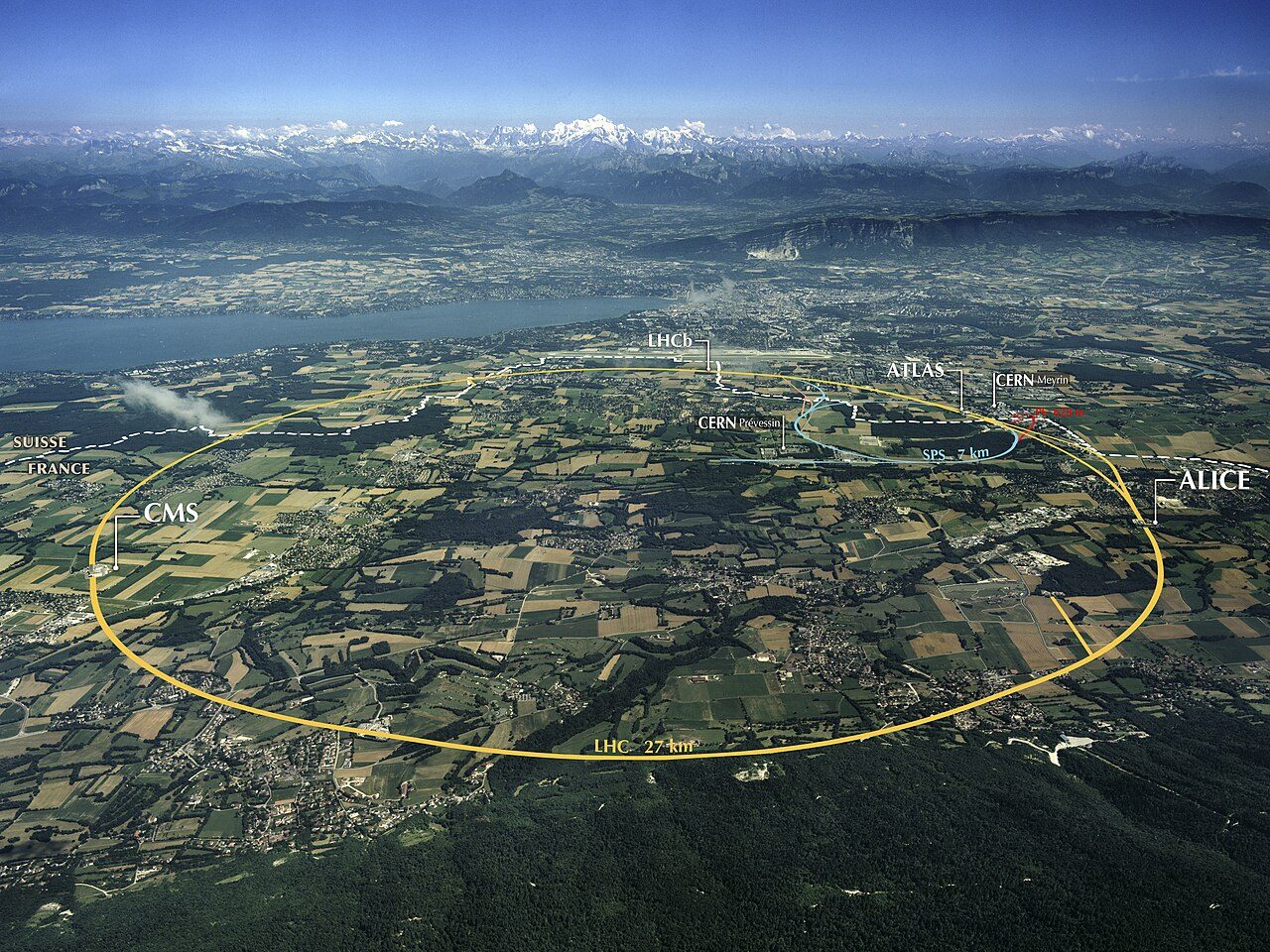
At 10:28 on the morning of 10 September 2008, a beam of protons completed its first circuit of the Large Hadron Collider at CERN near Geneva — the world's largest and most powerful particle accelerator, switched on after fourteen years of construction. September 10 is also the day of the Battle of Lake Erie in 1813, Elias Howe's sewing-machine patent in 1846, and France's last guillotine execution in 1977.
Choose another date: open the On This Day calendar to browse events, births and deaths for any day of the year.
At a Glance
- The machine
- A 27-kilometre ring of superconducting magnets in a tunnel 50 to 175 metres beneath the Franco-Swiss border near Geneva
- The moment
- The first beam circulated the full ring at 10:28 a.m. on 10 September 2008, cheered in the CERN control centre
- The builders
- CERN, the European Organization for Nuclear Research, with more than 10,000 scientists and engineers from over 100 countries
- The purpose
- To recreate conditions just after the Big Bang and find new physics — above all the Higgs boson, the particle that gives others mass
- The setback
- Nine days later a faulty electrical connection caused a magnet quench and a helium leak that shut the collider for more than a year
- The payoff
- First collisions came in 2010; on 4 July 2012 CERN announced the discovery of the Higgs boson
Events on this day
- 1608Captain John Smith is elected president of the council at Jamestown, Virginia, and imposes the discipline — 'he that will not work shall not eat' — credited with saving the colony.
- 1813At the Battle of Lake Erie, Captain Oliver Hazard Perry's American squadron defeats the British, securing the lake and sending the message 'We have met the enemy and they are ours.'
- 1846Elias Howe receives the first U.S. patent for a sewing machine using a lockstitch design.
- 1897London taxi driver George Smith becomes the first person known to be arrested for drunk driving, after crashing his cab into a building.
- 1919New York City welcomes home General John J. Pershing and 25,000 men of the First Division with a vast parade down Fifth Avenue.
- 1939Canada declares war on Germany, a week after Britain — its first independent declaration of war.
- 1960The Baghdad Conference of oil-producing nations opens, leading within days to the founding of OPEC.
- 1974Guinea-Bissau's independence from Portugal is formally recognised, ending one of Africa's longest liberation wars.
- 1977Hamida Djandoubi is executed by guillotine at Marseille — the last use of the guillotine in France.
- 1981Picasso's Guernica is displayed in Spain for the first time, forty years after it was painted, following the restoration of democracy.
- 1991Nirvana releases the single 'Smells Like Teen Spirit', the record that carries grunge — and a generation's disaffection — into the mainstream.
- 2008The Large Hadron Collider is powered up at CERN — the featured story above.
Born on this day
- 1839Charles Sanders Peirce — American philosopher and logician, founder of pragmatism.
- 1933Karl Lagerfeld — German fashion designer who led Chanel for more than three decades.
- 1945Jose Feliciano — Puerto Rican singer and guitarist of 'Light My Fire' and 'Feliz Navidad'.
- 1960Colin Firth — English actor, an Academy Award winner for The King's Speech.
- 1968Guy Ritchie — English film director of Lock, Stock and Two Smoking Barrels.
Died on this day
- 1669Henrietta Maria — queen consort of Charles I of England, dead in exile in France at 59.
- 1797Mary Wollstonecraft — English writer and author of A Vindication of the Rights of Woman, dead at 38 days after childbirth.
- 1898Elisabeth of Austria — empress of Austria, assassinated in Geneva by the anarchist Luigi Lucheni.
The featured story: the Large Hadron Collider is powered up, 10 September 2008
It is the largest machine ever built: a ring 27 kilometres around, buried in a tunnel beneath the farmland and villages of the Franco-Swiss border, lined with more than 1,600 superconducting magnets chilled to 1.9 degrees above absolute zero — colder than outer space — so that two beams of protons can be whipped around it in opposite directions at 99.999999 percent of the speed of light and smashed together inside detectors the size of cathedrals. On the morning of 10 September 2008, after fourteen years of construction and at a cost of several billion euros, the Large Hadron Collider was ready to learn whether it worked at all.
The first test was deliberately modest: circulate a single beam, in stages, all the way around. In the CERN control centre in Prevessin, engineers threaded the beam sector by sector through the ring while the world's press watched — CERN had invited the media in force, partly to answer the lurid fringe claims, aired in lawsuits and headlines, that the collider might destroy the Earth. At 10:28 a.m. the beam completed the full circuit. A cheer went up; the project's director, Lyn Evans, declared, 'It's a fantastic moment.' A second beam later circulated in the opposite direction. There were no collisions that day — those would wait for higher energies and finer tuning — but the machine had proven itself a working accelerator, the most powerful ever made.
The triumph lasted nine days. On 19 September, during powering tests, a faulty soldered joint between two magnets failed; the resulting electrical arc punctured the helium enclosure, tonnes of liquid helium escaped, and dozens of magnets were damaged or displaced. The collider shut down for more than a year of repairs and redesign. It restarted in November 2009, set energy records within weeks, and achieved its first high-energy collisions in March 2010. Then, on 4 July 2012, CERN announced to the world what the machine had been built to find: a new particle consistent with the Higgs boson, the missing piece of the Standard Model proposed in 1964 — its theorist Peter Higgs, aged 83, was in the auditorium, in tears, to hear it.
The LHC's first switch-on has become the template for how big science announces itself: a global media event, a live demonstration, a machine as celebrity. Its discoveries since — the Higgs, hundreds of exotic particles, precision measurements that keep testing the Standard Model to destruction — all trace back to the morning a dot on a screen in the control centre completed a circle 27 kilometres long. The collider still runs, upgraded repeatedly, and is expected to operate into the 2040s: the experiment that began on 10 September 2008 is, by design, a lifetime's work.
Why this date matters
September 10 is a day of machines and messages. A sewing machine is patented in 1846 and a particle collider switches on in 2008; Perry's dispatch from Lake Erie in 1813 becomes an American proverb; a London cabby in 1897 becomes the first drunk driver on record; and in 1977 the guillotine, that most mechanical of executioners, falls for the last time in France, four years before abolition. Between the lockstitch and the Higgs boson, the date traces the whole arc of the machine age — and adds, in 'Smells Like Teen Spirit' in 1991, its soundtrack.
Sources
- HISTORY — This Day in History: September 10
- Wikipedia — Large Hadron Collider
- Wikipedia — September 10
- USA Today — Today in History: September 10
The facts on this page were checked against these sources on 19 November 2026. The History Trail's permanent pages are researched and written for this site; the live profiles elsewhere on The History Trail are assembled automatically from Wikipedia and Wikidata.
About the Author
Researched and written by the The History Trail Editorial Team — the accountable editorial function behind this site's permanent story pages. The team works from the published sources cited on each page; it does not invent historians, reviewers or credentials, and it corrects errors openly.
Fact Check
Every load-bearing fact on this page traces to one of the sources listed above, and significant claims link to their source in the text. Our checking method is described on the methodology page; errors can be reported via the corrections page.
Sources & Citations
Cite this page as: The History Trail Editorial Team, The History Trail — this article's title, publication and update dates are shown beneath its headline. The full source list appears under Sources above; the site's source standards are on the sources page.