
On This Day
October 6 in History
On 6 October 1973, at two in the afternoon on Yom Kippur, Egypt crossed the Suez Canal and Syria attacked the Golan Heights, achieving almost complete surprise and beginning the Yom Kippur War — a nineteen-day conflict that brought the superpowers close to confrontation. October 6 is also the day The Jazz Singer premiered in 1927 and the Gang of Four was arrested in 1976.
Choose another date: open the On This Day calendar to browse events, births and deaths for any day of the year.
At a Glance
- The attack
- 2 p.m., 6 October 1973 — Egypt across the Suez Canal, Syria onto the Golan Heights
- Why that day
- Yom Kippur, Israel's holiest day, when the country stood still; it was also Ramadan
- Egypt's aim
- Sadat sought a foothold in the Sinai to break the deadlock left by the Six-Day War of 1967
- The crossing
- Operation Badr breached the Bar Lev Line, its sand walls washed away by water cannon
- The crisis
- U.S. resupply of Israel and Soviet resupply of Egypt and Syria raised superpower tensions
- The end
- Ceasefire under UN Resolution 338 took hold on 25 October, after nineteen days
Events on this day
- 1600Jacopo Peri's Euridice, the earliest surviving opera, is performed in Florence for the wedding of Maria de' Medici.
- 1789A Paris crowd marches on Versailles and compels Louis XVI to move to Paris, where the revolution can watch him.
- 1866The Reno brothers carry out the first peacetime train robbery in United States history, in Indiana.
- 1889The Moulin Rouge cabaret opens in Paris, with its red windmill and the can-can.
- 1908Austria-Hungary annexes Bosnia and Herzegovina, sparking the Bosnian Crisis that poisons relations before the First World War.
- 1927The Jazz Singer premieres in New York, the first feature film with spoken dialogue, and the silent era begins to end.
- 1939The Battle of Kock ends the Polish September Campaign, as the last Polish field army surrenders to Germany.
- 1948A magnitude 7.3 earthquake levels Ashgabat, capital of Soviet Turkmenistan; estimates of the dead range from 10,000 to 110,000.
- 1973Egypt and Syria attack Israel on Yom Kippur, beginning the October War — the featured story above.
- 1976In China, the Gang of Four, including Mao's widow Jiang Qing, is arrested, ending the Cultural Revolution era weeks after Mao's death.
- 2010Instagram is released; the photo-sharing app gains an estimated 25,000 users on its first day.
- 2018Brett Kavanaugh is confirmed to the United States Supreme Court by a 50–48 Senate vote after a bitterly contested process.
Born on this day
- 1846George Westinghouse — American inventor and industrialist who championed alternating-current electricity.
- 1887Le Corbusier — Swiss-French architect who reshaped modern building and city planning.
- 1908Carole Lombard — American film actress, the screwball-comedy star of My Man Godfrey.
- 1914Thor Heyerdahl — Norwegian explorer who sailed the Kon-Tiki raft across the Pacific.
Died on this day
- 1891Charles Stewart Parnell — Irish nationalist leader, the 'uncrowned king of Ireland', dead at 45.
- 1892Alfred, Lord Tennyson — Britain's poet laureate for over forty years, author of In Memoriam.
- 1981Anwar Sadat — president of Egypt, assassinated by Islamist soldiers at a Cairo parade marking the anniversary of the 1973 war he launched.
- 1989Bette Davis — American actress of All About Eve, dead in France at 81.
The featured story: the Yom Kippur War begins, 6 October 1973
At two o'clock in the afternoon on 6 October 1973 — Yom Kippur, the holiest day of the Jewish year, and the tenth day of Ramadan — Egypt and Syria attacked Israel simultaneously on two fronts. Egyptian infantry poured across the Suez Canal under a massive artillery barrage, overrunning the Bar Lev Line, the string of Israeli fortifications on the canal's east bank that had been considered nearly impregnable. On the Golan Heights, Syrian tanks advanced against thin Israeli defences. The attack achieved almost complete surprise: Israel, confident after its sweeping victory in the Six-Day War of 1967, had dismissed the Egyptian and Syrian troop concentrations as exercises, and its reserve army — the bulk of its strength — was at home or in synagogue when the war began.
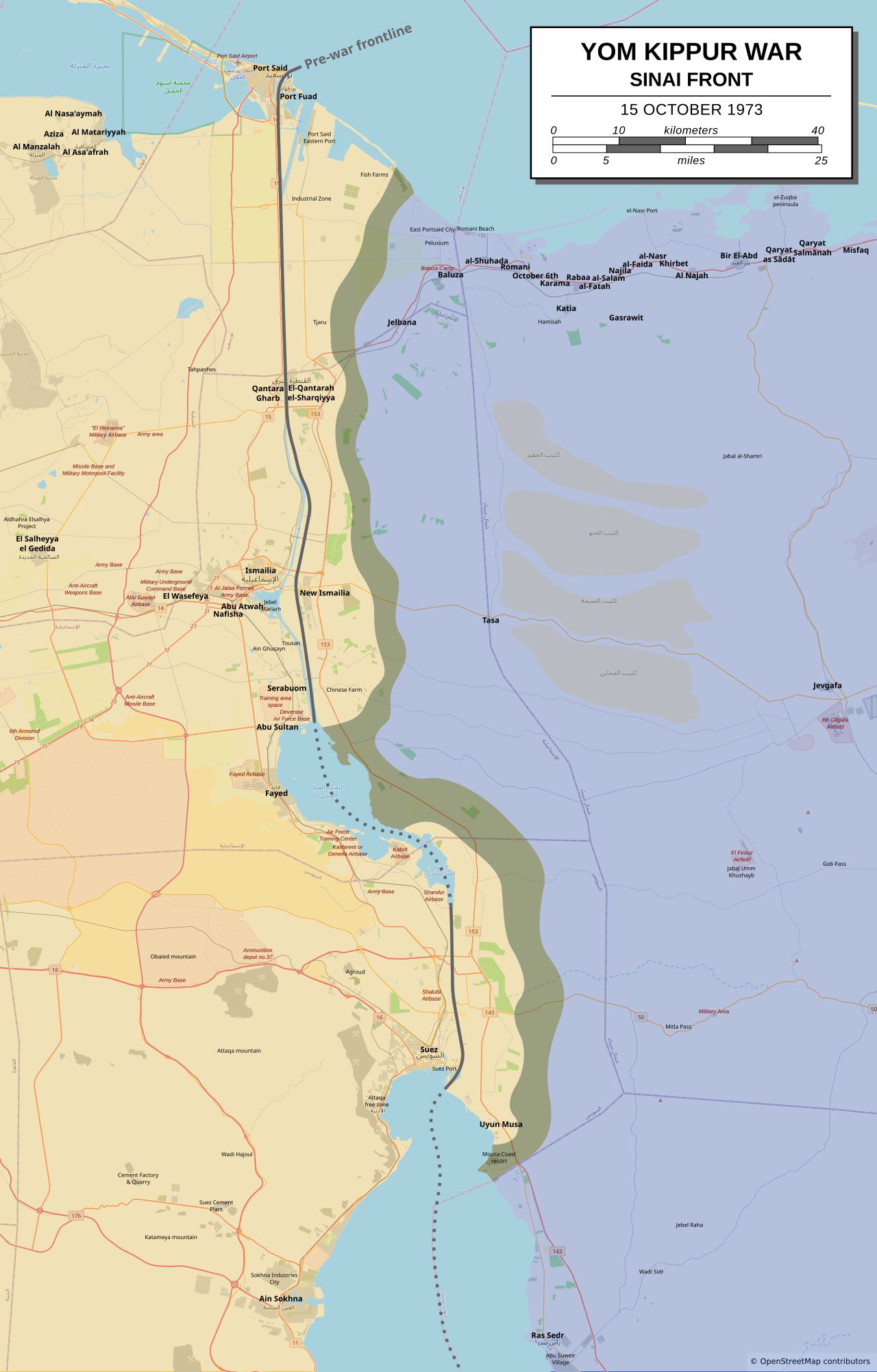
Egypt's President Anwar Sadat did not aim to destroy Israel, which he knew he could not do. His object was limited and political: cross the canal, seize a strip of the Sinai taken by Israel in 1967, and break the diplomatic deadlock that had left the occupied territory in Israeli hands for six years. The crossing itself, Operation Badr, was a masterpiece of preparation. Egyptian engineers breached the Bar Lev Line's towering sand ramparts not with explosives but with high-pressure water cannon, cutting dozens of passages in hours, and threw pontoon bridges across the canal under the shelter of a missile umbrella that kept the Israeli air force at bay. Within days, a hundred thousand Egyptian soldiers were dug in on the east bank.
Israel recovered from the shock with desperate speed. On the Golan, a handful of tanks held the Syrian advance until reserves arrived; in the Sinai, after a failed counterattack, Israeli forces under Ariel Sharon found a gap between the two Egyptian armies and, on the night of 15–16 October, crossed the canal themselves, turning the war around. As Israeli troops closed on Damascus's outskirts and encircled an Egyptian army in the Sinai, the conflict became a superpower crisis: the Soviet Union resupplied Egypt and Syria, the United States airlifted arms to Israel, and American forces worldwide were placed on heightened alert. The UN Security Council's Resolution 338 called for a ceasefire, and after further fighting the guns finally fell silent on 25 October.
The war lasted nineteen days and killed thousands, but its deepest effects were political. It shattered Israel's sense of invulnerability, destroyed the prestige of its governing generation, and restored Arab military honour after the humiliation of 1967. It also triggered the Arab oil embargo, which quadrupled oil prices and convulsed the world economy. Above all, it made peace negotiable: within six years Sadat had flown to Jerusalem, and Egypt and Israel signed the Camp David Accords and a peace treaty — the first between Israel and an Arab state. The surprise attack of 6 October 1973 thus achieved by war what its planners most wanted: a route back to the negotiating table.
Why this date matters
October 6 is a date of shocks administered and received. An earthquake erased Ashgabat on it in 1948 under a blanket of Soviet silence; talkies arrived on it in 1927, ending a whole art form's first era; China's Cultural Revolution effectively ended on it in 1976 with the arrest of the Gang of Four. Its centre, though, is the afternoon in 1973 when two armies attacked on the one day their enemy was least ready — a reminder that in history the calendar itself can be a weapon, and that a war begun as a limited gamble can end up redrawing the politics of a region and the price of oil for the whole world.
Sources
- Encyclopaedia Britannica — On This Day: October 6
- HISTORY — The Yom Kippur War Brings United States and USSR to Brink of Conflict
- HISTORY — This Day in History: October 6
- EBSCO Research Starters — Earthquake Devastates Ashgabat
The facts on this page were checked against these sources on 19 November 2026. The History Trail's permanent pages are researched and written for this site; the live profiles elsewhere on The History Trail are assembled automatically from Wikipedia and Wikidata.
About the Author
Researched and written by the The History Trail Editorial Team — the accountable editorial function behind this site's permanent story pages. The team works from the published sources cited on each page; it does not invent historians, reviewers or credentials, and it corrects errors openly.
Fact Check
Every load-bearing fact on this page traces to one of the sources listed above, and significant claims link to their source in the text. Our checking method is described on the methodology page; errors can be reported via the corrections page.
Sources & Citations
Cite this page as: The History Trail Editorial Team, The History Trail — this article's title, publication and update dates are shown beneath its headline. The full source list appears under Sources above; the site's source standards are on the sources page.