
On This Day
October 5 in History
On 5 October 1813 American forces under William Henry Harrison defeated the British and their Native allies at the Battle of the Thames in Canada, and the Shawnee leader Tecumseh was killed — ending the confederacy that had resisted American expansion across the Old Northwest. October 5 is also the day Chief Joseph surrendered in 1877 and Steve Jobs died in 2011.
Choose another date: open the On This Day calendar to browse events, births and deaths for any day of the year.
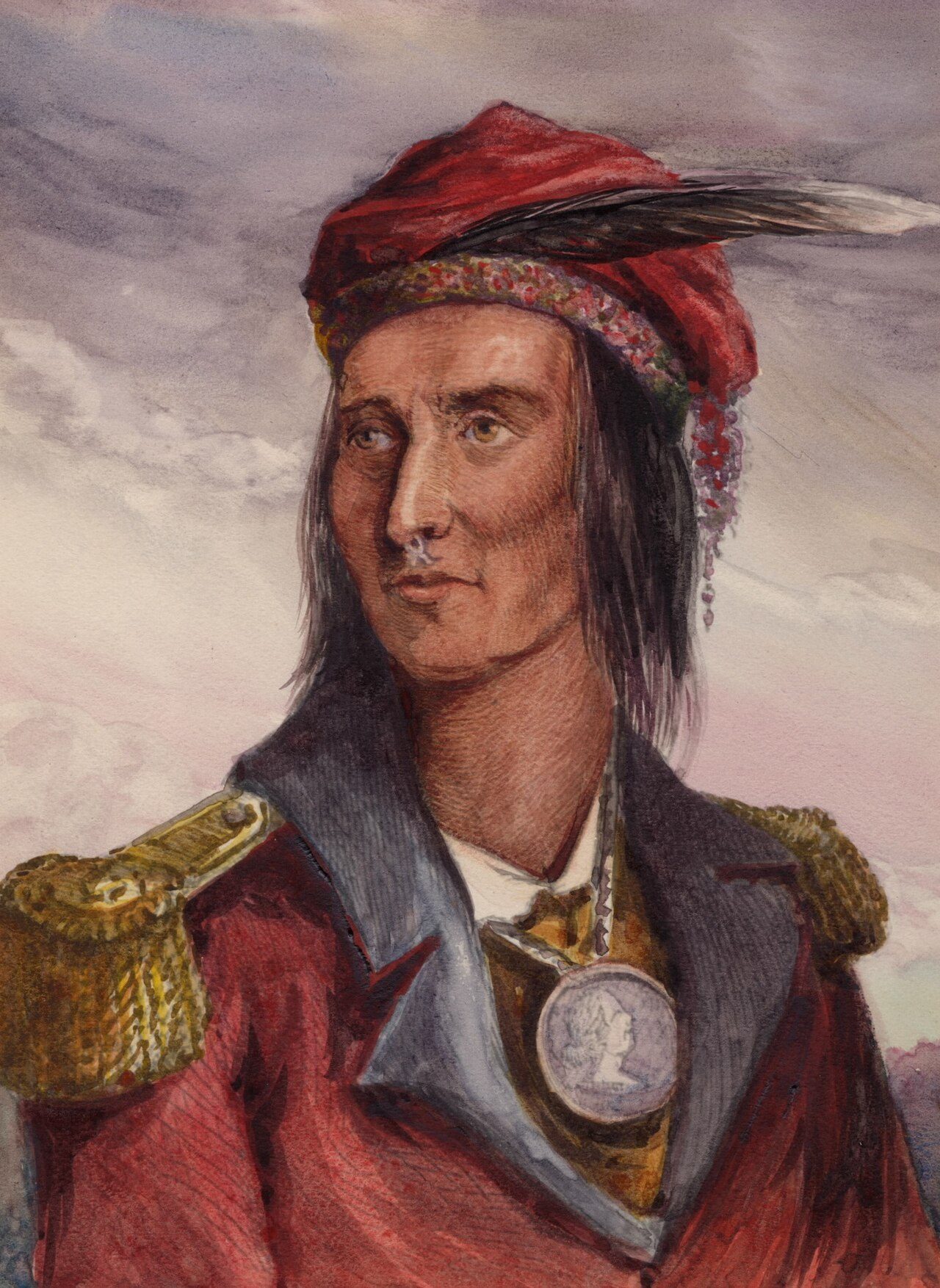
At a Glance
- The battle
- 5 October 1813, near Moraviantown on the Thames River, Upper Canada (now Ontario)
- The commanders
- William Henry Harrison for the United States; Henry Procter for Britain, with Tecumseh's confederacy
- What forced it
- Perry's American victory on Lake Erie on 10 September 1813 cut the British supply line
- The outcome
- A rapid American victory; the British line collapsed under a mounted charge
- The death
- Tecumseh was killed; the shot was never certainly attributed
- The consequence
- His confederacy dissolved, ending organised Native resistance in the Old Northwest
Events on this day
- 1813American forces under William Henry Harrison defeat the British and their Native allies at the Battle of the Thames; Tecumseh is killed — the featured story above.
- 1877Chief Joseph surrenders to United States troops in Montana, ending the Nez Perce flight and the speech remembered for 'I will fight no more forever'.
- 1892The Dalton Gang is destroyed attempting to rob two banks at once in Coffeyville, Kansas; eight men die, and only Emmett Dalton survives.
- 1931Clyde Pangborn and Hugh Herndon complete the first nonstop flight across the Pacific, from Japan to Washington state.
- 1947President Harry Truman delivers the first televised address from the White House, asking Americans to save food for hungry Europe.
- 1953Earl Warren is sworn in as Chief Justice of the United States, beginning the liberal Warren Court era.
- 1962The first James Bond film, Dr. No, premieres in London, and the Beatles release their first single, Love Me Do, on the same day.
- 1969Monty Python's Flying Circus is broadcast for the first time on BBC television.
- 1970The Public Broadcasting Service (PBS) begins broadcasting in the United States.
- 1983Polish union leader Lech Wałęsa is awarded the Nobel Peace Prize for the Solidarity movement.
- 1989The Dalai Lama is awarded the Nobel Peace Prize for his nonviolent campaign for Tibet.
- 2001Barry Bonds hits his 71st and 72nd home runs of the season, breaking Mark McGwire's single-season record.
Born on this day
- 1713Denis Diderot — French philosopher who edited the Encyclopédie, the great work of the Enlightenment.
- 1829Chester A. Arthur — 21st president of the United States, who succeeded the assassinated Garfield.
- 1864Louis Lumière — French inventor who, with his brother Auguste, pioneered motion pictures.
- 1882Robert Goddard — American physicist who built and flew the first liquid-fuelled rocket.
- 1902Ray Kroc — American businessman who turned McDonald's into a global fast-food empire.
- 1936Václav Havel — Czech playwright and dissident who became president after the Velvet Revolution.
- 1975Kate Winslet — English actress of Titanic and Mare of Easttown, born in Reading.
Died on this day
- 1813Tecumseh — Shawnee leader whose confederacy resisted American expansion, killed at the Battle of the Thames.
- 1941Louis Brandeis — associate justice of the U.S. Supreme Court and champion of the right to privacy.
- 2011Steve Jobs — co-founder of Apple, who reshaped personal computing and the telephone, dead at 56.
The featured story: the Battle of the Thames and the death of Tecumseh, 5 October 1813
The Battle of the Thames, fought in Upper Canada on 5 October 1813, lasted barely an hour, but it decided the fate of the Old Northwest in the War of 1812 and cost the Shawnee leader Tecumseh his life. Tecumseh had spent years building a confederacy of Native nations to resist the United States' expansion into the lands north of the Ohio River, and when war came in 1812 he allied his confederacy with Britain. Together they had taken Detroit and threatened the American frontier. By the autumn of 1813, however, the alliance was starving: American Commodore Oliver Hazard Perry's victory on Lake Erie on 10 September severed the British supply line, and the British commander, General Henry Procter, abandoned Detroit and retreated up the Thames River with Tecumseh's warriors reluctantly covering his rear.
Tecumseh bitterly opposed the retreat — he had promised his people they would stand and fight — and at last Procter agreed to make a stand near the mission village of Moraviantown, on the north bank of the Thames. His force was small and exhausted: a few hundred British regulars of the 41st Regiment and perhaps a thousand Native warriors, drawn up in open woodland with the river on one side and a swamp on the other. Against them came Major General William Henry Harrison with some 3,500 men, including a regiment of Kentucky mounted riflemen. On the afternoon of 5 October the Kentuckians charged straight through the thin British line, which collapsed almost at once; Procter fled the field, and the battle's real fighting shifted to the swamp, where Tecumseh's warriors resisted fiercely until their leader fell.
Who fired the shot that killed Tecumseh was disputed for decades — Colonel Richard Mentor Johnson of Kentucky built a vice-presidential career on the claim — but it was never certainly established. What is certain is the effect. Tecumseh's body was never conclusively identified, and his confederacy, which had always been held together by his personal authority, dissolved with his death. The Thames was the last serious Native resistance east of the Mississippi mounted in alliance with a European power; within a generation the nations of the Old Northwest had been removed westward, and the region was opened to American settlement.
The battle made Harrison's reputation as surely as it ended Tecumseh's cause. 'Tippecanoe and Tyler too' — Tippecanoe being his earlier fight against Tecumseh's brother — carried Harrison to the presidency in 1840. Tecumseh, meanwhile, grew in death into one of the most admired figures of the continent's history, praised even by the Canadians and Americans who had fought him as a statesman and orator of the first rank. The confederacy he built died on the Thames on 5 October 1813; the argument he made for it — that the land belonged to all Native nations in common and could not be sold piecemeal — outlived him by centuries.
Why this date matters
October 5 has an unusual range: it runs from a forest battle in Canada in 1813 to a bank raid in Kansas, the first televised presidential address, the birth of both James Bond on screen and the Beatles on record on the same day in 1962, and two Nobel Peace Prizes for dissidents, Wałęsa and the Dalai Lama. Yet its weight lies at the start of that list. The Thames was the hinge on which the interior of North America turned: one short fight ended organised Native resistance in the Old Northwest and set the continent's map on the course it still follows. Few hours in history have closed so large a question so completely.
Sources
- Encyclopaedia Britannica — On This Day: October 5
- HISTORY — Tecumseh Defeated
- HISTORY — Apple Founder Steve Jobs Dies
- HISTORY — This Day in History: October 5
The facts on this page were checked against these sources on 19 November 2026. The History Trail's permanent pages are researched and written for this site; the live profiles elsewhere on The History Trail are assembled automatically from Wikipedia and Wikidata.
About the Author
Researched and written by the The History Trail Editorial Team — the accountable editorial function behind this site's permanent story pages. The team works from the published sources cited on each page; it does not invent historians, reviewers or credentials, and it corrects errors openly.
Fact Check
Every load-bearing fact on this page traces to one of the sources listed above, and significant claims link to their source in the text. Our checking method is described on the methodology page; errors can be reported via the corrections page.
Sources & Citations
Cite this page as: The History Trail Editorial Team, The History Trail — this article's title, publication and update dates are shown beneath its headline. The full source list appears under Sources above; the site's source standards are on the sources page.