
On This Day
November 30 in History
On 30 November 1939, without a declaration of war, Soviet forces crossed the Finnish border along its whole length and Soviet aircraft bombed Helsinki: the Winter War had begun. The Red Army expected to be in the Finnish capital in weeks; instead, a nation of fewer than four million held the Soviet Union at bay for 105 days. November 30 is also the birthday of Mark Twain and Winston Churchill, both born on this date, and the day Barbados became independent in 1966 and ChatGPT was released in 2022.
Choose another date: open the On This Day calendar to browse events, births and deaths for any day of the year.
At a Glance
- The pretext
- Four days earlier the USSR blamed Finland for shelling the Soviet village of Mainila — an incident Finland denied and historians regard as staged
- The demands
- Stalin had demanded Finnish territory on the Karelian Isthmus, islands in the Gulf of Finland and a base at Hanko; Finland refused the full package
- The imbalance
- The Red Army attacked with an estimated 465,000 men and some 1,000 aircraft, per HISTORY's account, against a Finnish army a fraction of its size
- The defence
- Finland's Mannerheim Line, ski troops and winter itself broke up Soviet columns; the 'motti' tactics destroyed whole divisions in the forests
- The cost
- Finland lost an estimated 25,000 dead; Soviet deaths are estimated at well over 100,000
- The peace
- The Moscow Peace Treaty of March 1940 cost Finland about a tenth of its territory — but Finland, alone among Germany's neighbours, was never occupied
Events on this day
- 1609Galileo Galilei begins his telescopic observations of the Moon, the work that will become the Sidereus Nuncius and overturn the perfect heavens.
- 1700At the Battle of Narva, the 18-year-old Charles XII of Sweden routs a much larger Russian army in a snowstorm, an early sensation of the Great Northern War.
- 1782British and American representatives sign preliminary articles of peace in Paris, recognising United States independence in substance a year before the Treaty of Paris.
- 1786The Grand Duchy of Tuscany, under Leopold II, promulgates a new penal code abolishing the death penalty — the first modern state to do so.
- 1872Scotland and England draw 0–0 at Hamilton Crescent, Glasgow, in the first official international football match.
- 1936The Crystal Palace in London, the vast glass hall of the Great Exhibition of 1851, is destroyed by fire in a single night.
- 1939The Soviet Union invades Finland, opening the Winter War — the featured story above.
- 1966Barbados becomes independent of the United Kingdom, with Errol Barrow as its first prime minister.
- 1979Pink Floyd releases The Wall, the concept album that becomes one of the best-selling records of all time.
- 1982Michael Jackson's Thriller is released; it becomes the best-selling album in history.
- 1999Exxon and Mobil complete their merger, forming ExxonMobil, then the world's largest publicly traded oil company.
- 2022OpenAI releases ChatGPT, the conversational AI whose arrival brings generative artificial intelligence to a mass public within weeks.
Born on this day
- 1667Jonathan Swift — Irish satirist, dean of St Patrick's, Dublin, and author of Gulliver's Travels and A Modest Proposal.
- 1835Mark Twain — American writer, born Samuel Langhorne Clemens in Missouri, author of Tom Sawyer and Huckleberry Finn.
- 1874Winston Churchill — British statesman born at Blenheim Palace, who leads his country through the Second World War.
- 1874Lucy Maud Montgomery — Canadian novelist who creates Anne of Green Gables, born the same day as Churchill.
- 1929Dick Clark — American television host whose American Bandstand shapes the country's popular music for decades.
Died on this day
- 1718Charles XII — king of Sweden, killed at 36 before the fortress of Fredriksten in Norway, ending Sweden's age as a great power.
- 1900Oscar Wilde — Irish playwright and wit, author of The Importance of Being Earnest, dead in Paris at 46, two years after leaving prison.
- 2013Paul Walker — American actor of the Fast and Furious films, killed in a car crash at 40.
- 2018George H. W. Bush — 41st president of the United States, who presided over the end of the Cold War, dead at 94.
The featured story: the Soviet Union invades Finland, 30 November 1939
The war began in a negotiation that failed. In the autumn of 1939, with Poland already partitioned between Germany and the USSR under the Molotov-Ribbentrop Pact, Stalin summoned Finnish negotiators to Moscow and demanded strategic depth for Leningrad: a border pushed back on the Karelian Isthmus, islands in the Gulf of Finland, and a thirty-year lease on the Hanko peninsula for a Soviet base. Finland, a democracy of under four million people, offered concessions but not the whole package, and the talks broke down on 13 November. On 26 November came the Mainila incident — shells on a Soviet border village that Moscow blamed on Finland and Finland, offering a joint investigation, denied; historians generally regard the shelling as a Soviet fabrication. The USSR renounced the two countries' non-aggression pact, broke relations, and on the morning of 30 November attacked.
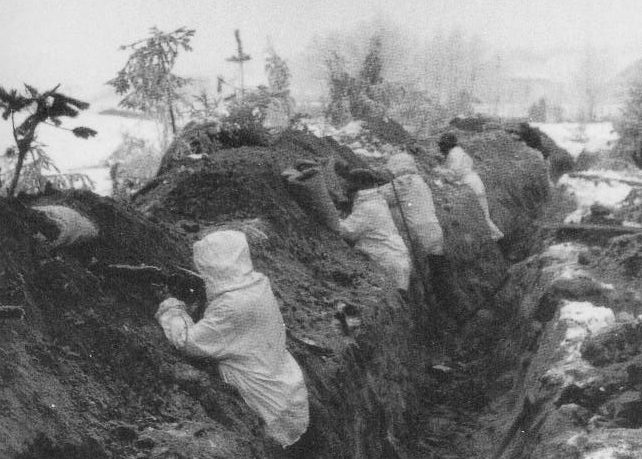
The invasion was expected in Moscow to be a parade. The Red Army crossed the border along a frontier more than a thousand kilometres long, and bombers struck Helsinki the first day, killing scores of civilians — and hardening, as the Finns noted, exactly the resistance the bombs were meant to soften. A puppet 'Finnish Democratic Republic' was proclaimed in the first captured border town, a government for a country the USSR expected to absorb. Instead the invasion stalled everywhere. On the Karelian Isthmus the Finnish Mannerheim Line — field fortifications derided in Soviet planning — held the main assault for weeks; in the forests further north, Finnish ski troops in white camouflage cut the road-bound Soviet columns into isolated pockets, motti, and destroyed them piece by piece in temperatures below minus thirty.
The disparity of loss became a world sensation. Tiny Finland, in the phrase of the time, was David against Goliath; volunteers, aid and sympathy flowed in, though the Allied expeditionary force debated in London and Paris never arrived. The Red Army, humiliated, reorganised under Timoshenko, massed overwhelming artillery, and in February 1940 finally ground through the Mannerheim Line by weight of numbers. Finland, its reserves exhausted, sought terms. The Moscow Peace Treaty, signed on 12 March 1940 after 105 days of war, took about a tenth of Finland's territory, including its second city, Viipuri, and displaced some 400,000 Karelians — but it left Finland independent and unoccupied, a fate no other state on the Soviet Union's western border escaped.
The Winter War's consequences ran far beyond Finland. The Red Army's early incompetence — the product of Stalin's purges of its officer corps — was noted in Berlin, and fed the German calculation that the Soviet Union could be quickly beaten in 1941; the lessons the Red Army drew and applied contributed to proving that calculation catastrophically wrong. Finland, meanwhile, fought the USSR again alongside Germany in the Continuation War of 1941–44, then held its independence through the Cold War by a careful neutrality the world learned to call Finlandisation. The war that began on 30 November remains the foundation story of modern Finland: proof, bought dearly, that a small state could refuse an empire and survive.
Why this date matters
November 30 is a day of small parties standing up to large ones. Finland faces the Soviet Union; Scotland and England meet as equals in the first football international; Tuscany abolishes the scaffold while empires still used it; and two of the English language's great talkers, Swift and Twain, share the date with the century's great war leader, Churchill — born, like Twain, on a day when words were the weapon. Even its newest entry fits the pattern: a small research laboratory's chatbot, released on this date in 2022, unsettling industries many times its size. The last day of November rewards the underestimated.
Sources
- Encyclopaedia Britannica — On This Day: November 30
- HISTORY — What Happened on November 30
- Encyclopaedia Britannica — Finnish-Russian War (Winter War)
- Encyclopaedia Britannica — Barbados independence (topic coverage)
The facts on this page were checked against these sources on 19 November 2026. The History Trail's permanent pages are researched and written for this site; the live profiles elsewhere on The History Trail are assembled automatically from Wikipedia and Wikidata.
About the Author
Researched and written by the The History Trail Editorial Team — the accountable editorial function behind this site's permanent story pages. The team works from the published sources cited on each page; it does not invent historians, reviewers or credentials, and it corrects errors openly.
Fact Check
Every load-bearing fact on this page traces to one of the sources listed above, and significant claims link to their source in the text. Our checking method is described on the methodology page; errors can be reported via the corrections page.
Sources & Citations
Cite this page as: The History Trail Editorial Team, The History Trail — this article's title, publication and update dates are shown beneath its headline. The full source list appears under Sources above; the site's source standards are on the sources page.