
On This Day
November 26 in History
On 26 November 1922, in Egypt's Valley of the Kings, the archaeologist Howard Carter made a small hole in a sealed doorway, held up a candle, and, as the hot air made the flame flicker, saw everywhere 'the glint of gold'. Asked by his patron Lord Carnarvon whether he could see anything, he answered: 'Yes, wonderful things.' It was the first sight of the only pharaoh's tomb ever found substantially intact. November 26 is also the day Casablanca premiered in 1942, India adopted its constitution in 1949, and Charles Schulz was born in 1922.
Choose another date: open the On This Day calendar to browse events, births and deaths for any day of the year.
At a Glance
- The search
- Carter had excavated in the Valley of the Kings since 1917 for Lord Carnarvon, with little to show; 1922 was to be the last funded season
- The steps
- A water boy found a step on 4 November 1922; a stairway led down to a sealed door bearing Tutankhamun's name
- The first look
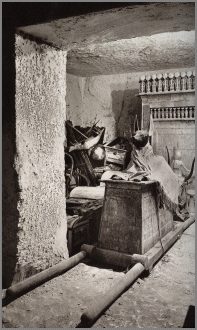
- On 26 November Carter breached the second sealed doorway and saw the antechamber, packed with gilded furniture, chariots and statues
- The king
- Tutankhamun, a boy pharaoh of the 18th Dynasty who died at about 19, more than 3,200 years earlier
- The clearance
- Cataloguing the tomb's thousands of objects took Carter's team ten years of meticulous work
- The legacy
- The discovery made Tutankhamun the world's most famous pharaoh and set the standard for scientific excavation recording
Events on this day
- 1789The first national Thanksgiving Day is observed in the United States, on the day proclaimed by President George Washington.
- 1863President Abraham Lincoln's proclamation makes Thanksgiving an annual national observance, fixed on the last Thursday of November.
- 1917The National Hockey League is founded in Montreal, Canada, with five charter teams.
- 1922Howard Carter first looks inside the tomb of Tutankhamun — the featured story above.
- 1924The Mongolian People's Republic is proclaimed, the world's second communist state, after the defeat of White Russian and Chinese forces.
- 1942The film Casablanca, starring Humphrey Bogart and Ingrid Bergman, premieres in New York City.
- 1948The first Polaroid Land camera, the Model 95, goes on sale in a Boston department store, selling out the first day.
- 1949India's Constituent Assembly adopts the constitution of the Republic of India, which comes into force the following January.
- 1965France launches its first satellite, Astérix, becoming the third country to put a satellite in orbit on its own rocket.
- 1966The world's first large tidal power station opens at La Rance in Brittany, France.
- 1983In the Brink's-Mat robbery, an estimated £26 million in gold bullion is stolen from a warehouse near London's Heathrow Airport; most of the gold is never recovered.
- 2003Concorde makes its final flight, to a museum at Filton, Bristol, retiring the world's only successful supersonic airliner.
- 2008Ten gunmen of the Pakistan-based group Lashkar-e-Taiba begin coordinated attacks across Mumbai, India; 166 people are killed over three days, by the commonly cited toll.
Born on this day
- 1731William Cowper — English poet and hymn writer, author of The Task and the hymn 'God moves in a mysterious way'.
- 1837John Newlands — English chemist whose law of octaves was an early step toward the periodic table of elements.
- 1894Norbert Wiener — American mathematician who founded cybernetics, the study of control and communication.
- 1911Samuel Reshevsky — Polish-born American chess prodigy and grandmaster, a leading player for half a century.
- 1922Charles Schulz — American cartoonist who created Peanuts, Charlie Brown and Snoopy.
- 1939Tina Turner — American singer, born Anna Mae Bullock in Tennessee, who became one of rock's defining performers.
Died on this day
- 1504Isabella I — queen of Castile, who with Ferdinand of Aragon united Spain and sponsored Columbus's first voyage.
- 1883Sojourner Truth — American abolitionist and women's rights campaigner, born into slavery, famed for her speech 'Ain't I a Woman?'.
- 1956Tommy Dorsey — American big-band trombonist and bandleader, dead at 51.
- 2018Stephen Hillenburg — American animator who created SpongeBob SquarePants, dead at 57.
The featured story: Carter looks into Tutankhamun's tomb, 26 November 1922
The Valley of the Kings had been picked over for a century, and by 1922 the consensus was that it was exhausted. Howard Carter, who had spent five fruitless seasons digging for his patron, the Earl of Carnarvon, persuaded him to fund one last campaign before giving up the concession. On 4 November 1922, workmen clearing rubble at the foot of the tomb of Ramesses VI uncovered a step cut into the rock. By the next afternoon a flight of sixteen steps led to a sealed doorway stamped with royal seals — and, among them, the name of Tutankhamun, a minor boy-king whose tomb had never been found. Carter reburied the staircase and telegraphed Carnarvon in England: 'At last have made wonderful discovery in Valley.'
Carnarvon arrived on 23 November, and the staircase was cleared again. Beyond the first doorway lay a rubble-filled corridor, and at its end, on the afternoon of 26 November, a second sealed door. Carter made a small breach in its upper corner, inserted an iron rod — nothing struck back — then widened the hole, lit a candle to test the air, and peered in. As his eyes adjusted he saw a room crammed with objects: gilded couches in the shapes of animals, statues, chariots dismantled and stacked, boxes, vases, and everywhere gold. Behind the far wall, guarded by two life-size statues, lay another sealed door — the burial chamber, still untouched.
The discovery was, and remains, unique: the only royal Egyptian tomb to survive into the modern age with its contents substantially whole, robbed in antiquity but resealed and then forgotten under workmen's huts. What followed set Carter apart as much as the finding. Refusing to rush, he spent a decade clearing the four small rooms object by object — more than five thousand items, each photographed in place by Harry Burton, drawn, recorded and conserved before removal. The burial chamber, opened in February 1923, held nested golden shrines, a quartzite sarcophagus and the king's mummified body, its head covered by the gold mask that has become the most recognisable artefact of the ancient world.
The Tutankhamun excavation made archaeology a mass spectacle — newspapers bought exclusive rights, tourists besieged the Valley, and Carnarvon's sudden death in April 1923, from an infected shaving cut, launched the legend of the pharaohs' curse. Its scholarly legacy is quieter and larger: Carter's records, now at Oxford's Griffith Institute, remain a model of excavation method, and the tomb's contents, displayed complete in Cairo, taught the world to see ancient Egypt not through monuments alone but through the furnished rooms of a single, short life. The last funded season had been the right one.
Why this date matters
November 26 is a day of doors opening. Carter opens a sealed one into the ancient world; Casablanca opens in New York and teaches cinema its most quoted farewell; India adopts the constitution that opens its republic; France opens a satellite programme and a tidal power station; and in America the day itself is an opening — the first national Thanksgiving, later made annual by Lincoln on this date. Against them stand the day's closures: a supersonic airliner's last flight in 2003 and the Mumbai attacks of 2008. But the date's centre of gravity is a candle flame flickering in escaping air, and gold answering it.
Sources
- Encyclopaedia Britannica — On This Day: November 26
- HISTORY — What Happened on November 26
- Encyclopaedia Britannica — Tutankhamun
- Griffith Institute, University of Oxford — Tutankhamun: Anatomy of an Excavation
The facts on this page were checked against these sources on 19 November 2026. The History Trail's permanent pages are researched and written for this site; the live profiles elsewhere on The History Trail are assembled automatically from Wikipedia and Wikidata.
About the Author
Researched and written by the The History Trail Editorial Team — the accountable editorial function behind this site's permanent story pages. The team works from the published sources cited on each page; it does not invent historians, reviewers or credentials, and it corrects errors openly.
Fact Check
Every load-bearing fact on this page traces to one of the sources listed above, and significant claims link to their source in the text. Our checking method is described on the methodology page; errors can be reported via the corrections page.
Sources & Citations
Cite this page as: The History Trail Editorial Team, The History Trail — this article's title, publication and update dates are shown beneath its headline. The full source list appears under Sources above; the site's source standards are on the sources page.