
On This Day
May 31 in History
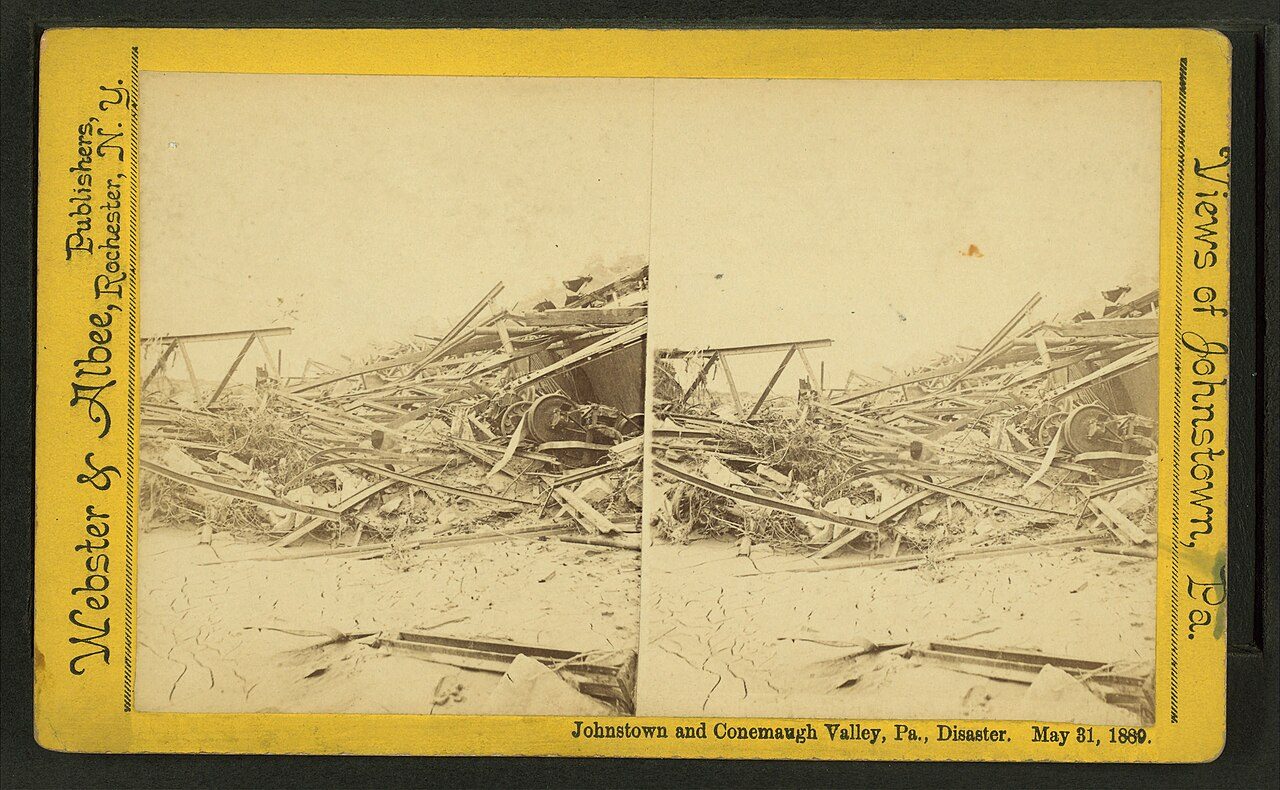
May 31 is the day the water came to Johnstown. On this day in 1889, after days of heavy rain, the neglected South Fork Dam above Johnstown, Pennsylvania, gave way, and a lake poured down the valley into the industrial town, killing 2,208 people in one of the worst disasters in American history. The relief effort that followed was the young American Red Cross's first major operation. The date also saw the end of the Boer War in 1902, the start of the Battle of Jutland in 1916 and the beginning of the Tulsa race massacre in 1921.
Choose another date: open the On This Day calendar to browse events, births and deaths for any day of the year.
At a Glance
- Date
- 31 May 1889
- Location
- Johnstown, Pennsylvania
- Cause
- Failure of the South Fork Dam after days of heavy rain
- Water released
- About 14.55 million cubic metres
- Deaths
- 2,208 by the official count
- Damage
- About $17 million
- Relief landmark
- The American Red Cross's first major disaster relief operation
Events on this day
- 1578Martin Frobisher sails from England with 15 ships and 400 men for the Canadian Arctic, chasing gold and a route to Asia; his cargo of ore proves to be fool's gold.
- 1859The great bell Big Ben is installed in the clock tower above the Houses of Parliament in London.
- 1873Heinrich Schliemann announces his discovery of a hoard of ancient treasure at Troy, which he calls the treasure of King Priam.
- 1889The South Fork Dam fails above Johnstown, Pennsylvania, and the flood kills more than 2,200 people — the featured story above.
- 1902The Treaty of Vereeniging, signed in Pretoria, ends the Boer War between Britain and the Boer republics.
- 1910The Union of South Africa is established, uniting the British colonies of the Cape, Natal, Transvaal and Orange River.
- 1916The Battle of Jutland, the largest naval battle of the First World War, begins between the British and German fleets.
- 1921The Tulsa race massacre begins in Oklahoma; white mobs destroy the prosperous Black neighbourhood of Greenwood, killing as many as 300 people.
- 1961The Republic of South Africa comes into being, withdrawing from the Commonwealth.
- 1970A massive earthquake strikes Ancash in Peru, killing more than 66,000 people in quake and landslides.
- 2005Former FBI official W. Mark Felt is revealed as 'Deep Throat', the Watergate source, ending thirty years of speculation.
Born on this day
- 1819Walt Whitman — American poet whose Leaves of Grass remade American verse in the voice of democracy
- 1852Francisco Moreno — Argentine explorer and scientist who surveyed Patagonia and founded the La Plata Museum
- 1930Clint Eastwood — American actor and Oscar-winning director, born in San Francisco
- 1943Joe Namath — American football quarterback who guaranteed and delivered the Jets' victory in Super Bowl III
Died on this day
- 1594Tintoretto — Venetian Renaissance painter noted for the dramatic energy and lighting of works such as The Last Supper.
- 1809Joseph Haydn — Austrian composer, father of the symphony and the string quartet, who died in Vienna aged 77 as Napoleon's army bombarded the city
- 1962Adolf Eichmann — Nazi SS officer who organised the deportation of Europe's Jews, hanged in Israel after trial in Jerusalem
The featured story: The day the dam broke, 31 May 1889
Fourteen miles up the Little Conemaugh River from the steel town of Johnstown stood the South Fork Dam, an earthen wall holding back a reservoir two miles long. The lake belonged to the South Fork Fishing and Hunting Club, a private retreat whose members were among the richest industrialists in Pittsburgh. The club had altered the dam, lowering its crest and partly blocking its spillway, and maintenance had been neglected for years. Johnstown's people, living in the narrow valley below, had worried aloud about the dam for a decade, and were always assured it was safe.
The spring of 1889 was one of the wettest in memory, and on 30 and 31 May rain fell in torrents across the hills. The reservoir rose to the crest and beyond. Engineers at the dam watched the water top the wall and sent a warning rider down the valley, but Johnstown had heard false alarms before, and the message arrived as rumour rather than command. In the middle of the afternoon of 31 May the dam simply dissolved. Some 14.55 million cubic metres of water were released at once, and the lake emptied down the valley in under an hour, gathering trees, houses, locomotives and barbed wire into a moving wall of debris.
The flood struck Johnstown at about forty miles an hour. Whole streets were scoured to the bedrock. The wreckage piled against the stone arches of the Pennsylvania Railroad bridge, forming a jam thirty feet high, which then caught fire and burned for days, killing survivors trapped within it. When the waters fell, the official count put the dead at 2,208, with damage estimated at $17 million. It was the deadliest flood in American history, and the nation followed every detail in the newspapers.
Help arrived in a new form. Clara Barton, then in her late sixties, brought fifty volunteers of the young American Red Cross to Johnstown and stayed for months, in what became the organisation's first major disaster relief operation and the template for its work ever since. Survivors sued the fishing club, but the courts treated the disaster as an act of God and no damages were ever recovered from the wealthy members. The site of the dam is preserved today by the Johnstown Flood National Memorial, established in 1964.
Why this date matters
May 31 is a date of pressure finding its release. A dam bursts over Johnstown; fleets collide at Jutland; a mob destroys Greenwood; an empire's general sails home with fool's gold believing it treasure. Again and again the date shows stored-up forces, water, gunpowder, racial hatred, imperial ambition, breaking their banks at once. Yet it also holds the quieter arts of endurance: Whitman born to sing a young democracy, Haydn dying composedly in a besieged city, and Clara Barton's volunteers proving that organised mercy could answer organised catastrophe. May 31 is the month's reckoning, the day the bill for neglect and violence comes due.
Sources
- Encyclopaedia Britannica — On This Day: May 31
- HISTORY — This Day in History: May 31
- Encyclopaedia Britannica — Joseph Haydn
- The Writer's Almanac — May 31
- Wikimedia Commons — Pile of twisted metal after the flood, Johnstown file page

The facts on this page were checked against these sources on 19 November 2026. The History Trail's permanent pages are researched and written for this site; the live profiles elsewhere on The History Trail are assembled automatically from Wikipedia and Wikidata.
About the Author
Researched and written by the The History Trail Editorial Team — the accountable editorial function behind this site's permanent story pages. The team works from the published sources cited on each page; it does not invent historians, reviewers or credentials, and it corrects errors openly.
Fact Check
Every load-bearing fact on this page traces to one of the sources listed above, and significant claims link to their source in the text. Our checking method is described on the methodology page; errors can be reported via the corrections page.
Sources & Citations
Cite this page as: The History Trail Editorial Team, The History Trail — this article's title, publication and update dates are shown beneath its headline. The full source list appears under Sources above; the site's source standards are on the sources page.