
On This Day
June 23 in History
On 23 June 1972, with one signature, Title IX became law in the United States: 37 words banning sex discrimination in any education programme receiving federal money. It transformed classrooms first and playing fields soon after. June 23 is also the day the typewriter was patented, Bannockburn began, and Britain voted for Brexit.
Choose another date: open the On This Day calendar to browse events, births and deaths for any day of the year.
At a Glance
- The law
- Title IX of the Education Amendments of 1972, signed by President Richard Nixon on 23 June 1972
- The sentence
- 37 words barring exclusion or discrimination on the basis of sex in federally funded education
- The architects
- Representatives Edith Green and Patsy Mink in the House, Senator Birch Bayh in the Senate
- The model
- Title VI of the Civil Rights Act of 1964, with sex in place of race
- The sporting effect
- Girls in US high-school sport rose from about 300,000 in 1972 to more than three million within a generation
- The honour
- Renamed the Patsy Takemoto Mink Equal Opportunity in Education Act in 2002, weeks after Mink's death
Events on this day
- 1314The Battle of Bannockburn begins in Scotland; over two days Robert the Bruce's army defeats a much larger English force.
- 1865Stand Watie, a Cherokee chief and Confederate brigadier, becomes the last Confederate general to surrender in the Civil War.
- 1868Christopher Latham Sholes, Samuel Soule and Carlos Glidden receive a patent for their typewriter, the machine that brings the QWERTY keyboard into the world.
- 1956Gamal Abdel Nasser is elected president of Egypt, the sole candidate, with a reported 99.95 percent of the vote.
- 1972Title IX of the Education Amendments is signed into law, banning sex discrimination in federally funded education — the featured story above.
- 1972On tape at the White House, Nixon agrees to use the CIA to block the FBI's Watergate investigation — the 'smoking gun' conversation that ends his presidency two years later.
- 1989Tim Burton's Batman opens in American cinemas, launching the modern era of the superhero blockbuster.
- 1992The mob boss John Gotti, the 'Teflon Don', is sentenced to life in prison in New York.
- 2013Nik Wallenda walks a high wire across the Little Colorado River Gorge near the Grand Canyon, without a harness.
- 2016British voters choose in a referendum to leave the European Union, by 52 to 48 percent.
- 2018A Thai youth football team, the Wild Boars, and their coach are trapped by floodwater inside the Tham Luang cave.
Born on this day
- 1894Edward, Duke of Windsor — king of the United Kingdom as Edward VIII for eleven months of 1936, before his abdication.
- 1912Alan Turing — English mathematician who formalised computing, led the Enigma codebreaking effort at Bletchley Park and devised the Turing test.
- 1940Wilma Rudolph — American sprinter who overcame childhood polio to win three gold medals at the 1960 Rome Olympics.
- 1948Clarence Thomas — associate justice of the United States Supreme Court from 1991.
Died on this day
- 1823John Philip Kemble — English actor-manager, the leading tragedian of the London stage in his generation.
- 2006Aaron Spelling — American television producer of Charlie's Angels, Dynasty and Beverly Hills, 90210, among the most successful in TV history.
- 2009Ed McMahon — American broadcaster, Johnny Carson's announcer and sidekick on The Tonight Show for three decades.
- 2011Peter Falk — American actor, the rumpled detective of Columbo, dead at 83.
The featured story: Title IX becomes law, 23 June 1972
On 23 June 1972 President Richard Nixon signed the Education Amendments of 1972, and one short passage inside them — Title IX — quietly rewrote American education. Its operative sentence is 37 words long: no person in the United States shall, on the basis of sex, be excluded from participation in, be denied the benefits of, or be subjected to discrimination under any education programme or activity receiving federal financial assistance. As HISTORY summarises it, Title IX prohibits federally funded educational institutions from discriminating against students or employees based on sex. Almost every school and university in the country took federal money, so almost every one of them was covered.
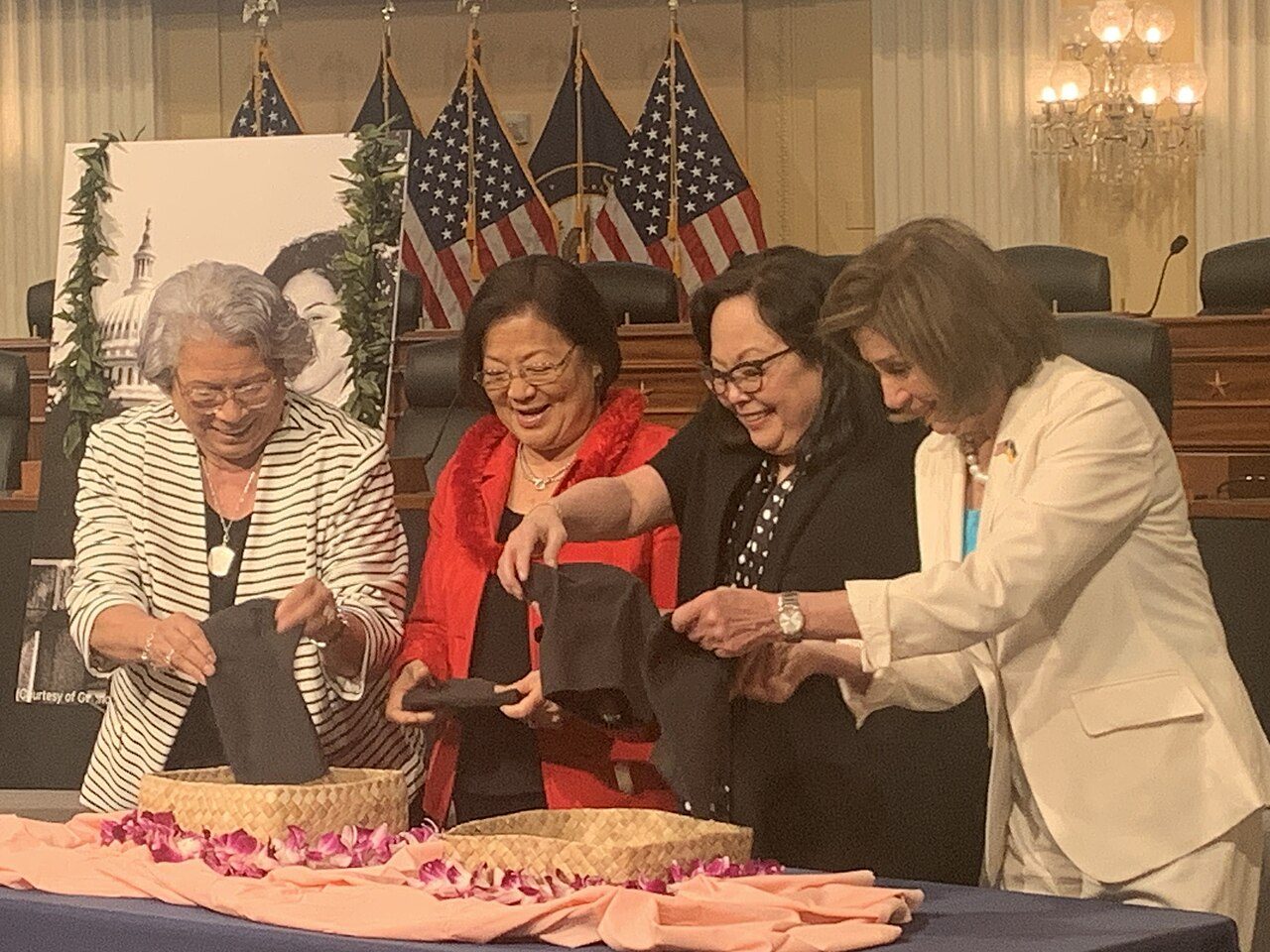
The law had been built in Congress over two years. Representative Edith Green of Oregon held hearings in 1970 that documented, in detail, how women were excluded from programmes, paid less as faculty and steered away from whole fields of study. Representative Patsy Mink of Hawaii — the first woman of colour elected to Congress, who had herself been rejected by medical schools because she was a woman — carried the cause in the House, working with Senator Birch Bayh in the Senate. The final wording was modelled on the Civil Rights Act of 1964, with sex in place of race. Notably, the sentence said nothing about sport. Nobody on the floor that June described what it would do to playing fields, because nobody yet knew.
Sport is where the law became visible. In 1972 roughly 300,000 American girls played high-school sports and fewer than 30,000 women competed at college level, on a sliver of athletic budgets; within a generation, girls' high-school participation had passed three million and women's college sport had become a mass institution, producing the generations that filled Olympic teams and World Cup squads. The implementing regulations of 1975, and the three-part test that followed, required schools to offer opportunities proportionate to their students. The law's reach proved wider than athletics: it was applied to admissions, scholarships, hiring, and later to schools' handling of sexual harassment and assault, making it a general charter of equal treatment in education rather than a sports rule.
Title IX was contested from the start and remains so — over how opportunities are counted, over the balance between men's and women's programmes, and over its application to harassment cases and, more recently, to transgender athletes. Its central figure received her due late: Mink died in September 2002, and within weeks Congress renamed the law the Patsy Takemoto Mink Equal Opportunity in Education Act, by a vote of 410 to nothing. Half a century after a signing ceremony that barely mentioned it, the 37 words of 23 June 1972 stand among the most consequential sentences in American statute law.
Why this date matters
June 23 is a day on which small mechanisms changed large worlds. A patent for a typewriter in 1868 fixed the keyboard layout still under every typist's fingers; 37 words in an education bill in 1972 rearranged who got to study, teach and play across a continent; a referendum in 2016 set Britain on the road out of the European Union. Its battles bookend the pattern — Bannockburn, where a small nation beat a larger army, and Stand Watie's surrender, the last of a lost cause. Again and again the date rewards the underestimated instrument: the sentence, the patent, the single vote.
Sources
- Encyclopaedia Britannica — On This Day: June 23
- HISTORY — What Happened on June 23
- HISTORY — Title IX enacted
- Encyclopaedia Britannica — Typewriter
The facts on this page were checked against these sources on 19 November 2026. The History Trail's permanent pages are researched and written for this site; the live profiles elsewhere on The History Trail are assembled automatically from Wikipedia and Wikidata.
About the Author
Researched and written by the The History Trail Editorial Team — the accountable editorial function behind this site's permanent story pages. The team works from the published sources cited on each page; it does not invent historians, reviewers or credentials, and it corrects errors openly.
Fact Check
Every load-bearing fact on this page traces to one of the sources listed above, and significant claims link to their source in the text. Our checking method is described on the methodology page; errors can be reported via the corrections page.
Sources & Citations
Cite this page as: The History Trail Editorial Team, The History Trail — this article's title, publication and update dates are shown beneath its headline. The full source list appears under Sources above; the site's source standards are on the sources page.