
On This Day
June 21 in History
On 21 June 1788 New Hampshire voted to ratify the United States Constitution — the ninth state to do so, and therefore the vote that turned a drafted plan into a working government. June 21 is also the day the first Ferris wheel opened in Chicago, Spain entered the American war, and SpaceShipOne made the first private spaceflight.
Choose another date: open the On This Day calendar to browse events, births and deaths for any day of the year.
At a Glance
- The threshold
- Article VII required ratification by 9 of the 13 states to establish the Constitution
- The ninth state
- New Hampshire, approving 57 votes to 47 on 21 June 1788 after an earlier adjournment
- The first state
- Delaware, which ratified unanimously on 7 December 1787
- The hardest fights
- Virginia ratified 89–79 and New York 30–27, both after New Hampshire had decided the question
- The price of support
- Promised amendments became the Bill of Rights, ratified in 1791
- The last holdouts
- North Carolina ratified in November 1789 and Rhode Island in May 1790
Events on this day
- 1779Spain declares war on Great Britain, bringing Spanish power into the American Revolutionary War on the American side in all but name.
- 1788New Hampshire becomes the ninth state to ratify the United States Constitution, the vote that brings it into force — the featured story above.
- 1813At the Battle of Vitoria, Wellington's allied army routs the French in Spain, the decisive battle of the Peninsular War.
- 1834Cyrus McCormick is granted a patent for his mechanical reaper, the machine that transformed grain harvesting.
- 1893The first Ferris wheel opens to the public at the World's Columbian Exposition in Chicago, carrying up to 2,160 passengers at a time.
- 1913Tiny Broadwick becomes the first woman to parachute from an aeroplane, jumping over Los Angeles.
- 1942Rommel's Afrika Korps captures Tobruk in Libya, taking the port and tens of thousands of Allied prisoners.
- 1963Cardinal Giovanni Battista Montini is elected pope, taking the name Paul VI.
- 1964Civil rights workers James Chaney, Andrew Goodman and Michael Schwerner are murdered by the Ku Klux Klan in Mississippi.
- 1982John Hinckley Jr., who shot President Ronald Reagan, is found not guilty by reason of insanity.
- 1990An earthquake near the Caspian Sea in Iran kills an estimated 50,000 people and injures many more.
- 2004SpaceShipOne makes the first privately funded human spaceflight, reaching the edge of space above California.
Born on this day
- 1839Machado de Assis — Brazilian novelist, author of Dom Casmurro and the founder of the Brazilian Academy of Letters.
- 1905Jean-Paul Sartre — French philosopher and writer, the leading voice of existentialism, who declined the Nobel Prize in Literature.
- 1919Paolo Soleri — Italian-born American architect, builder of the experimental desert town of Arcosanti.
- 1953Benazir Bhutto — Pakistani politician who in 1988 became the first woman to lead a Muslim-majority country in modern times.
- 1955Michel Platini — French footballer, three-time European Footballer of the Year and later president of UEFA.
- 1982Prince William — elder son of King Charles III and Diana, Princess of Wales, and heir to the British throne.
Died on this day
- 1527Niccolo Machiavelli — Florentine diplomat and author of The Prince, the founding text of modern political realism.
- 1876Antonio Lopez de Santa Anna — Mexican general and repeated president, the strongman of Mexico's early republic, dead in Mexico City.
- 223Liu Bei — warlord who founded the Shu Han kingdom in China's Three Kingdoms period.
The featured story: the United States Constitution is ratified, 21 June 1788
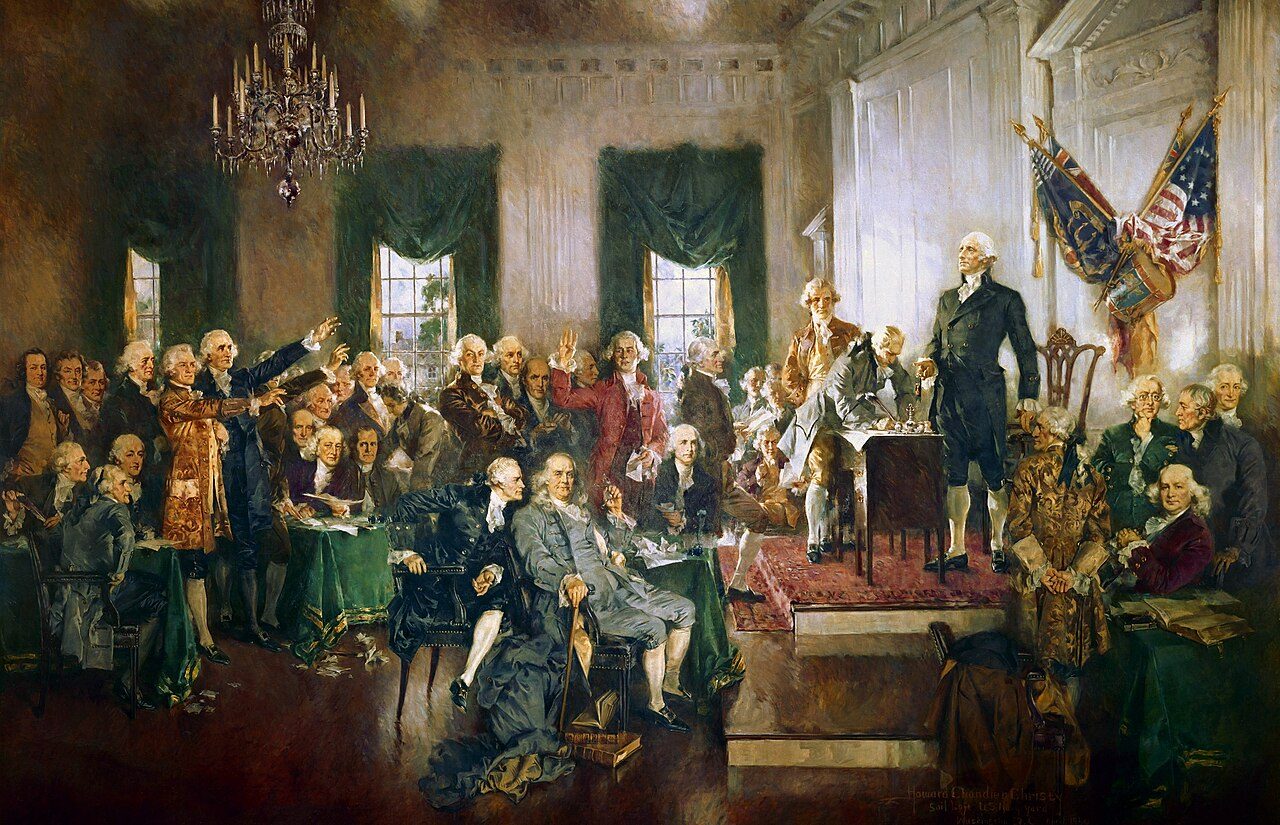
On 21 June 1788 New Hampshire became the ninth state to ratify the United States Constitution, and with that vote the document crossed the threshold its own Article VII had set: approval by nine of the thirteen states was enough to establish it. A plan drafted in Philadelphia the previous summer, in a convention that had been called only to revise the Articles of Confederation, was now to become the frame of a new federal government. The United States had spent the war and the years since as a loose confederation in which Congress could ask the states for money but not compel them; the Constitution replaced that arrangement with a government that could tax, regulate commerce and act directly on citizens.
Ratification had never been a formality. Delaware ratified first, unanimously, in December 1787, and Pennsylvania, New Jersey, Georgia and Connecticut followed quickly. Then the argument hardened. Opponents — the Anti-Federalists — charged that the Constitution created a distant, powerful government with no bill of rights, and in the big, decisive states the outcome was genuinely in doubt. Massachusetts ratified in February 1788 only after Federalists promised to support amendments, a bargain that supplied the model for what followed. Through the spring the tally climbed: Maryland in April, South Carolina in May. Everything then turned on Virginia and New York, the largest states, without which the new Union would be geographically broken.
New Hampshire's convention supplied the ninth vote before either giant had decided. Its delegates had adjourned once already, in February, when ratification looked likely to fail; recalled in June, they approved the Constitution by 57 votes to 47, with instructions to recommend amendments, including what became the Bill of Rights. The news reached Virginia's convention, still debating in Richmond, and stiffened the Federalists there: the Union would now exist with or without Virginia. Four days later Virginia ratified, 89 to 79, with Patrick Henry leading the losing side. New York followed in July by the narrowest of margins, 30 to 27, after the newspaper essays later collected as The Federalist Papers had argued the Constitution's case in public.
The Confederation Congress set the machinery in motion that autumn: elections were called, and the new government was to meet in New York in March 1789. George Washington, who had presided over the Philadelphia convention, was the unanimous choice of the electoral college for president. North Carolina held out until November 1789 and Rhode Island until May 1790, joining a Union already up and running. The document they completed remains the oldest written national constitution still in force, amended 27 times — the first ten amendments, the Bill of Rights ratified in 1791, being the direct price of the arguments lost and won in the summer of 1788.
Why this date matters
June 21 is the summer solstice in the northern hemisphere, the longest day, and its history has a habit of turning on thresholds crossed in public: a constitution becoming law on a ninth state's vote, a giant wheel turning for the first time over Chicago, a woman stepping out of an aeroplane with a parachute in 1913 and a private spaceship crossing into space in 2004. Against those firsts stand the day's warnings — Tobruk's fall, an earthquake that killed tens of thousands, and three young civil rights workers murdered in Mississippi in 1964 for registering voters. It is a date about who gets to belong to a political community, and at what price.
Sources
- Encyclopaedia Britannica — On This Day: June 21
- HISTORY — What Happened on June 21
- Encyclopaedia Britannica — Constitution of the United States of America
- National Archives — The Constitution of the United States
The facts on this page were checked against these sources on 19 November 2026. The History Trail's permanent pages are researched and written for this site; the live profiles elsewhere on The History Trail are assembled automatically from Wikipedia and Wikidata.
About the Author
Researched and written by the The History Trail Editorial Team — the accountable editorial function behind this site's permanent story pages. The team works from the published sources cited on each page; it does not invent historians, reviewers or credentials, and it corrects errors openly.
Fact Check
Every load-bearing fact on this page traces to one of the sources listed above, and significant claims link to their source in the text. Our checking method is described on the methodology page; errors can be reported via the corrections page.
Sources & Citations
Cite this page as: The History Trail Editorial Team, The History Trail — this article's title, publication and update dates are shown beneath its headline. The full source list appears under Sources above; the site's source standards are on the sources page.