
On This Day
June 12 in History
On 12 June 1964 Nelson Mandela and seven fellow defendants were sentenced to life imprisonment at the end of South Africa's Rivonia Trial — the sentence that made him the world's most famous prisoner and, in time, his country's first democratic president. June 12 is also the day of Loving v. Virginia, Reagan's 'tear down this wall' speech, and Anne Frank's birthday.
Choose another date: open the On This Day calendar to browse events, births and deaths for any day of the year.
At a Glance
- The trial
- The Rivonia Trial, Pretoria, 1963–64, named for the Johannesburg suburb where the underground leadership was arrested
- The verdict
- Mandela and seven others convicted of sabotage and conspiracy on 11 June 1964; one defendant, Lionel Bernstein, was acquitted
- The sentence
- Life imprisonment for all eight, handed down on 12 June 1964 — the death penalty had been widely expected
- The speech
- Mandela's statement from the dock on 20 April 1964 ended: an ideal 'for which I am prepared to die'
- The prison
- Robben Island, where Mandela spent 18 of his 27 years behind bars
- The reversal
- Released 11 February 1990; elected president of South Africa in April 1994
Events on this day
- 1776Virginia adopts its Declaration of Rights, drafted by George Mason — a model for the American Bill of Rights.
- 1898Emilio Aguinaldo proclaims the independence of the Philippines from Spain, during the Spanish-American War.
- 1942Anne Frank receives a diary for her 13th birthday in Amsterdam; she begins writing in it two days later.
- 1963Medgar Evers, the NAACP's Mississippi field secretary, is shot dead in his own driveway in Jackson by a white supremacist.
- 1964Nelson Mandela and seven others are sentenced to life imprisonment at the end of the Rivonia Trial — the featured story above.
- 1967In Loving v. Virginia, the US Supreme Court unanimously strikes down state laws banning interracial marriage.
- 1979Bryan Allen pedals the Gossamer Albatross across the English Channel, the first human-powered flight to cross it.
- 1981Raiders of the Lost Ark, Steven Spielberg and George Lucas's adventure film, opens in cinemas.
- 1987Standing at the Brandenburg Gate in Berlin, President Ronald Reagan challenges Mikhail Gorbachev: 'Mr. Gorbachev, tear down this wall.'
- 1991Boris Yeltsin is elected president of the Russian republic, the first democratically chosen leader in Russia's history.
- 2016A gunman murders 49 people at the Pulse nightclub in Orlando, Florida, then the deadliest mass shooting in US history.
Born on this day
- 1827Johanna Spyri — Swiss author of Heidi, the children's novel that made the Alps famous worldwide.
- 1915David Rockefeller — American banker who ran Chase Manhattan and the last surviving grandson of John D. Rockefeller.
- 1924George H. W. Bush — 41st president of the United States, who presided over the end of the Cold War.
- 1929Anne Frank — German-born Jewish diarist whose account of hiding from the Nazis became a classic of war literature.
- 1941Chick Corea — American jazz pianist and composer, a pioneer of jazz fusion.
- 1974Hideki Matsui — Japanese baseball star who became a World Series MVP with the New York Yankees.
Died on this day
- 1912Frederic Passy — French economist and first joint winner, in 1901, of the Nobel Peace Prize.
- 1997Bulat Okudzhava — Russian poet and singer-songwriter, the bard of the Soviet thaw generation.
- 1963Medgar Evers — American civil rights leader assassinated in Jackson, Mississippi, at 37; his killer was not finally convicted until 1994.
- 2003Gregory Peck — American actor, Oscar winner as Atticus Finch in To Kill a Mockingbird, dead at 87.
- 2023Silvio Berlusconi — Italian media magnate and three-time prime minister, dead at 86.
The featured story: Nelson Mandela is sentenced to life, 12 June 1964
On 12 June 1964, in the Palace of Justice in Pretoria, Nelson Mandela and seven fellow defendants in the Rivonia Trial were sentenced to life imprisonment. They had been convicted the day before of sabotage and conspiracy to overthrow South Africa's apartheid state, charges that carried a possible death sentence. Judge Quartus de Wet, who had earlier acquitted one defendant outright, chose life instead — a decision that spared the men and, in the long run, preserved the leadership that would one day govern the country.
The trial had grown out of a police raid on Liliesleaf Farm in the Johannesburg suburb of Rivonia in July 1963, where the underground leadership of Umkhonto we Sizwe, the armed wing Mandela had co-founded, was arrested almost entire. Mandela himself was already in prison, serving a five-year sentence, and was brought to join them. Over nine months the accused turned the dock into a platform. Mandela's statement from it on 20 April 1964 — closing with the declaration that a democratic and free society was an ideal 'for which I am prepared to die' — became one of the century's defining speeches.
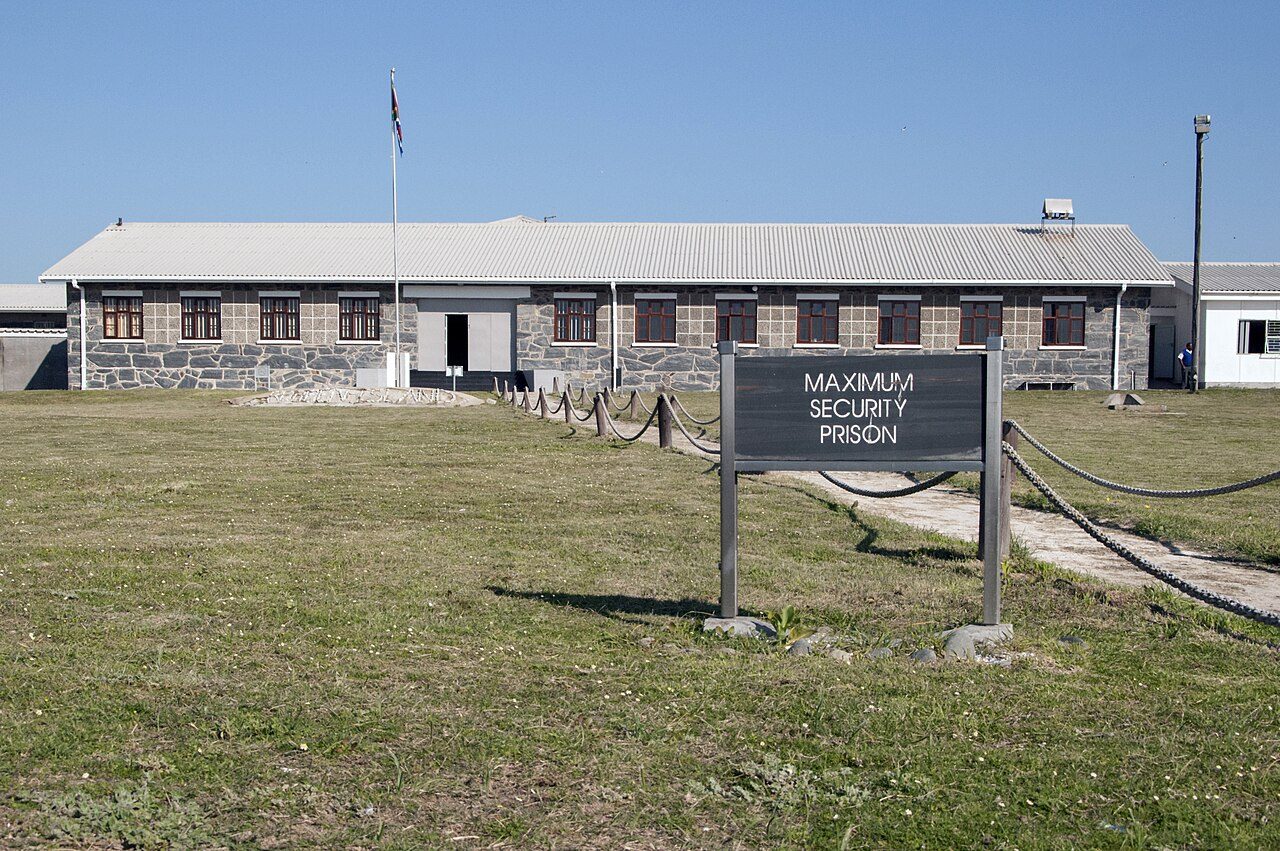
The eight men were flown to Robben Island, the maximum-security prison in Table Bay, where they were held in single cells in a separate section, put to breaking stones and quarrying lime, and denied almost all contact with the outside world. The government intended them to be forgotten. Instead, as the years passed, the island became a byword for apartheid's cruelty, the prisoners organised a kind of university among themselves, and 'Free Nelson Mandela' grew from a slogan into a worldwide campaign that no South African government could finally ignore.
Mandela served 27 years in all — 18 of them on Robben Island — before his release on 11 February 1990. Four years later he voted for the first time in his life and was elected president of a democratic South Africa. The sentence that was meant to silence him for good had instead given his cause its most famous prisoner, and his patience in enduring it became central to the negotiated, largely peaceful transition that followed. Few courtroom defeats in history have been so completely reversed by time.
Why this date matters
June 12 is, above almost any other date, a day about the law being turned against injustice — and about how long that takes. On it, Virginia first wrote down that rights belong to people rather than kings; a court in Washington struck down the marriage laws of sixteen states; another court in Pretoria handed down a life sentence meant to end a liberation movement, and instead created its martyr-in-waiting. It is also Anne Frank's birthday, and the day her future murderer's ideology killed Medgar Evers. The date's lesson is double: courts can entrench a wrong for a generation, and outlast it.
Sources
- Encyclopaedia Britannica — On This Day: June 12
- HISTORY — What Happened on June 12
- National Constitution Center — On this day: Supreme Court rejects race-based marriage laws
- Wikimedia Commons — Maximum Security Prison, Robben Island (02)

The facts on this page were checked against these sources on 19 November 2026. The History Trail's permanent pages are researched and written for this site; the live profiles elsewhere on The History Trail are assembled automatically from Wikipedia and Wikidata.
About the Author
Researched and written by the The History Trail Editorial Team — the accountable editorial function behind this site's permanent story pages. The team works from the published sources cited on each page; it does not invent historians, reviewers or credentials, and it corrects errors openly.
Fact Check
Every load-bearing fact on this page traces to one of the sources listed above, and significant claims link to their source in the text. Our checking method is described on the methodology page; errors can be reported via the corrections page.
Sources & Citations
Cite this page as: The History Trail Editorial Team, The History Trail — this article's title, publication and update dates are shown beneath its headline. The full source list appears under Sources above; the site's source standards are on the sources page.