
On This Day
January 3 in History
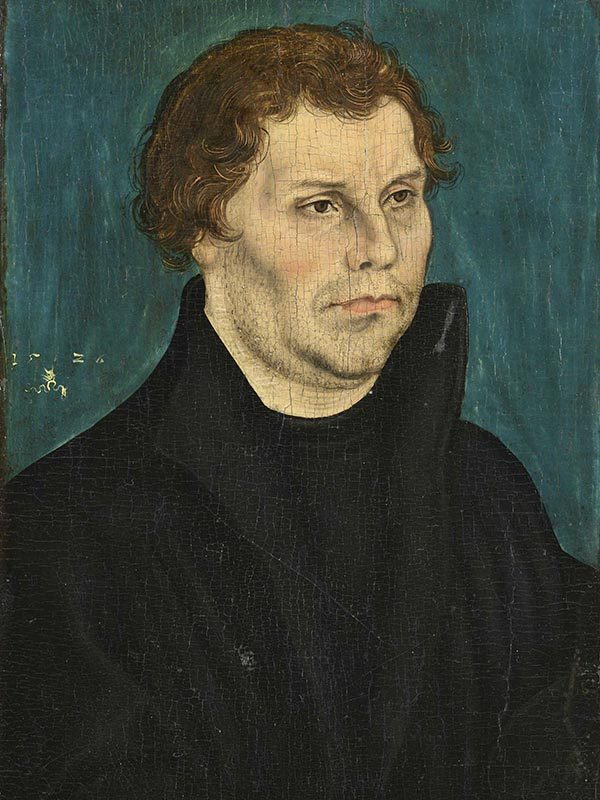
On 3 January 1521 Pope Leo X issued the bull Decet Romanum Pontificem, excommunicating Martin Luther and completing the breach between Rome and the German reformer whose protest had begun with the Ninety-five Theses. January 3 is also the day Alaska became the 49th American state and Howard Carter uncovered Tutankhamun's sarcophagus.
Choose another date: open the On This Day calendar to browse events, births and deaths for any day of the year.
At a Glance
- The bull
- Decet Romanum Pontificem, issued by Pope Leo X at St Peter's, Rome, on 3 January 1521, declaring Luther excommunicated
- The warning before it
- The bull Exsurge Domine (15 June 1520) had condemned 41 propositions drawn from Luther's writings and given him 60 days to recant
- Luther's answer
- On 10 December 1520 Luther publicly burned Exsurge Domine outside Wittenberg's Elster Gate, together with books of canon law
- What excommunication meant
- Luther was cut off from the sacraments and the communion of the Church; the Edict of Worms later in 1521 made him an outlaw in the Empire as well
- What followed
- Luther refused to recant at the Diet of Worms that spring, and the Lutheran movement survived under the protection of German princes
- The breach made permanent
- The excommunication was never lifted; the division between the Roman Catholic Church and the churches of the Reformation endures today
Events on this day
- 1521Pope Leo X excommunicates Martin Luther by the bull Decet Romanum Pontificem — the featured story above.
- 1777George Washington's army defeats the British at the Battle of Princeton, New Jersey, completing the Trenton–Princeton campaign.
- 1870Construction begins on the Brooklyn Bridge in New York; it will open in 1883 as the world's longest suspension bridge.
- 1924Howard Carter's team uncovers the stone sarcophagus of Tutankhamun in the Valley of the Kings, two years after entering the tomb.
- 1938President Franklin D. Roosevelt founds the March of Dimes to fight polio, the organisation that later funded the Salk vaccine.
- 1959Alaska is admitted to the Union as the 49th state, by proclamation of President Dwight D. Eisenhower.
- 1961The United States severs diplomatic relations with Cuba, two years after Fidel Castro's revolution.
- 1987Aretha Franklin becomes the first woman inducted into the Rock and Roll Hall of Fame.
- 1990Manuel Noriega surrenders to United States forces in Panama, days after taking refuge in the Vatican's embassy.
- 1999NASA launches the Mars Polar Lander; contact is lost as it descends to the Martian surface that December.
- 2009The Bitcoin network is established as the pseudonymous Satoshi Nakamoto mines its first block, the Genesis block.
Born on this day
- 106 BCCicero — Roman orator and statesman whose speeches and letters shaped Latin prose and republican thought.
- 1883Clement Attlee — British prime minister whose postwar government created the National Health Service and the welfare state.
- 1892J. R. R. Tolkien — English philologist and author of The Hobbit and The Lord of the Rings.
- 1956Mel Gibson — American-Australian actor and director of Braveheart.
- 1964Cheryl Miller — American basketball player, among the greatest in the history of the women's game.
- 1969Michael Schumacher — German racing driver, seven-time Formula One world champion.
- 2003Greta Thunberg — Swedish climate activist whose school strike grew into a worldwide movement.
Died on this day
- 1795Josiah Wedgwood — English potter who industrialised ceramics and founded the Wedgwood company.
- 1946William Joyce — American-born broadcaster of Nazi propaganda as 'Lord Haw-Haw', hanged for treason in London.
- 1967Jack Ruby — Dallas nightclub owner who shot Lee Harvey Oswald live on television; he dies awaiting a retrial.
- 1979Conrad Hilton — American hotelier who built the Hilton chain from a single Texas hotel into a global empire.
The featured story: the excommunication of Martin Luther, 3 January 1521
When Martin Luther posted his Ninety-five Theses at Wittenberg in October 1517, he believed he was opening an academic argument about indulgences — the payments by which the Church promised to shorten a soul's time in purgatory. The argument would not stay academic. Luther's critique widened into an attack on papal authority itself, his books spread across Germany on the new printing presses, and Rome moved through its machinery: investigation, summons, and finally a formal threat. On 15 June 1520 Leo X issued Exsurge Domine, condemning 41 propositions from Luther's writings and giving him sixty days to submit or be excommunicated.
Luther's answer was a bonfire. On 10 December 1520, outside Wittenberg's Elster Gate, he publicly burned the papal bull along with volumes of canon law, while students threw the works of his opponents onto the flames. It was a deliberate, theatrical refusal: the professor was telling the pope that the deadline would not be met. Rome proceeded exactly as canon law required. Three weeks later, on 3 January 1521, Leo X signed Decet Romanum Pontificem — 'It pleases the Roman Pontiff' — the bull that formally cast Luther out of the Church, naming him and his followers as heretics cut off from the sacraments.
Excommunication was the gravest spiritual penalty the medieval Church possessed, and in a world where church and state interlocked it carried civil danger too. Luther was now summoned before the emperor himself at the Diet of Worms in April 1521, where, asked to recant his books, he refused. The resulting Edict of Worms declared him an outlaw: his writings were banned and anyone might seize him. He survived because a prince, Frederick the Wise of Saxony, hid him in the Wartburg castle, where Luther spent his concealment translating the New Testament into German — putting the contested scripture into the hands of ordinary readers.
The excommunication of 3 January 1521 is the point at which the quarrel became a schism. Negotiated reunion remained theoretically possible for years, and churchmen on both sides sometimes sought it, but the sentence was never lifted and the institutions hardened around it: Lutheran churches under princely protection, a Roman Church driven to its own reforming Council of Trent, and a Europe divided by confession for centuries. A dispute over indulgences had become, by a document signed in Rome on this day, the permanent division of Western Christianity.
Why this date matters
January 3 has a habit of drawing lines. On it, a pope drew the line that split Western Christianity; Washington drew a line under Britain's hopes of recovering New Jersey in a single winter campaign; the United States drew a line across its map to admit Alaska and drew a diplomatic line against Cuba; and in 2009 an anonymous programmer drew the first block of a chain that proposed to redraw money itself. Even its quieter entries are thresholds — a bridge begun, a tomb opened, a spacecraft launched. It is a day of first stones and final sentences, when institutions announce that something old is closed and something new has begun.
Sources
- Encyclopaedia Britannica — On This Day: January 3
- HISTORY — What Happened on January 3
- Papal Encyclicals Online — Decet Romanum Pontificem (1521)
- National Archives — Proclamation 3269: Admission of Alaska (1959)
The facts on this page were checked against these sources on 19 November 2026. The History Trail's permanent pages are researched and written for this site; the live profiles elsewhere on The History Trail are assembled automatically from Wikipedia and Wikidata.
About the Author
Researched and written by the The History Trail Editorial Team — the accountable editorial function behind this site's permanent story pages. The team works from the published sources cited on each page; it does not invent historians, reviewers or credentials, and it corrects errors openly.
Fact Check
Every load-bearing fact on this page traces to one of the sources listed above, and significant claims link to their source in the text. Our checking method is described on the methodology page; errors can be reported via the corrections page.
Sources & Citations
Cite this page as: The History Trail Editorial Team, The History Trail — this article's title, publication and update dates are shown beneath its headline. The full source list appears under Sources above; the site's source standards are on the sources page.