
On This Day
January 11 in History
On 11 January 1922 Leonard Thompson, a fourteen-year-old boy dying of diabetes at Toronto General Hospital, received the first injection of insulin ever given to a human being — the moment a disease that had always been a death sentence became survivable. January 11 is also the day Theodore Roosevelt proclaimed the Grand Canyon a national monument and Amelia Earhart flew solo from Hawaii to California.
Choose another date: open the On This Day calendar to browse events, births and deaths for any day of the year.
At a Glance
- The patient
- Leonard Thompson, 14, admitted to Toronto General Hospital in December 1921, critically ill with diabetes and wasted to about 65 pounds
- The injection
- On 11 January 1922 Thompson was injected with 15 ml of a beef pancreatic extract prepared by Frederick Banting and Charles Best
- The first result
- The extract lowered his blood sugar only modestly and caused an abscess; the trial was judged a partial failure
- The success
- On 23 January 1922, using James Collip's purified extract, Thompson's blood glucose returned to normal — the first successful treatment of diabetes with insulin
- The team
- Banting and Best worked in J. J. R. Macleod's laboratory at the University of Toronto; Collip joined to purify the extract
- The prize and the patent
- Banting and Macleod won the 1923 Nobel Prize and shared their prize money with Best and Collip; the discoverers sold the insulin patent to the University of Toronto for one dollar each
Events on this day
- 630Muhammad and his followers enter Mecca, completing the Muslim conquest of the city largely without bloodshed.
- 1569England's first recorded state lottery is drawn at St Paul's Cathedral in London, to raise money for harbours and public works.
- 1861Alabama secedes from the Union, the fourth state to leave as the American South moves toward civil war.
- 1908President Theodore Roosevelt proclaims the Grand Canyon a national monument, protecting it eleven years before it becomes a national park.
- 1922Leonard Thompson receives the first insulin injection given to a human being — the featured story above.
- 1927A dinner in Los Angeles hosted by Louis B. Mayer sets in motion the founding of the Academy of Motion Picture Arts and Sciences, the future home of the Oscars.
- 1935Amelia Earhart flies solo from Honolulu to Oakland, California — the first person to make that Pacific crossing alone.
- 1964The United States Surgeon General, Luther Terry, publishes Smoking and Health, the landmark report concluding that smoking causes cancer.
- 2002The first detainees arrive at the United States detention camp at Guantanamo Bay, Cuba, from the war in Afghanistan.
Born on this day
- 1755Alexander Hamilton — American founding father and first secretary of the treasury; his birth year is disputed between 1755 and 1757.
- 1815John A. Macdonald — the first prime minister of Canada, who stitched the Dominion together in 1867.
- 1858Harry Gordon Selfridge — American retailer who founded Selfridges in London and retaught Britain how to shop.
- 1859George Curzon — viceroy of India and British foreign secretary, of the Curzon Line.
- 1971Mary J. Blige — American singer crowned the queen of hip-hop soul.
Died on this day
- 1753Hans Sloane — Irish physician and collector whose bequest of books, coins and curiosities founded the British Museum.
- 1928Thomas Hardy — English novelist and poet of Tess of the d'Urbervilles and Jude the Obscure.
- 1941Emanuel Lasker — German chess master, world champion for 27 years, the longest reign in the game's history.
- 1966Alberto Giacometti — Swiss sculptor of elongated figures, among the defining artists of the twentieth century.
- 1988Isidor Rabi — American physicist and Nobel laureate, a pioneer of magnetic resonance.
The featured story: insulin is used to treat diabetes, 11 January 1922
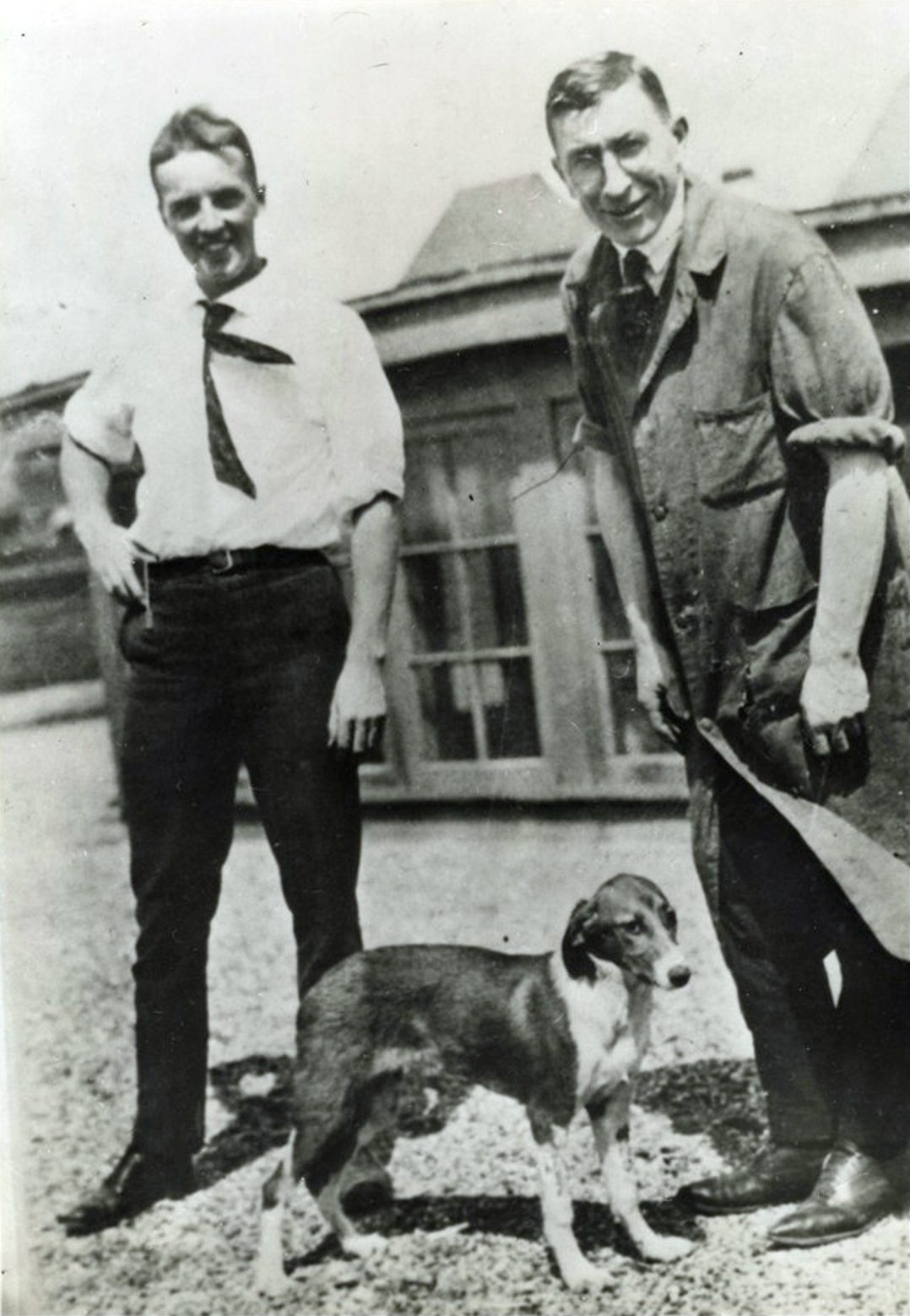
Before 1922, a diagnosis of type 1 diabetes was a sentence of death, usually within months. The only known treatment was a near-starvation diet that bought a little time at terrible cost, and children — the disease's typical victims — wasted away in diabetic comas from which no one woke. Leonard Thompson, fourteen years old, was admitted to Toronto General Hospital on 2 December 1921 in exactly that condition, weighing about 65 pounds. In a laboratory across the city, at the University of Toronto, a young surgeon named Frederick Banting and a medical student, Charles Best, had spent the previous summer extracting from the pancreases of dogs a substance that lowered the animals' blood sugar. They called the active principle insulin.
On 11 January 1922 Thompson became the first human being to receive it: an injection of 15 millilitres of extract prepared by Banting and Best from beef pancreas, administered at the hospital under the direction of its physicians, in the programme Macleod supervised at the university. The result was instructive but disappointing — his blood sugar fell somewhat, yet the extract was too crude, and a sterile abscess formed at the injection site. A lesser team might have stopped. Instead the biochemist James Collip, working around the clock, found a way to purify the extract, and on 23 January Thompson was treated again. This time his blood glucose fell to normal, the signs of his disease receded, and a dying boy began to recover.
The news moved at the speed of hope. Within months, insulin was being given to patients across North America; production was scaled up with the University of Toronto's Connaught Laboratories and the pharmaceutical company Eli Lilly, and a treatment that had not existed in January was, by 1923, saving lives on two continents. In October 1923 the Nobel Prize in Physiology or Medicine was awarded to Banting and Macleod. Banting, furious that Best had been passed over, immediately shared half his prize money with him; Macleod shared his half with Collip. The discoverers had already sold the patent to the University of Toronto for a dollar each, believing that insulin belonged to the world.
Thompson himself lived thirteen more years on insulin, dying in 1935 at twenty-seven — not of diabetes but of pneumonia following a motorcycle accident. His thirteen years stand for the discovery's real measure: not a cure, for insulin is a treatment that must be taken for life, but the conversion of a fatal disease into a manageable one. Every person alive today with type 1 diabetes — millions of them — is living inside the extra time that began in a Toronto hospital ward on 11 January 1922, with an imperfect injection that only half worked, and a team that refused to accept the half.
Why this date matters
January 11 is a day of doors opening onto new dispensations. Mecca opened its gates to Muhammad in 630 and a faith acquired its holy city; England opened a lottery and invented a durable way of taxing hope; a president's signature opened the Grand Canyon to protection; a Surgeon General's report opened the long public argument with tobacco. Above all, a hospital ward in Toronto opened the era in which diabetes could be survived. The date's character is the threshold crossed quietly — few of these moments looked world-changing on the day — by people who understood that a first, imperfect attempt is how every permanent change begins.
Sources
- Encyclopaedia Britannica — On This Day: January 11
- HISTORY — What Happened on January 11
- HISTORY — First human receives insulin injection to treat diabetes
- University of Toronto, Thomas Fisher Rare Book Library — Leonard Thompson
- PubMed Central — Insulin: A Pacesetter for the Shape of Modern Biomedical Science and the Nobel Prize
The facts on this page were checked against these sources on 19 November 2026. The History Trail's permanent pages are researched and written for this site; the live profiles elsewhere on The History Trail are assembled automatically from Wikipedia and Wikidata.
About the Author
Researched and written by the The History Trail Editorial Team — the accountable editorial function behind this site's permanent story pages. The team works from the published sources cited on each page; it does not invent historians, reviewers or credentials, and it corrects errors openly.
Fact Check
Every load-bearing fact on this page traces to one of the sources listed above, and significant claims link to their source in the text. Our checking method is described on the methodology page; errors can be reported via the corrections page.
Sources & Citations
Cite this page as: The History Trail Editorial Team, The History Trail — this article's title, publication and update dates are shown beneath its headline. The full source list appears under Sources above; the site's source standards are on the sources page.