
On This Day
February 15 in History
On the night of 15 February 1898 the American battleship USS Maine, lying at anchor in Havana Harbor, blew up and sank, killing more than 260 of her crew. Spain and the United States blamed different causes, but American newspapers had no doubt — Remember the Maine, to hell with Spain — and within ten weeks the two countries were at war. February 15 is also Galileo's birthday and the day Singapore fell in 1942 and the Soviet Union finally left Afghanistan in 1989.
Choose another date: open the On This Day calendar to browse events, births and deaths for any day of the year.
At a Glance
- The ship
- USS Maine, an American battleship sent to Havana in January 1898 to protect U.S. interests during Cuba's revolt against Spain
- The explosion
- About 9:40 p.m., 15 February 1898 — a blast destroys the forward part of the ship, which sinks in the harbour
- The dead
- Two officers and 264 men, in the figure given by the official American report on the wreck
- The inquiries
- Spanish investigators blame an internal explosion; the American court of inquiry blames a mine — the two findings are never reconciled
- The slogan
- Remember the Maine, to hell with Spain — the rallying cry of the newspapers that demand war
- The result
- The Spanish-American War of 1898; Spain loses Cuba, Puerto Rico, Guam and the Philippines, and the United States emerges as a world power
Events on this day
- 1764Auguste Chouteau settles St. Louis at the confluence of the Mississippi and Missouri rivers, founding a fur-trading post that becomes a great river city.
- 1898An explosion sinks the USS Maine in Havana Harbor, killing most of her crew — the featured story above.
- 1903Toy maker Morris Michtom puts two stuffed bears in his shop window and calls them Teddy bears, after President Theodore Roosevelt.
- 1927The silent film It is released and its star, Clara Bow, becomes Hollywood's first It girl.
- 1933Giuseppe Zangara fires at President-elect Franklin D. Roosevelt in Miami; Roosevelt is unhurt but Chicago mayor Anton Cermak is fatally wounded.
- 1942Singapore, Britain's great stronghold in Asia, falls to Japanese forces after a week of fighting.
- 1950Walt Disney's animated Cinderella opens in American theatres, rescuing the studio's fortunes.
- 1961The entire United States figure skating team is killed when its airliner crashes in Belgium on the way to the world championships in Prague.
- 1965Canada's new Maple Leaf flag is raised over Parliament Hill in Ottawa for the first time.
- 1978Leon Spinks, in only his eighth professional fight, defeats Muhammad Ali to become world heavyweight boxing champion.
- 1989The Soviet Union withdraws its last troops from Afghanistan, ending an occupation that began in 1979.
- 1998Dale Earnhardt Sr. wins the Daytona 500 at last, after twenty years of trying.
- 2003Millions of people in more than 600 cities around the world march against the impending invasion of Iraq.
Born on this day
- 1564Galileo Galilei — Italian astronomer and physicist whose telescope work and mechanics founded modern science.
- 1820Susan B. Anthony — American pioneer of the women's suffrage movement, who fought fifty years for the vote.
- 1861Alfred North Whitehead — English mathematician and philosopher, co-author with Bertrand Russell of Principia Mathematica.
- 1947John Adams — American composer of operas including Nixon in China and of the memorial On the Transmigration of Souls.
- 1948Art Spiegelman — American cartoonist whose graphic novel Maus retold his father's survival of the Holocaust.
- 1954Matt Groening — American cartoonist, creator of Life in Hell and of The Simpsons and Futurama.
Died on this day
- 1965Nat King Cole — American singer and pianist of Unforgettable and a pioneering Black television host, dead of cancer at 45.
- 1988Richard Feynman — American physicist, Nobel laureate and beloved teacher, dead in Los Angeles at 69.
- 2008Steve Fossett — American adventurer and record-breaking aviator, legally declared dead five months after his plane vanished over Nevada.
- 2016Vanity — Canadian singer Denise Matthews, protégée of Prince and leader of Vanity 6, dead at 57.
The featured story: the USS Maine explodes in Havana Harbor, 15 February 1898
The Maine had come to Havana on a mission described as friendly. Cuba was in revolt against Spanish rule, riots had broken out in the capital, and Washington sent the battleship in January 1898 to protect American lives and property. She lay at a buoy in the harbour for three weeks, a grey embodiment of American power in a Spanish port. At about twenty minutes to ten on the night of 15 February, an explosion tore through her forward magazines. The front third of the ship was destroyed; the rest sank into the harbour mud. Two officers and 264 of her crew, in the official count, were killed.
What caused the explosion was disputed then and is not settled now. The Spanish inquiry concluded that the blast was internal — a fire or accident in the ship's own magazines. The American naval court of inquiry concluded that a mine had detonated beneath the ship and set off her forward magazines, though it fixed no blame on Spain itself. A study ordered by Admiral Hyman Rickover in the 1970s argued for an internal cause, a coal-bunker fire igniting the magazine; a later computer-modelling study kept the mine theory alive. The honest summary, more than a century on, is that the evidence raised with the wreck in 1911 still supports argument in both directions.
None of that uncertainty survived contact with the American press of 1898. William Randolph Hearst's New York Journal and Joseph Pulitzer's World, locked in a circulation war, printed the Maine as a Spanish atrocity; Remember the Maine, to hell with Spain became a national slogan. Congress recognised Cuban independence, Spain broke relations, and on 25 April the United States declared war — backdated to 21 April. The war lasted ten weeks of fighting. By its end Spain had lost Cuba, Puerto Rico, Guam and the Philippines, and the United States, which had gone to war over a harbour explosion, found itself an overseas empire.
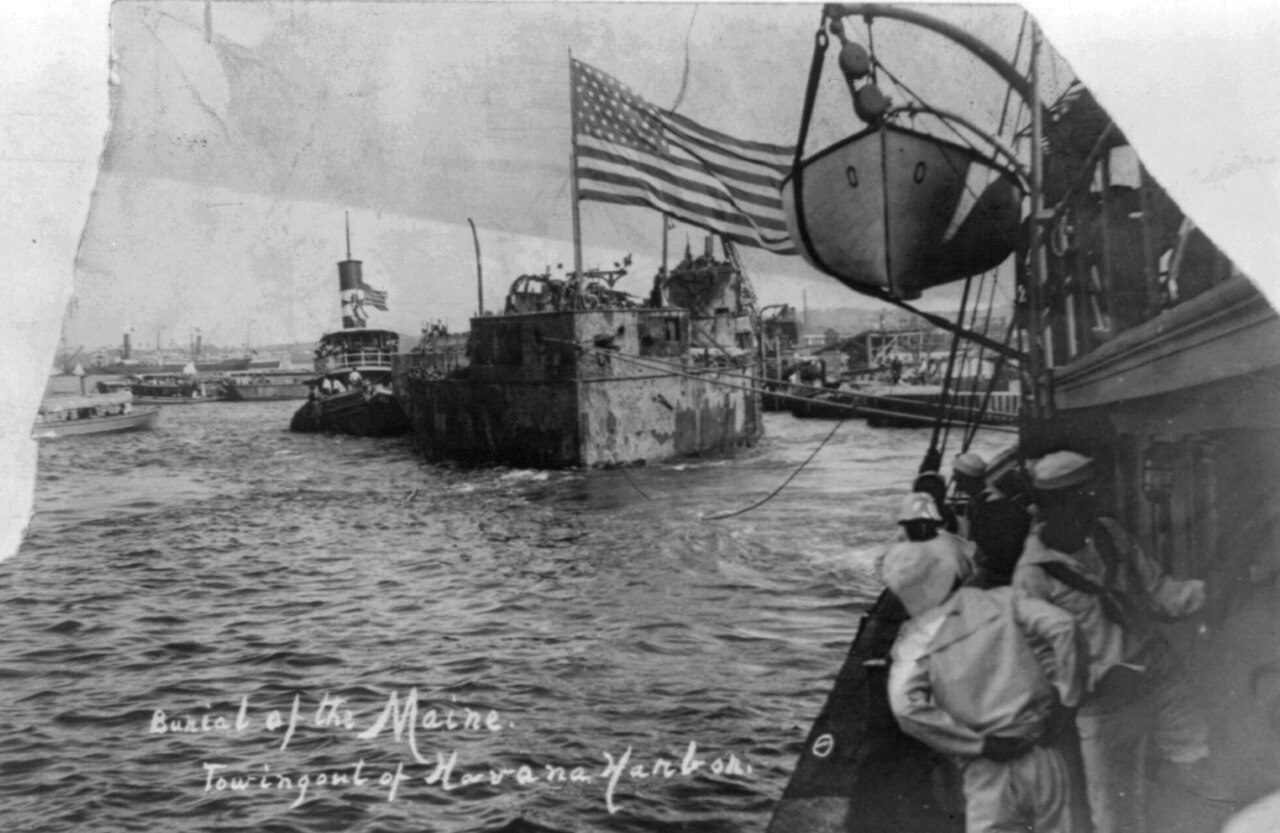
The Maine herself had a long afterlife. Her wreck was raised in 1911–12, most of the remaining dead recovered and buried at Arlington, and the hull towed out to sea and sunk with honours in deep water. Her mast stands at Arlington National Cemetery, another at Annapolis. But her real monument is the cautionary one: a disaster whose cause was never proved became the certain casus belli of a war — the cleanest example in American history of how quickly an explosion can outrun the evidence.
Why this date matters
February 15 is a date of sudden reversals. A battleship explodes at anchor in 1898 and an empire changes hands; Singapore, thought impregnable, falls in 1942; an unknown boxer beats Muhammad Ali in 1978; an occupying army finally marches home from Afghanistan in 1989. It is also a day of gentler firsts — the teddy bear in 1903, Cinderella in 1950, a new flag for Canada in 1965 — and of the largest coordinated protest the world had yet seen, in 2003. The pattern is the hinge: things that looked permanent — Spanish Cuba, British Singapore, Soviet Afghanistan — turn out to be one February day from ending.
Sources
- Encyclopaedia Britannica — On This Day: February 15
- HISTORY — What Happened on February 15
- U.S. House of Representatives — Report on the Wreck of the Maine (1911)
The facts on this page were checked against these sources on 19 November 2026. The History Trail's permanent pages are researched and written for this site; the live profiles elsewhere on The History Trail are assembled automatically from Wikipedia and Wikidata.
About the Author
Researched and written by the The History Trail Editorial Team — the accountable editorial function behind this site's permanent story pages. The team works from the published sources cited on each page; it does not invent historians, reviewers or credentials, and it corrects errors openly.
Fact Check
Every load-bearing fact on this page traces to one of the sources listed above, and significant claims link to their source in the text. Our checking method is described on the methodology page; errors can be reported via the corrections page.
Sources & Citations
Cite this page as: The History Trail Editorial Team, The History Trail — this article's title, publication and update dates are shown beneath its headline. The full source list appears under Sources above; the site's source standards are on the sources page.