
On This Day
April 13 in History
On 13 April 1970, some 200,000 miles from Earth and two days out from Florida, oxygen tank No. 2 aboard Apollo 13 exploded, crippling the spacecraft and turning the third Moon-landing mission into a fight for survival. April 13 is also Thomas Jefferson's birthday, the day Handel's Messiah was first performed, and the day Sidney Poitier broke the Oscars' colour bar.
Choose another date: open the On This Day calendar to browse events, births and deaths for any day of the year.
At a Glance
- The moment
- 13 April 1970, 55 hours 55 minutes into the flight, about 200,000 miles (322,000 km) from Earth
- The words
- Jack Swigert reports to Houston: 'We've had a problem here' — Jim Lovell repeats it: 'Houston, we've had a problem'
- The cause
- Damaged wiring inside oxygen tank No. 2 short-circuited when its fans were switched on, igniting insulation
- The damage
- The explosion crippled the service module; the second oxygen tank leaked away, and with it power and water
- The lifeboat
- The crew powered down the command module and lived in the lunar module Aquarius, built for two men
- The outcome
- After four cold, rationed days the crew splashed down safely in the Pacific on 17 April
Events on this day
- 1742Handel's oratorio Messiah is performed for the first time, in Dublin, with the composer conducting.
- 1796America's first elephant, a two-year-old from Bengal, arrives in New York; she is exhibited ten days later at 25 cents a view.
- 1870The Metropolitan Museum of Art is founded in New York City.
- 1895Alfred Dreyfus is imprisoned on Devil's Island off French Guiana, after a treason conviction driven by antisemitism; he is eventually cleared.
- 1941Japan and the Soviet Union sign a neutrality pact in Moscow.
- 1943President Franklin D. Roosevelt dedicates the Jefferson Memorial in Washington, on the 200th anniversary of Jefferson's birth.
- 1964Sidney Poitier wins the Academy Award for Best Actor for Lilies of the Field — the first Black actor to win the award.
- 1970An oxygen tank explodes aboard Apollo 13 — the featured story above.
- 1997Tiger Woods, at 21, wins the Masters by a record twelve strokes, the youngest champion in the tournament's history.
- 2002Hugo Chávez is restored to the Venezuelan presidency two days after a coup briefly removed him.
- 2024Iran launches hundreds of drones and missiles at Israel, the first direct military confrontation between the two states.
Born on this day
- 1519Catherine de' Medici — Italian noblewoman who became queen of France and the power behind three of its kings.
- 1743Thomas Jefferson — American Founding Father, principal author of the Declaration of Independence and third president of the United States.
- 1906Samuel Beckett — Irish novelist and playwright of Waiting for Godot, winner of the Nobel Prize in Literature.
- 1909Eudora Welty — American writer whose stories and novels chronicled the small-town South.
- 1963Garry Kasparov — Russian chess grandmaster, the youngest undisputed world champion and Deep Blue's famous opponent.
Died on this day
- 1695Jean de La Fontaine — French fabulist whose retellings of Aesop's tales became classics of French literature.
- 2015Günter Grass — German novelist of The Tin Drum and Nobel laureate, dead at 87.
- 2018Milos Forman — Czech-American director of One Flew Over the Cuckoo's Nest and Amadeus, dead at 86.
- 2023Mary Quant — English fashion designer who popularised the miniskirt and defined Swinging London style.
The featured story: an oxygen tank explodes aboard Apollo 13, 13 April 1970
The evening of 13 April 1970 was, by the standards of a Moon flight, almost dull. Apollo 13's crew — Jim Lovell, Jack Swigert and Fred Haise — had just finished a television broadcast that the networks had not bothered to carry, and were settling the spacecraft for the night, some 200,000 miles from Earth. As a last routine task, Houston asked Swigert to stir the cryogenic oxygen tanks. He flipped the switches. Sixteen seconds later a bang ran through the ship, warning lights lit across the panel, and Swigert radioed the words that entered history: Houston, we've had a problem here.
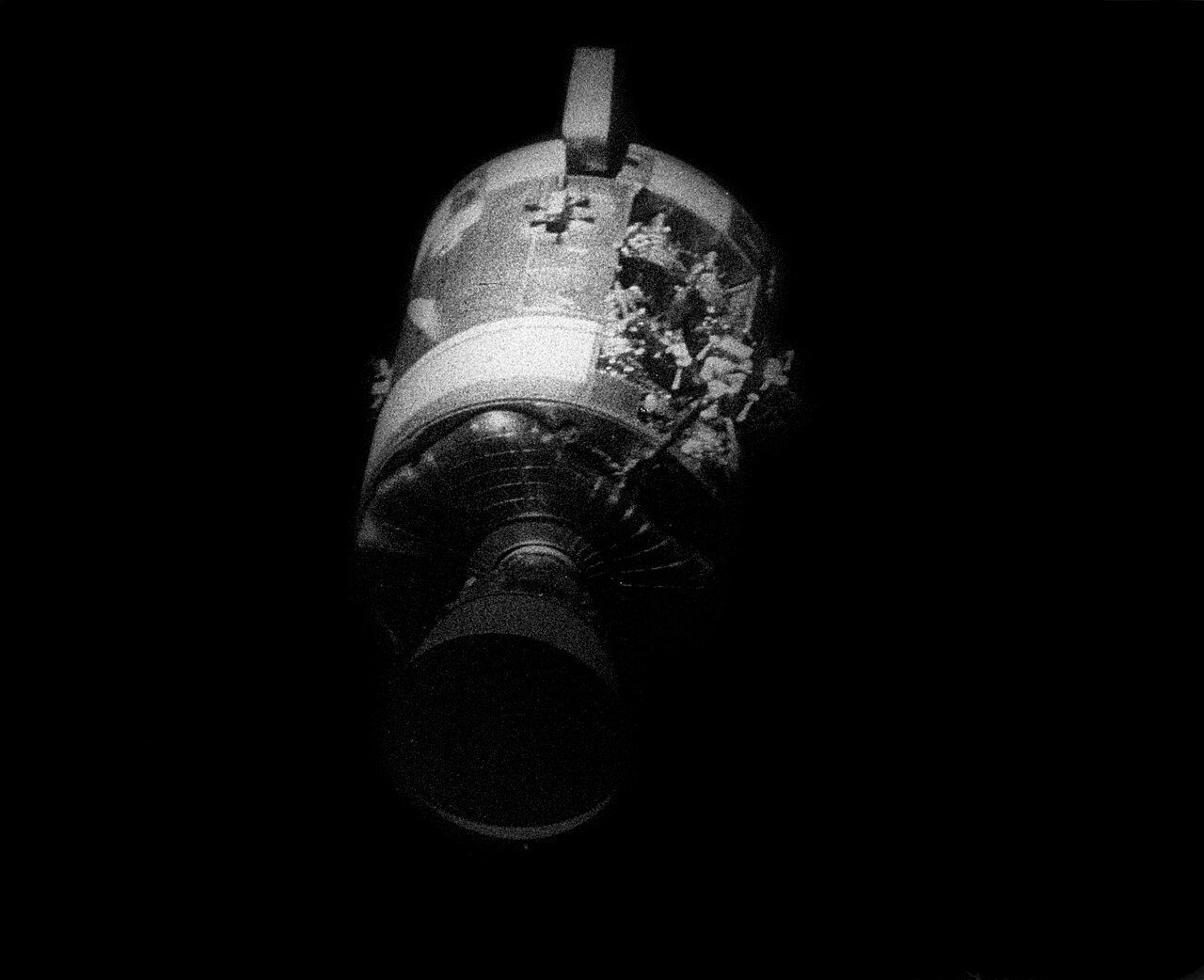
The problem was total. Oxygen tank No. 2 had exploded — a fire inside it, started by damaged wire insulation, had blown its dome off and wrecked the bay around it. Tank No. 1 was leaking its oxygen into space through damaged plumbing. Since the command module's fuel cells breathed that oxygen to make electricity and water, Odyssey was dying on a timer of hours. The Moon landing was instantly forgotten; the Fra Mauro highlands passed unvisited. The only question was whether three men could be kept alive for the four days it would take to loop around the Moon and fall back to Earth.
The answer was the lunar module Aquarius — a spindly lander designed to hold two men on the Moon for two days, now asked to hold three men in deep space for four. The crew powered Odyssey down completely to save its batteries for re-entry, and lived in Aquarius on rations of water, in temperatures near freezing, while carbon dioxide from their own breath slowly built up. On the ground, engineers dumped a box of flight kit onto a table and improvised the famous fix: a plastic bag, a flight sock, tape and a suit hose that let the command module's square lithium-hydroxide canisters work in the lander's round slots.
It worked. A burn swung the ship onto a faster return path, a second burn corrected it, and on 17 April the crew powered Odyssey up from cold — a procedure never rehearsed — jettisoned the wrecked service module, whose whole side was missing, and rode the command module through re-entry. Splashdown in the Pacific, four miles from the recovery ship, was precise. NASA's review board traced the explosion to a chain of small oversights years old. The flight that never reached the Moon became the agency's proudest story: not a landing, but a rescue conducted across 200,000 miles of space.
Why this date matters
April 13 is a day of stages, literal and otherwise. Handel's Messiah was first heard on one in Dublin in 1742; America's first elephant was exhibited on one in 1796; Sidney Poitier took his Oscar on one in 1964. And its greatest drama played out on no stage at all, in a crippled spacecraft that the whole world watched by radio. It is fitting that the day also belongs to Thomas Jefferson, born in 1743 and commemorated by his memorial's dedication exactly two hundred years later: a day for words, music and nerve.
Sources
- Encyclopaedia Britannica — On This Day: April 13
- HISTORY — What Happened on April 13
- HISTORY — Apollo 13 oxygen tank explodes
- NASA — Apollo 13 Mission
The facts on this page were checked against these sources on 19 November 2026. The History Trail's permanent pages are researched and written for this site; the live profiles elsewhere on The History Trail are assembled automatically from Wikipedia and Wikidata.
About the Author
Researched and written by the The History Trail Editorial Team — the accountable editorial function behind this site's permanent story pages. The team works from the published sources cited on each page; it does not invent historians, reviewers or credentials, and it corrects errors openly.
Fact Check
Every load-bearing fact on this page traces to one of the sources listed above, and significant claims link to their source in the text. Our checking method is described on the methodology page; errors can be reported via the corrections page.
Sources & Citations
Cite this page as: The History Trail Editorial Team, The History Trail — this article's title, publication and update dates are shown beneath its headline. The full source list appears under Sources above; the site's source standards are on the sources page.