
On This Day
July 14 in History
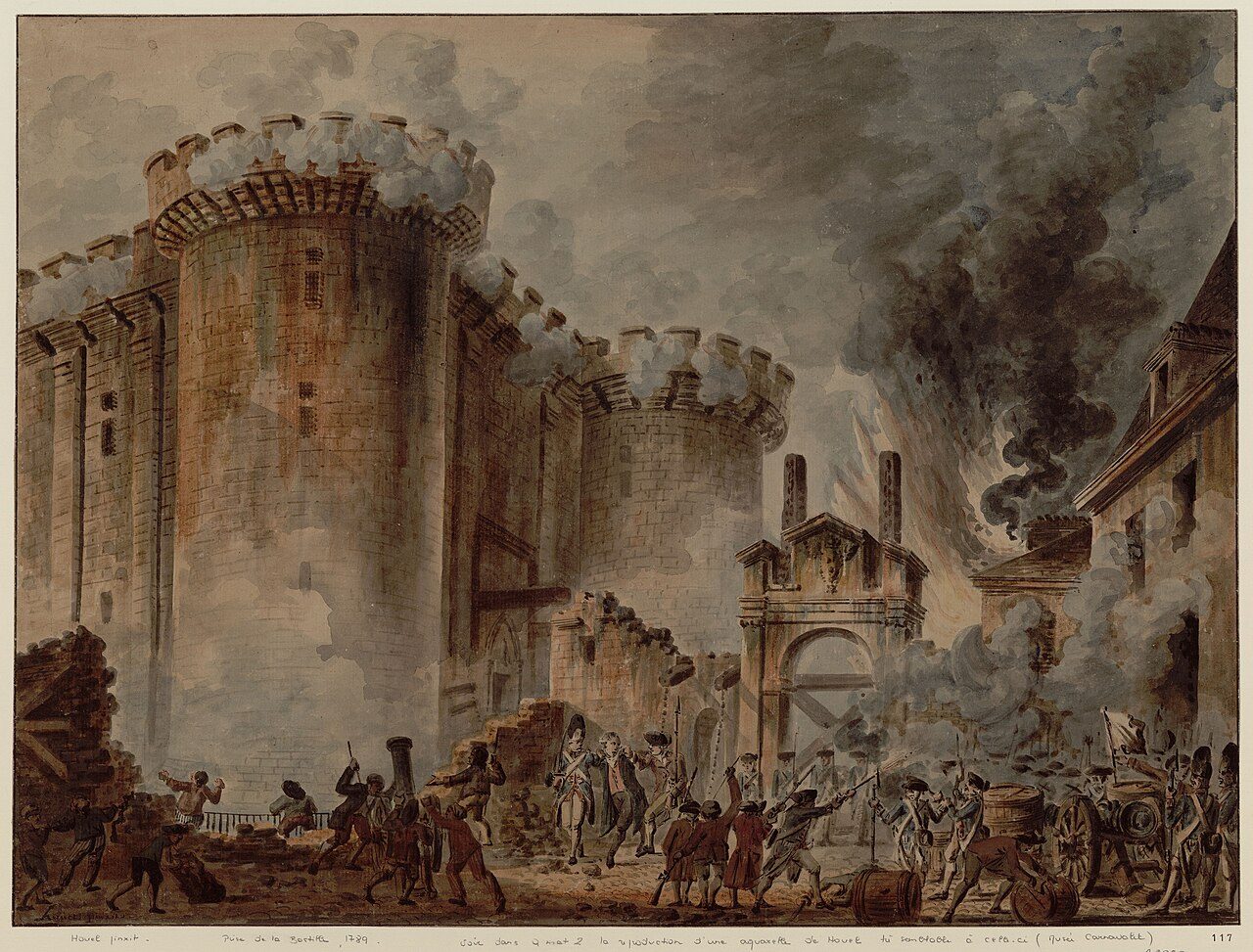
On 14 July 1789 a Paris crowd seized the Bastille fortress-prison, and a political crisis became the French Revolution — the event France still celebrates as its national day.
Choose another date: open the On This Day calendar to browse events, births and deaths for any day of the year.
At a Glance
- Date
- 14 July 1789
- Place
- The Bastille Saint-Antoine, Paris, France
- Prisoners freed
- Seven — four counterfeiters, two men held as mentally ill, and one count
- Governor
- Bernard-René Jordan de Launay, killed after surrendering
- Spark
- Dismissal of minister Jacques Necker and royal troops massing around Paris
Events on this day
- 1223Louis VIII becomes King of France on the death of his father, Philip II.
- 1420Czech Hussite forces under Jan Žižka defeat a Crusader army at the Battle of Vítkov Hill.
- 1790The first Fête de la Fédération celebrates French unity, one year after the Bastille fell.
- 1791The Priestley Riots begin in Birmingham, targeting scientist Joseph Priestley, a supporter of the French Revolution.
- 1798The Sedition Act becomes law in the United States, criminalising false or malicious statements about the government.
- 1865Edward Whymper's party completes the first ascent of the Matterhorn; four climbers die on the descent.
- 1881Sheriff Pat Garrett shoots and kills the outlaw Billy the Kid at Fort Sumner, New Mexico.
- 1902The Campanile of St Mark's Square in Venice collapses, also demolishing the adjoining loggetta.
- 1933Adolf Hitler's Gleichschaltung decree abolishes every German political party except the Nazis.
- 1960Jane Goodall arrives at Gombe Stream in present-day Tanzania to begin her study of wild chimpanzees.
- 1965Mariner 4 flies past Mars and transmits the first close-up photographs of another planet.
- 2015NASA's New Horizons probe flies past Pluto, completing the first reconnaissance of the classical Solar System.
Born on this day
- 1602Cardinal Jules Mazarin — Italian-born chief minister who governed France for nearly two decades.
- 1862Gustav Klimt — Austrian painter, founder of the Vienna Secession and creator of The Kiss.
- 1868Gertrude Bell — English archaeologist, writer and political officer influential in the modern Middle East.
- 1912Woody Guthrie — American folk singer-songwriter whose songs chronicled the Dust Bowl and the Depression.
- 1913Gerald Ford — 38th President of the United States, who succeeded Richard Nixon in 1974.
- 1918Ingmar Bergman — Swedish director whose films reshaped world cinema.
- 1960Jane Lynch — American actress and comedian, Emmy winner for Glee.
- 1988Conor McGregor — Irish mixed martial artist, former two-division UFC champion.
Died on this day
- 1223Philip II of France — the king who greatly expanded the French royal domain.
- 1789Bernard-René de Launay — governor of the Bastille, killed after its surrender on this day.
- 1816Francisco de Miranda — Venezuelan general and precursor of Latin American independence.
- 1817Germaine de Staël — French writer and political thinker, a leading voice against Napoleon.
- 1827Augustin-Jean Fresnel — French physicist who revived the wave theory of light and invented the lighthouse lens.
- 1904Paul Kruger — president of the South African Republic during the Boer War.
- 1939Alphonse Mucha — Czech painter, defining artist of the Art Nouveau style.
- 2017Maryam Mirzakhani — Iranian mathematician, the first woman to win the Fields Medal.
The featured story: the day the Bastille fell
In the summer of 1789 France was broke, hungry and arguing about who should rule it. The Estates-General had met at Versailles for the first time in 175 years, the commoners of the Third Estate had declared themselves a National Assembly, and King Louis XVI had answered by gathering royal troops around Paris and dismissing his popular finance minister, Jacques Necker, on 11 July. To many Parisians it looked like a coup was coming: the Assembly would be arrested and the city starved into obedience. What the crowd needed, urgently, was weapons — and gunpowder.
On the morning of 14 July about nine hundred Parisians converged on the Bastille, the medieval fortress on the city's eastern edge that had served as a state prison since 1659. They were not, at first, trying to free anyone. Two days earlier its governor, Bernard-René Jordan de Launay, had taken delivery of 250 barrels of gunpowder transferred from the Arsenal, and the Bastille's cannon commanded the surrounding streets. Delegates from the Hôtel de Ville negotiated through the morning, and de Launay even withdrew the cannon from the walls — but before that concession could be announced, two men cut the chains of a drawbridge, part of the crowd surged into the outer yard, and the garrison opened fire. A misunderstanding had become a battle.
The balance tipped in the afternoon, when rebellious companies of the French Guard joined the attackers, bringing discipline, muskets and two cannon that were dragged into position against the main gate. Veterans Jacob-Job Élie and Pierre-Augustin Hulin helped organise the assault. De Launay, who briefly considered blowing up the powder store and the neighbourhood with it, was talked out of it by his own officers and lowered the second drawbridge. The crowd flooded in, seized the powder and freed the fortress's entire population of prisoners: seven men. About 98 attackers and one defender died in the fighting; de Launay was marched to the Hôtel de Ville and killed on its steps.
Militarily the prize was almost empty, but politically it was enormous. For the first time, ordinary Parisians had defeated the king's coercive power in the capital itself, and Louis — who reinstated Necker two days later — could not undo it. The Bastille was demolished stone by stone, its remains sold as souvenirs and sent to districts across France, and the date became the founding myth of the Revolution: within weeks feudal dues were abolished and the Declaration of the Rights of Man and of the Citizen was proclaimed. Since 1880, 14 July has been France's national holiday, Bastille Day.
Why this date matters
Fourteen July is the rare date whose meaning was made by a crowd rather than a court or an army. The Bastille held only seven prisoners, yet its fall proved that royal authority in Paris rested on consent that had been withdrawn — and every French government since has had to reckon with that lesson. It is fitting that the same date later gathered quieter revolutions: Jane Goodall arriving at Gombe in 1960 to rewrite our understanding of animals, and Mariner 4 and New Horizons extending human sight to Mars and Pluto. The day keeps its original shape, though: people reaching past the limits set for them.
Sources
- Encyclopaedia Britannica — Storming of the Bastille
- Encyclopaedia Britannica — Bastille
- Wikipedia — July 14 (events, births and deaths lists)
- Wikimedia Commons — Prise de la Bastille by Jean-Pierre Houël

The facts on this page were checked against these sources on 18 November 2026. The History Trail's permanent pages are researched and written for this site; the live profiles elsewhere on The History Trail are assembled automatically from Wikipedia and Wikidata.
About the Author
Researched and written by the The History Trail Editorial Team — the accountable editorial function behind this site's permanent story pages. The team works from the published sources cited on each page; it does not invent historians, reviewers or credentials, and it corrects errors openly.
Fact Check
Every load-bearing fact on this page traces to one of the sources listed above, and significant claims link to their source in the text. Our checking method is described on the methodology page; errors can be reported via the corrections page.
Sources & Citations
Cite this page as: The History Trail Editorial Team, The History Trail — this article's title, publication and update dates are shown beneath its headline. The full source list appears under Sources above; the site's source standards are on the sources page.