
On This Day
July 13 in History
On 13 July 1930, in Montevideo, Uruguay, the first FIFA World Cup kicked off with two matches played at the same hour — and France's Lucien Laurent scored the first goal in World Cup history. July 13 is also the day Marat was murdered in his bath, the New York draft riots began, and Live Aid played to the world.
Choose another date: open the On This Day calendar to browse events, births and deaths for any day of the year.
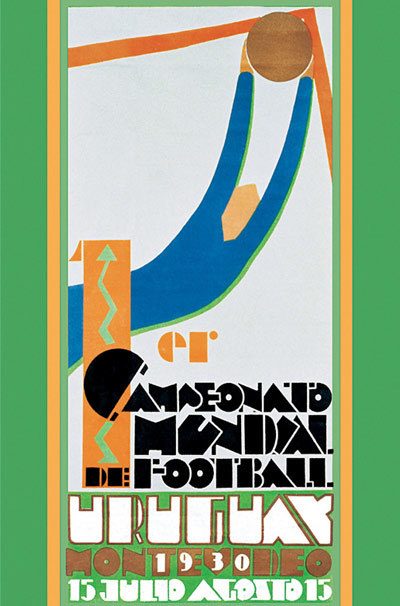
At a Glance
- The hosts
- Uruguay — Olympic champions and centenary hosts, who built the Estadio Centenario in Montevideo for the tournament
- The field
- 13 teams, by invitation only; just four European sides made the long sea voyage
- The opening day
- 13 July 1930: France beat Mexico 4–1 and the United States beat Belgium 3–0, in simultaneous matches
- The first goal
- Lucien Laurent of France, a volley in the 19th minute against Mexico at the Estadio Pocitos
- The final
- Uruguay beat Argentina 4–2 on 30 July to become the first world champions
- The legacy
- The tournament founded the most watched sporting event on Earth
Events on this day
- 1787The United States Congress enacts the Northwest Ordinance, setting the pattern for admitting new states from the territory north-west of the Ohio River.
- 1793Charlotte Corday murders French revolutionary leader Jean-Paul Marat in his bath in Paris.
- 1863The New York City draft riots begin — four days of violence against the Civil War conscription law that leave more than a hundred people dead.
- 1930The first FIFA World Cup begins in Montevideo, Uruguay — the featured story above.
- 1949The Vatican's Decree Against Communism, issued by Pope Pius XII, excommunicates Catholic communists.
- 1960John F. Kennedy is nominated for the presidency at the Democratic National Convention in Los Angeles.
- 1985Live Aid, Bob Geldof's twin concerts in London and Philadelphia, raises money for Ethiopian famine relief before a global television audience.
- 1990The romantic thriller Ghost, starring Patrick Swayze and Demi Moore, opens in American cinemas.
- 2016Theresa May becomes prime minister of the United Kingdom, succeeding David Cameron after the Brexit referendum.
- 2024Former president Donald Trump survives an assassination attempt at a campaign rally in Butler, Pennsylvania, wounded in the ear.
Born on this day
- 1934Wole Soyinka — Nigerian playwright and poet, the first African winner of the Nobel Prize in Literature.
- 1940Patrick Stewart — English actor of the Royal Shakespeare Company who became Captain Jean-Luc Picard in Star Trek: The Next Generation.
- 1942Harrison Ford — American actor, the screen's Han Solo and Indiana Jones.
- 1944Ernő Rubik — Hungarian architect and inventor of Rubik's Cube, the best-selling puzzle in history.
- 1957Cameron Crowe — American film director of Jerry Maguire and Almost Famous, and a teenage Rolling Stone journalist before that.
Died on this day
- 1793Jean-Paul Marat — French revolutionary journalist and politician, murdered in his bath by Charlotte Corday.
- 1954Frida Kahlo — Mexican painter of searing self-portraits, dead in Coyoacán at 47.
- 2010George Steinbrenner — owner of the New York Yankees for 37 years, dead on the day of the All-Star Game.
- 2017Liu Xiaobo — Chinese writer and Nobel Peace Prize laureate, dead in state custody after years of imprisonment for his pro-democracy writing.
The featured story: the first FIFA World Cup begins in Montevideo, 13 July 1930
The World Cup was born of frustration and ambition. Football had outgrown the Olympics, where amateur rules excluded the professionals who now dominated the game, and in 1928 FIFA voted to stage its own championship. The choice of host fell to Uruguay: Olympic football champions in 1924 and 1928, celebrating the centenary of their independence in 1930, and willing to pay the visiting teams' expenses and build a stadium for the occasion. What Uruguay could not do was shorten the Atlantic. With the Depression biting, most European federations declined the two-week sea voyage, and by the time the tournament opened only four European teams — France, Belgium, Romania and Yugoslavia — had made the trip, joining nine from the Americas.
There was no qualifying competition; the thirteen invitees were simply divided into groups. The opening matches were played simultaneously on 13 July 1930 at two Montevideo grounds. At the Estadio Pocitos, France met Mexico; at the Gran Parque Central, the United States met Belgium. Nineteen minutes into the French match, winger Ernest Libérati crossed from the right and Lucien Laurent volleyed the ball past the Mexican goalkeeper — the first goal in World Cup history, in a match France won 4–1 despite losing their goalkeeper to injury and finishing, in the custom of the time, with a makeshift replacement. The Americans won 3–0 in the other game.
Laurent, a factory worker from Saint-Maur, later recalled that the goal earned little more than a few pats on the back: 'we congratulated each other, but without jumping all over one another like they do now.' The tournament gathered pace over the following fortnight in the vast, still-unfinished Estadio Centenario, and on 30 July the hosts beat Argentina 4–2 in the final, coming from 2–1 down — a match so charged that the finalists argued over whose ball to use and the Belgian referee took to the field, it was said, with a revolver in his pocket.
The first World Cup was small, improvised and half-empty by modern standards, and several of its details — the snow Laurent remembered falling during his goal, the one-armed Uruguayan scorer Héctor Castro — sound like legend. But its structure was complete from the start: a host nation, groups, a final, a trophy, and a global argument about football. Every four years since, with only the war years missing, the world has stopped for its descendant.
Why this date matters
July 13 specialises in beginnings that nobody could switch off. A law written in 1787 organised a continent's expansion; a murder in a Paris bath in 1793 announced the Terror's logic of political killing; a football tournament improvised in Montevideo in 1930 grew into the largest shared ritual on the planet; and a charity concert in 1985 invented the global media event for a cause. Even its riots were a beginning of sorts — the draft riots exposed, in blood, what emancipation and conscription would cost the Union's cities. The day's pattern is ignition: small rooms, small crowds, consequences far beyond either.
Sources
- Encyclopaedia Britannica — On This Day: July 13
- HISTORY — What Happened on July 13
- FIFA — Lucien Laurent, the first World Cup goalscorer
- Wikimedia Commons — Uruguay 1930 World Cup poster

The facts on this page were checked against these sources on 19 November 2026. The History Trail's permanent pages are researched and written for this site; the live profiles elsewhere on The History Trail are assembled automatically from Wikipedia and Wikidata.
About the Author
Researched and written by the The History Trail Editorial Team — the accountable editorial function behind this site's permanent story pages. The team works from the published sources cited on each page; it does not invent historians, reviewers or credentials, and it corrects errors openly.
Fact Check
Every load-bearing fact on this page traces to one of the sources listed above, and significant claims link to their source in the text. Our checking method is described on the methodology page; errors can be reported via the corrections page.
Sources & Citations
Cite this page as: The History Trail Editorial Team, The History Trail — this article's title, publication and update dates are shown beneath its headline. The full source list appears under Sources above; the site's source standards are on the sources page.