
On This Day
July 28 in History
On 28 July 1914, exactly one month after the Sarajevo assassination, Austria-Hungary declared war on Serbia by telegram — and the First World War began.
Choose another date: open the On This Day calendar to browse events, births and deaths for any day of the year.
At a Glance
- Date
- 28 July 1914, declaration sent by telegram from Vienna
- Trigger
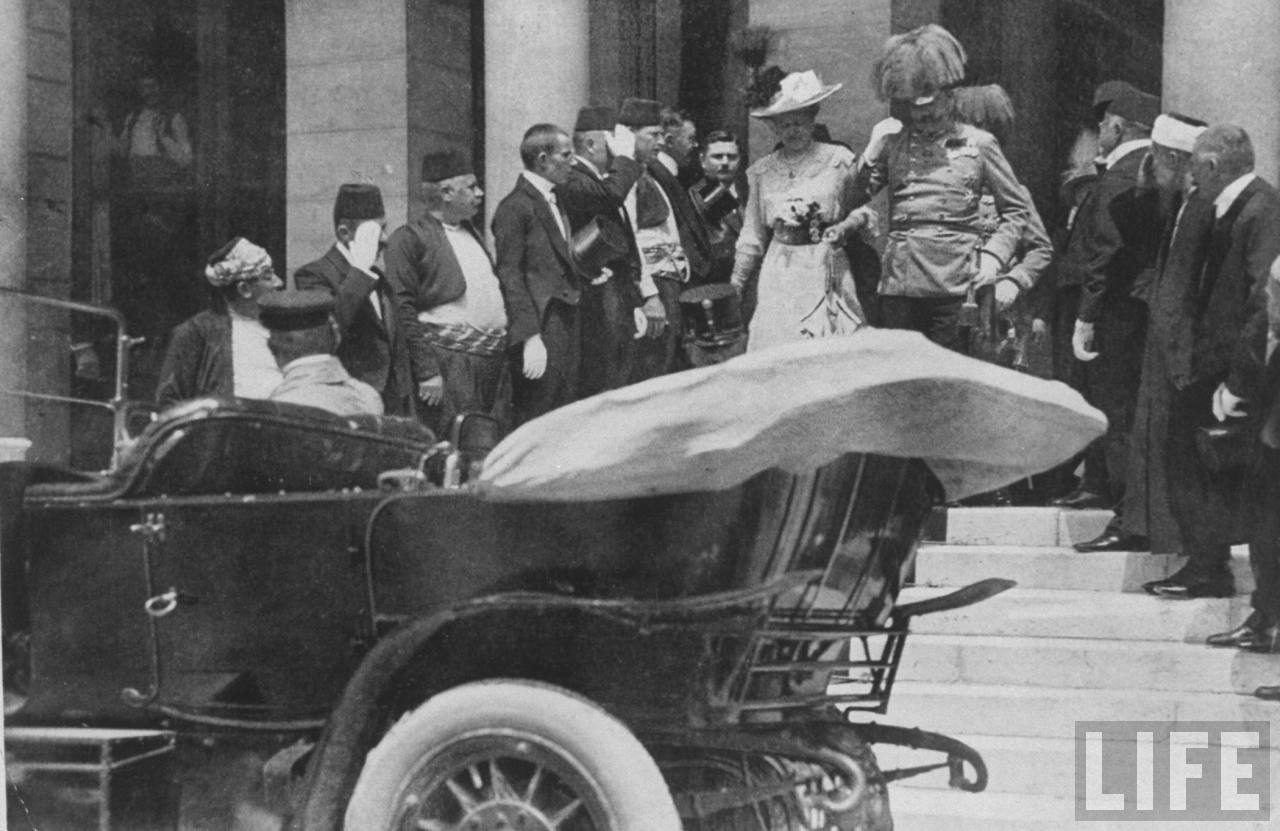
- Assassination of Archduke Franz Ferdinand in Sarajevo, 28 June 1914
- Ultimatum
- Delivered to Serbia on 23 July, with 48 hours to accept
- Key figures
- Emperor Franz Joseph I; foreign minister Count Leopold Berchtold; assassin Gavrilo Princip
- First shots
- Early hours of 29 July — Austro-Hungarian monitors shell Belgrade
Events on this day
- 1540Henry VIII marries his fifth wife, Catherine Howard; his minister Thomas Cromwell is executed the same day.
- 1794Maximilien Robespierre is guillotined in Paris, ending the Reign of Terror's most radical phase.
- 1821José de San Martín declares the independence of Peru from Spain at Lima.
- 1868The Fourteenth Amendment to the US Constitution is certified, guaranteeing citizenship and due process.
- 1917The Silent Parade marches down Fifth Avenue in New York against lynching and anti-Black violence.
- 1935The Boeing B-17 Flying Fortress makes its first flight at Seattle.
- 1945A US Army B-25 bomber crashes into the Empire State Building in fog, killing 14 people.
- 1976The Tangshan earthquake devastates the Chinese city of Tangshan, killing at least 242,000 people.
- 1984The Summer Olympic Games open in Los Angeles, boycotted by the Soviet Union and its allies.
- 2005The Provisional IRA formally ends its thirty-year armed campaign in Northern Ireland.
Born on this day
- 1804Ludwig Feuerbach — German philosopher whose critique of religion influenced Marx.
- 1844Gerard Manley Hopkins — English poet, published only after his death to lasting fame.
- 1866Beatrix Potter — English author and illustrator, creator of Peter Rabbit, and a pioneering conservationist.
- 1887Marcel Duchamp — French-American artist whose readymades redefined modern art.
- 1902Karl Popper — Austrian-British philosopher of science, author of The Open Society.
- 1915Charles H. Townes — American physicist, co-inventor of the maser and laser, Nobel laureate.
- 1929Jacqueline Kennedy Onassis — First Lady of the United States, 1961–63, later a noted editor.
- 1958Terry Fox — Canadian athlete whose Marathon of Hope raised millions for cancer research.
Died on this day
- 1540Thomas Cromwell — Henry VIII's chief minister, executed by bill of attainder on this day.
- 1655Cyrano de Bergerac — French playwright and duellist, later the hero of Rostand's play.
- 1741Antonio Vivaldi — Italian Baroque composer of The Four Seasons, dead in Vienna.
- 1750Johann Sebastian Bach — German composer, the towering figure of Baroque music.
- 1794Maximilien Robespierre — French revolutionary leader, guillotined the day after his arrest.
- 1968Otto Hahn — German chemist, discoverer of nuclear fission, Nobel laureate.
- 2004Francis Crick — English biophysicist, co-discoverer of the structure of DNA.
The featured story: a war declared by telegram
The First World War began with a message, not a battle. On 28 June 1914, in Sarajevo, the Bosnian Serb student Gavrilo Princip shot Archduke Franz Ferdinand, heir to the Austro-Hungarian throne, and his wife Sophie. Vienna's leaders saw both a crime to punish and an opportunity: Serbia, in their view, was the magnet pulling the empire's South Slav peoples away, and a short, victorious war might save the monarchy itself. But Austria-Hungary would not move without its ally. On 5 July Germany gave the famous 'blank cheque' — a promise of support even if Russia backed Serbia — and the machinery of the July Crisis began to turn.
What followed was a month of ultimatums drafted to fail. On 23 July Austria-Hungary handed Serbia ten demands so sweeping — including the right for Austro-Hungarian officials to investigate on Serbian soil — that they amounted to a surrender of sovereignty, with only 48 hours to accept. Serbia, advised by Russia, accepted almost everything and offered to refer the disputed point to The Hague. It was not enough, and was perhaps never meant to be. Vienna broke off relations, and on the morning of 28 July Emperor Franz Joseph signed the declaration. At about 11 a.m. foreign minister Count Berchtold's telegram reached Belgrade: because Serbia's reply was unsatisfactory, Austria-Hungary 'considers herself henceforward in a state of war with Serbia.' It is often described as the first declaration of war sent by wire.
Vienna imagined a local war. Instead, the alliance system converted it into a continental one within days. Russia, Serbia's protector, moved from partial to general mobilisation; Germany declared war on Russia on 1 August and on France on 3 August, marching through Belgium under the Schlieffen Plan; Britain declared war on Germany on 4 August. The first shots came even before the diplomats finished: in the early hours of 29 July, the Austro-Hungarian river monitors Bodrog, Temes and Szamos shelled Serbian positions across the Sava at Belgrade — the opening shots of a war that would last more than four years.
By November 1918 the war had killed an estimated 20 million people, destroyed four empires — including Austria-Hungary itself, the state that had declared it — and redrawn the map of Europe and the Middle East. The peace settlement stored up grievances that fed a second, larger war twenty years later. All of it traces back to the choices of a few dozen men in July 1914, and to this date: the moment a regional quarrel was deliberately turned into a war that no one then knew how to stop.
Why this date matters
July 28 is the hinge on which the twentieth century turned. The world of 27 July 1914 — of empires, gold standards and a Europe that had not fought a general war in a century — still believed a Balkan quarrel could be contained. The world of 29 July was mobilising millions. Historians still argue over how far the war was chosen and how far Europe 'sleepwalked' into it, but the declaration itself was no accident: it was signed, timed and telegraphed. Remembering this date is remembering that catastrophes can begin as paperwork.
Sources
- History.com — First World War begins to escalate
- Cambridge University Press — The Origins of World War I: Austria-Hungary
- Wikipedia — July Crisis
- Wikipedia — July 28 (events, births and deaths lists)
The facts on this page were checked against these sources on 18 November 2026. The History Trail's permanent pages are researched and written for this site; the live profiles elsewhere on The History Trail are assembled automatically from Wikipedia and Wikidata.
About the Author
Researched and written by the The History Trail Editorial Team — the accountable editorial function behind this site's permanent story pages. The team works from the published sources cited on each page; it does not invent historians, reviewers or credentials, and it corrects errors openly.
Fact Check
Every load-bearing fact on this page traces to one of the sources listed above, and significant claims link to their source in the text. Our checking method is described on the methodology page; errors can be reported via the corrections page.
Sources & Citations
Cite this page as: The History Trail Editorial Team, The History Trail — this article's title, publication and update dates are shown beneath its headline. The full source list appears under Sources above; the site's source standards are on the sources page.