
People
Frida Kahlo
Frida Kahlo planned to be a doctor. At eighteen a bus crash shattered her spine, pelvis and leg, and confined her to bed — where she taught herself to paint. The self-portraits that followed made her, after her death, one of the most recognisable artists of the twentieth century.
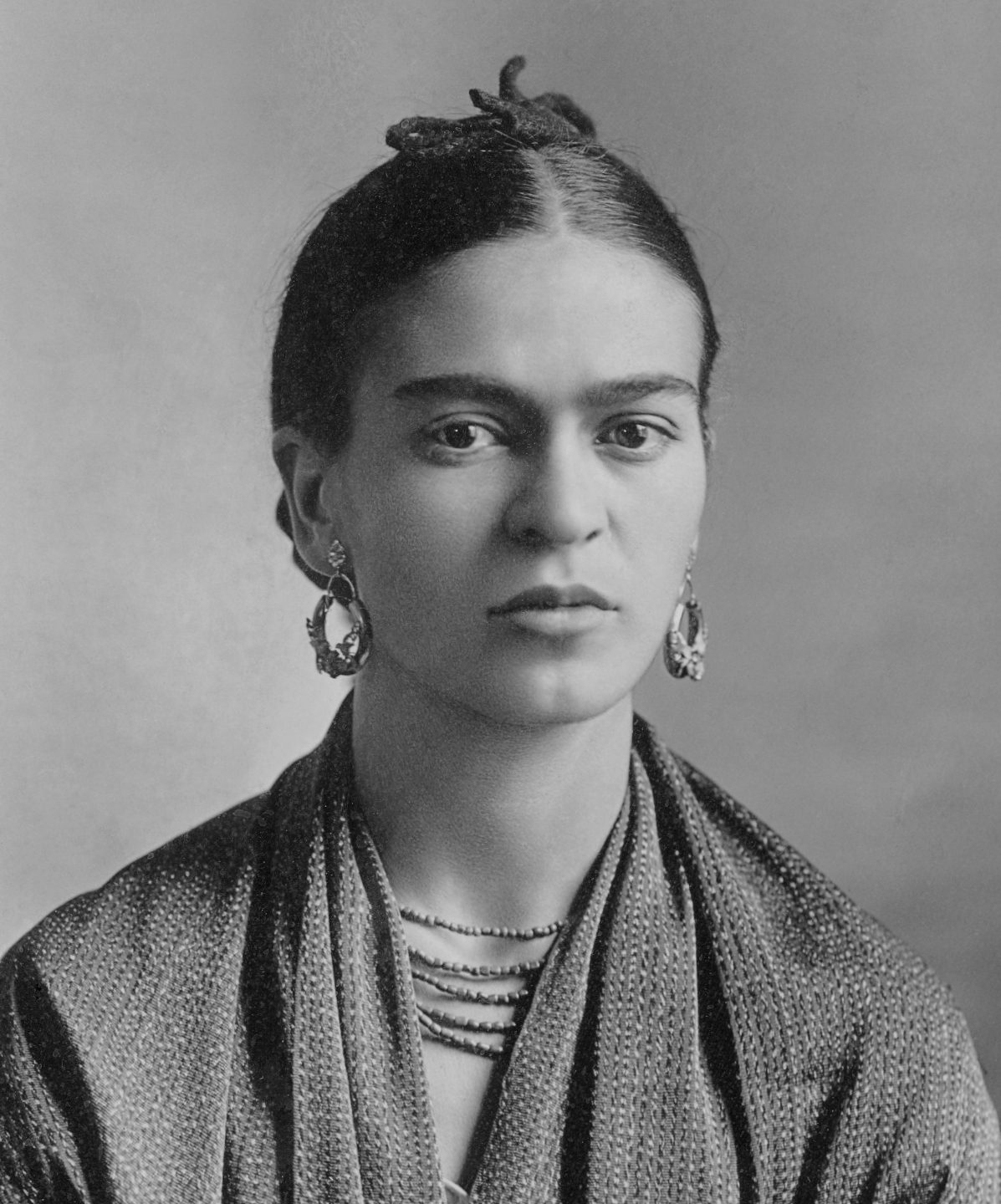
At a Glance
- Born
- 6 July 1907, Coyoacán, Mexico
- Died
- 13 July 1954, Coyoacán, aged 47
- The accident
- 1925 — the bus she was riding collided with a trolley; she suffered multiple fractures and underwent more than 30 medical procedures in later decades
- First known work
- Self-Portrait Wearing a Velvet Dress, 1926, painted while bedridden
- Marriage
- Diego Rivera — married 1929, divorced 1939, remarried 1940
- Milestone
- Her painting The Frame (c. 1938) was acquired by the French government, making her the first 20th-century Mexican artist in France's national collection
Introduction
Frida Kahlo was a Mexican painter best known for her uncompromising and brilliantly coloured self-portraits, which deal with identity, the human body and death. Her art was shaped by her experiences: lifelong health struggles and disability after a near-fatal bus accident, her Mexican and European heritage, and her complicated marriage to the muralist Diego Rivera, one of Mexico's most celebrated painters.
During her lifetime Kahlo was respected in creative circles in Mexico and elsewhere, but she struggled to make money from her art and was often overshadowed by Rivera's murals. Her reputation grew steadily after her death, reaching what some critics called Fridamania by the twenty-first century — a fame built on the whole body of her work rather than on any single painting.
Background
Kahlo was born in Coyoacán in 1907 to a German father of Hungarian descent, a professional photographer, and a Mexican mother of Spanish and Native American descent. She was especially close to her father and frequently assisted him in his studio, where she acquired a sharp eye for detail. As a child she suffered a bout of polio that left her with a slight limp. Although she took some drawing classes, she was more interested in science, and in 1922 she entered the National Preparatory School in Mexico City intending eventually to study medicine.
In 1925, riding a bus home from school, she was in a collision with a trolley that changed the direction of her life. Her injuries were catastrophic: multiple fractures in her spine, right leg, collarbone, ribs and pelvis, a dislocated shoulder, a crushed right foot, and her abdomen and uterus punctured by an iron handrail. The injuries plagued her for the rest of her life, through more than thirty medical procedures. While bedridden she taught herself to paint, studying the Old Masters, and produced her first known work, Self-Portrait Wearing a Velvet Dress, in 1926.
Timeline
- 6 July 1907
Born in Coyoacán, Mexico, daughter of photographer Guillermo Kahlo and Matilde Calderón.
- 1913
Contracts polio, which leaves her with a slight limp.
- 1922
Enters the National Preparatory School in Mexico City, intending to study medicine; there she first meets Diego Rivera, painting a mural.
- 1925
Seriously injured when her bus collides with a trolley; during her slow recovery she teaches herself to paint.
- 1926
Paints Self-Portrait Wearing a Velvet Dress, her first known work.
- 1929
Marries Diego Rivera; she adopts the traditional Tehuana dress that becomes her trademark.
- 1930–33
Accompanies Rivera to the United States for his mural commissions in San Francisco, Detroit and New York; paints Henry Ford Hospital and My Birth in 1932.
- 1938
First solo exhibition, at the Julien Levy Gallery in New York; the actor Edward G. Robinson buys four of her paintings.
- 1939
Shows in Paris; the French government acquires The Frame. She divorces Rivera, and remarries him the following year.
- 1953
Her first solo exhibition in Mexico; too ill to stand, she attends it in a bed. Her right leg is amputated later that year.
- 13 July 1954
Dies at home in Coyoacán, days after her 47th birthday; the documented cause is a pulmonary embolism.
Significance
Kahlo's subject was herself, examined without flinching. After her convalescence she joined the Mexican Communist Party, met Rivera again, showed him her work and was encouraged by him to continue. In the United States in the early 1930s, after a miscarriage in Detroit and the death of her mother, she painted some of her most harrowing works — Henry Ford Hospital, depicting herself haemorrhaging on a hospital bed amid a barren landscape, and My Birth, a taboo scene of a shrouded woman giving birth. No major artist before her had put the injured and reproductive female body at the centre of serious painting in this way.
Her identity was her material as much as her injuries. In her art she explored her ancestry as binary opposites — the colonial European side and the Indigenous Mexican side — and after marrying Rivera she remade her own image, wearing the flowered headdress, loose blouse, gold jewellery and long ruffled skirt of Tehuana dress. André Breton championed her as a self-taught Surrealist, a label she resisted; what she was doing was closer to autobiography, painted symbol by symbol.
Legacy
From 1943 Kahlo taught at La Esmeralda art school in Mexico City, holding classes at her home, La Casa Azul — the Blue House — when she was too ill to travel. Her last decade was one of declining health, and she died in 1954 at home in Coyoacán. Recognition came afterwards and then all at once: the double self-portrait The Two Fridas is often named her most famous painting, her home became a museum, and by the twenty-first century her face — painted by herself, on her own terms — had become one of the most reproduced images in the world.
Sources
- Encyclopaedia Britannica — Frida Kahlo
- Tate Modern — Frida: The Making of an Icon (exhibition)
- Encyclopaedia Britannica — Diego Rivera
The facts on this page were checked against these sources on 19 November 2026. The History Trail's permanent pages are researched and written for this site; the live profiles elsewhere on The History Trail are assembled automatically from Wikipedia and Wikidata.
About the Author
Researched and written by the The History Trail Editorial Team — the accountable editorial function behind this site's permanent story pages. The team works from the published sources cited on each page; it does not invent historians, reviewers or credentials, and it corrects errors openly.
Fact Check
Every load-bearing fact on this page traces to one of the sources listed above, and significant claims link to their source in the text. Our checking method is described on the methodology page; errors can be reported via the corrections page.
Sources & Citations
Cite this page as: The History Trail Editorial Team, The History Trail — this article's title, publication and update dates are shown beneath its headline. The full source list appears under Sources above; the site's source standards are on the sources page.