
Things
Basketball
Basketball is a game between two teams who score by throwing a ball through an elevated hoop - and it is the rare sport with a known inventor, place and date: James Naismith created it at the YMCA Training School in Springfield, Massachusetts, on 21 December 1891, using a soccer ball and two peach baskets, to give his students a safe indoor game for the winter.
At a Glance
- What it is
- A game between two teams, typically of five, who score by shooting the ball through the opponent's elevated hoop and net - the basket
- Inventor
- James Naismith (1861-1939), Canadian physical education instructor at the International YMCA Training School, Springfield, Massachusetts
- The date
- 21 December 1891 - the first game, played nine against nine with a soccer ball and two half-bushel peach baskets
- The rules
- Thirteen rules, posted in the gym and published in the Triangle on 15 January 1892; the original document sold at Sotheby's in 2010 for $4,338,500
- Why ten feet
- The baskets were nailed to the gymnasium balcony rail, which happened to be ten feet above the floor; the height has never changed
- The spread
- Carried worldwide by the YMCA: Canada first, then France (1893), England (1894) and Japan by 1900; FIBA founded 1932
- Olympic status
- Demonstration sport at St Louis 1904; an official Olympic sport from Berlin 1936, where Naismith presented the medals
Introduction
Most sports have no inventor. Basketball does. On 21 December 1891, in a gymnasium in Springfield, Massachusetts, a 30-year-old Canadian physical education instructor named James Naismith hung two peach baskets ten feet above the floor, posted thirteen typed rules on the bulletin board, and set his class of eighteen students to throwing a soccer ball into them. Britannica calls basketball the only major sport strictly of United States origin, and its origin is unusually well documented - the founding rules document itself survives, and in 2010 it sold at auction for more than four million dollars.
This page follows the documented story: why Naismith was asked to invent a game, what those first rules said and did not say, and how a winter gymnasium exercise spread through the YMCA network to the Olympic Games and the world.
A Winter Problem at Springfield
Naismith was teaching at the International YMCA Training School in Springfield - now Springfield College - when the New England winter closed in. Football season had ended, baseball was months away, and indoor exercise meant marching, calisthenics and gymnastics, which bored his restless class. The school's physical education head, Luther H. Gulick, asked Naismith to devise an indoor game that could replace the boring or dangerous exercises used in winter - by Smithsonian Magazine's account, he was given a fortnight to do it.
Naismith first tried adapting outdoor games indoors and found them too rough. As he later wrote in his book Basketball: Its Origin and Development, published posthumously in 1941, he studied games from the philosophical side. Small-ball games needed bats, sticks or racquets that took time to master; big-ball games like rugby relied on tackling, impossible indoors. He remembered a childhood game, duck on a rock, in which a stone was knocked off a larger rock by a lobbed throw - and concluded that his game's goal should be horizontal and elevated, so the ball had to be thrown in an arc, which would not encourage roughness. Players would not run with the ball at all.
Peach Baskets and Thirteen Rules
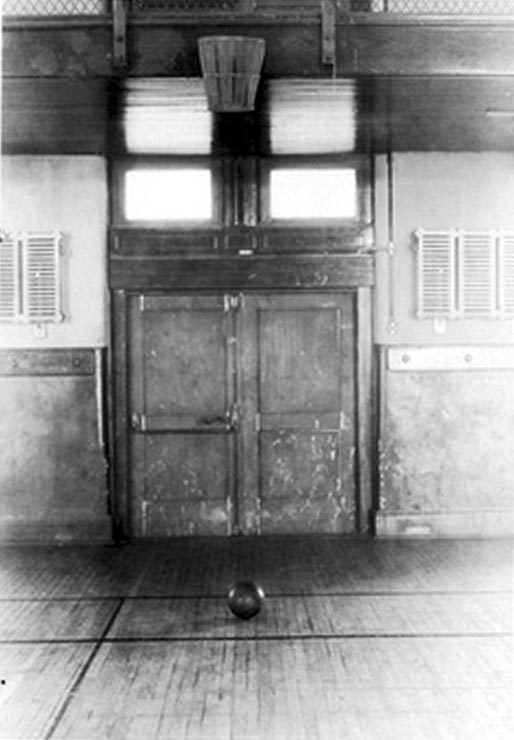
Naismith asked the building superintendent for two square boxes to use as goals. What he was brought instead was two half-bushel peach baskets. He nailed them to the lower rail of the gymnasium balcony, one at each end - the rail happened to be ten feet from the floor, and ten feet is the height of the basket to this day. The first game, on 21 December 1891, was played nine against nine with a soccer ball. After much running and shooting, William R. Chase made a midcourt shot - the only score of the contest, as Britannica records it.
The thirteen rules Naismith posted are the sport's founding document. Some survive almost unchanged: the ball may be thrown in any direction with one or both hands; a player cannot run with the ball; the side making the most goals shall be declared the winner. Others mark how different the first game was. There was no dribbling - a player in possession had to pass or shoot from the spot. The baskets kept their bottoms, so after each goal the ball had to be retrieved, at first by ladder. The rules were published on 15 January 1892 in the Triangle, the YMCA Training School's campus paper, and requests for copies arrived from associations everywhere.
Timeline
- 21 December 1891
James Naismith introduces basket ball at the YMCA Training School, Springfield, Massachusetts: nine against nine, a soccer ball, two peach baskets.
- 15 January 1892
Naismith's thirteen rules are published in the Triangle, the school's campus paper, and are sent to YMCAs across the country.
- 11 March 1892
The first public basketball game is played in Springfield before about 200 spectators; the students beat the teachers 5-1.
- 1893-1894
The game reaches France (1893) and England (1894); the first basketball is marketed in 1894, larger than a soccer ball.
- 18 January 1896
The first college game with five players a side: the University of Chicago beats the University of Iowa 15-12 at Iowa City.
- 1932
FIBA, the international basketball federation, is founded.
- 1936
Basketball becomes an official Olympic sport at Berlin; the 74-year-old Naismith presents the medals.
- 1949
The National Basketball Association (NBA) is formed in the United States.
- 1976
A women's basketball tournament is added to the Olympic Games at Montreal.
- 10 December 2010
Naismith's original rules document sells at Sotheby's in New York for $4,338,500, then a record for sports memorabilia.
From YMCA Gyms to the World
Basketball spread the way its inventor's employers could carry it: through the YMCA. Because Naismith and five of his original players were Canadians, Canada was the first country outside the United States to play the game; Britannica records its introduction in France in 1893 and England in 1894, then Australia, China and India, and Japan by 1900. The equipment evolved quickly - an iron hoop with a hammock-style net in 1893, a purpose-made laced ball in 1894, open-bottomed nets in 1912-13, so the ball could finally fall through. Team size settled at five in 1897.
The game's growth at home was not always welcome: within five years, Britannica notes, some YMCA associations outlawed it because gymnasiums once used by classes of fifty or sixty were now monopolised by ten to eighteen players - and members left to hire halls, which pushed basketball toward professional leagues. The colleges formed their own rules committee in 1905, FIBA was founded in 1932 to govern the international game, and in 1936 basketball became an official Olympic sport at Berlin, played outdoors on clay in the rain - the final, the United States against Canada, ended 19-8 in the mud, with Naismith himself presenting the medals.
Significance
Basketball's significance for sports history is its documentation. Football, boxing and most other games emerged over centuries from folk practice, and their origins can only be argued about. Basketball began on a known day, in a known room, from a written text by a named author who explained his reasoning and lived to see his game become an Olympic sport. That is why the two typed pages of the rules carry such weight: sold by the Naismith International Basketball Foundation at Sotheby's in New York on 10 December 2010, they made $4,338,500 including buyer's premium, then a record for sports memorabilia. The buyers, David and Suzanne Booth, intended the document for the University of Kansas, where Naismith coached from 1898.
Questions readers ask
Why ten feet? Because that was the height of the gymnasium balcony rail to which the peach baskets were nailed - an accident of architecture that became permanent. Why is it called basketball when the baskets are long gone? Because the name was fixed while the goals really were baskets; the iron hoop and net that replaced them kept the word. Did Naismith invent dribbling? No - his rules forbade running with the ball and made no provision for dribbling at all; the dribble developed later, within the rules' gaps, and was eventually written into the game.
Was the first game really 1-0? Britannica records a single score in that first contest, William R. Chase's midcourt shot. Scores stayed low for years - the 1936 Olympic final finished 19-8 - because the closed basket, the centre jump after every goal and two-handed set shots all slowed the game down. The sport Naismith designed to be safe and skilful became fast only after decades of small rule changes he did not live to see.
Legacy
Basketball is now organised internationally by FIBA and led professionally by leagues headed by the NBA, formed in 1949, and it is played recreationally on courts in parks, schools and driveways year-round. Its founder's name is carried by the Naismith Memorial Basketball Hall of Fame in Springfield, where the game began. Few inventions keep so much of their first draft: five players a side, a ball thrown through an elevated horizontal goal ten feet up - the peach basket is gone, but the geometry Naismith chose in December 1891 is still the geometry of every game played today.
Sources
- Encyclopaedia Britannica - Basketball
- Smithsonian Magazine - How a College Gym Teacher in Massachusetts Invented a New Sport
- Olympics.com - Olympic basketball's muddy beginnings
- Encyclopaedia Britannica - History of basketball
- KU Sports - Booths purchase original Naismith basketball rules at auction for more than $4 million
The facts on this page were checked against these sources on 19 November 2026. The History Trail's permanent pages are researched and written for this site; the live profiles elsewhere on The History Trail are assembled automatically from Wikipedia and Wikidata.
About the Author
Researched and written by the The History Trail Editorial Team — the accountable editorial function behind this site's permanent story pages. The team works from the published sources cited on each page; it does not invent historians, reviewers or credentials, and it corrects errors openly.
Fact Check
Every load-bearing fact on this page traces to one of the sources listed above, and significant claims link to their source in the text. Our checking method is described on the methodology page; errors can be reported via the corrections page.
Sources & Citations
Cite this page as: The History Trail Editorial Team, The History Trail — this article's title, publication and update dates are shown beneath its headline. The full source list appears under Sources above; the site's source standards are on the sources page.