
On This Day
June 18 in History
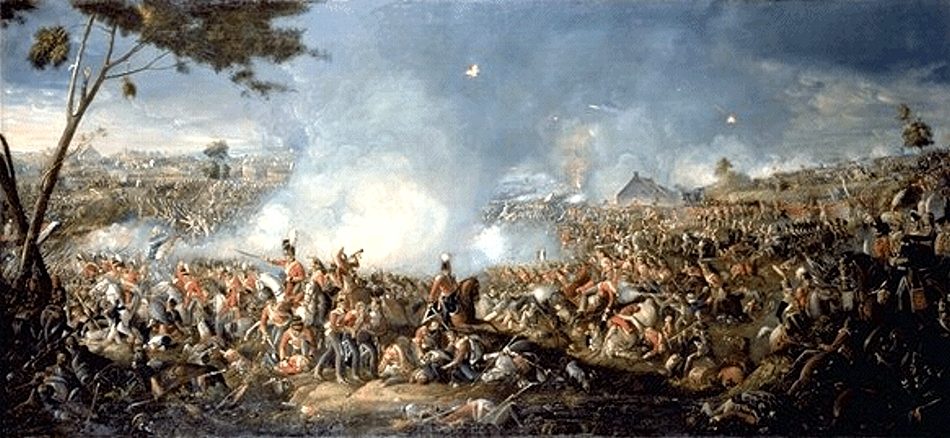
On 18 June 1815, near the village of Waterloo in present-day Belgium, Napoleon Bonaparte was defeated for the last time — ending 23 years of war in Europe.
Choose another date: open the On This Day calendar to browse events, births and deaths for any day of the year.
At a Glance
- Date
- 18 June 1815
- Place
- Near Waterloo, south of Brussels, in present-day Belgium
- Commanders
- Napoleon Bonaparte; the Duke of Wellington; Gebhard Leberecht von Blücher
- Forces
- About 72,000 French against 68,000 in Wellington's army, joined by some 45,000 Prussians
- Outcome
- French defeat; Napoleon abdicated four days later and was exiled to St Helena
Events on this day
- 618Li Yuan becomes Emperor Gaozu, founding three centuries of Tang dynasty rule in China.
- 1429French forces under Joan of Arc's banner defeat the English at the Battle of Patay.
- 1812President James Madison signs the US declaration of war on Britain, beginning the War of 1812.
- 1858Charles Darwin receives Alfred Russel Wallace's paper on evolution, prompting him to publish his own theory.
- 1873Susan B. Anthony is fined $100 for voting in the 1872 US presidential election.
- 1928Amelia Earhart becomes the first woman to fly across the Atlantic — as a passenger, with pilot Wilmer Stultz.
- 1940Charles de Gaulle broadcasts his Appeal of 18 June from London; Churchill delivers his 'Finest Hour' speech.
- 1948Columbia Records publicly introduces the long-playing vinyl record in New York.
- 1981The Lockheed F-117 Nighthawk stealth aircraft makes its first flight, in secret.
- 1983Sally Ride becomes the first American woman in space aboard the shuttle Challenger.
- 2023The submersible Titan implodes on a dive to the wreck of the Titanic, killing all five aboard.
Born on this day
- 1886George Mallory — English mountaineer who vanished near Everest's summit in 1924.
- 1901Grand Duchess Anastasia Nikolaevna — youngest daughter of Tsar Nicholas II, murdered in 1918.
- 1918Franco Modigliani — Italian-American economist, Nobel laureate for his life-cycle theory of saving.
- 1929Jürgen Habermas — German philosopher and sociologist of the public sphere.
- 1942Paul McCartney — English singer-songwriter, co-founder of the Beatles.
- 1942Roger Ebert — American film critic who brought serious criticism to a mass audience.
- 1942Thabo Mbeki — second president of post-apartheid South Africa.
- 1952Isabella Rossellini — Italian actress and model, star of Blue Velvet.
Died on this day
- 1464Rogier van der Weyden — Flemish painter, one of the masters of Early Netherlandish art.
- 1815Thomas Picton — Welsh general, the most senior British officer killed at Waterloo on this day.
- 1928Roald Amundsen — Norwegian explorer, first to the South Pole, lost on an Arctic rescue flight.
- 1936Maxim Gorky — Russian novelist and playwright, founder of socialist realism.
- 1974Georgy Zhukov — Soviet marshal who led the Red Army's drive to Berlin.
- 2010José Saramago — Portuguese novelist, Nobel laureate, author of Blindness.
- 2014Stephanie Kwolek — American chemist who invented Kevlar.
- 2024Willie Mays — American baseball great, among the finest all-round players ever.
The featured story: Napoleon's last day
Waterloo was the final throw of the most dramatic comeback in military history. Exiled to the island of Elba in 1814, Napoleon escaped in February 1815, landed in France with a thousand men, and watched the army sent to arrest him join him instead. By 20 March he was back in Paris and Louis XVIII had fled. Europe's powers — Britain, Prussia, Austria and Russia — each pledged 150,000 men to remove him for good, but their armies needed until July to assemble. Napoleon's only chance was to strike first, in Belgium, and destroy Wellington's Anglo-allied army and Blücher's Prussians separately before they could combine.
He nearly did it. On 16 June Napoleon beat the Prussians at Ligny while Marshal Ney held Wellington at Quatre Bras — but neither enemy was destroyed. Blücher's beaten army retreated north to Wavre, keeping contact with Wellington, instead of east away from him: the decision that decided the campaign. Wellington, promised Prussian help, stood his ground on a ridge south of the village of Waterloo, along the road to Brussels, anchoring his line on the fortified farm of Hougoumont and the walled farmhouse of La Haye Sainte. Napoleon, his army slowed by a night of torrential rain, delayed his attack until late morning on 18 June to let the sodden ground dry enough for his artillery and cavalry.
The battle became a test of endurance that Wellington's line only just passed. From about 11:30 a.m. the French attacked in waves: a diversion at Hougoumont that consumed thousands of men all day, a massed infantry assault beaten back by British cavalry — which then over-pursued and was cut down in turn — and repeated charges by thousands of French horsemen against infantry squares that refused to break. Ney finally took La Haye Sainte in the early evening, but there were no reserves left to exploit it. Meanwhile, from mid-afternoon, Prussian corps were arriving on Napoleon's right flank, exactly as Blücher had promised. Napoleon's last card, the Imperial Guard, advanced up the ridge at about 7:30 p.m. and was repulsed. Wellington ordered a general advance, the French army dissolved into rout, and at about 9:15 p.m. Wellington and Blücher met at the inn of La Belle Alliance.
The cost was savage for a single day: roughly 25,000 French killed and wounded and 9,000 captured, about 15,000 casualties in Wellington's army and 8,000 among the Prussians. Four days later Napoleon abdicated for the second and last time; in October the British shipped him to St Helena, in the South Atlantic, where he died in 1821. Waterloo is often said to have closed 23 years of warfare that began with revolutionary France in 1792 — near-continuous, though broken by short peaces such as Amiens in 1802–03, and it fixed the word itself in the language: to 'meet your Waterloo' is still to suffer the defeat from which there is no return.
Why this date matters
June 18 keeps returning to the theme of turning points argued in public. Waterloo ended Napoleon's era, and with it the long revolutionary and Napoleonic wars; in 1858 the Darwin–Wallace letters set science's greatest argument in motion; in 1940, on this same date, de Gaulle appealed to France to resist and Churchill promised a 'finest hour' — speeches that consciously answered Napoleon's century. Even the day's quieter entries, from the LP record in 1948 to Sally Ride's flight in 1983, mark moments when a field changed direction in a single day. Few dates let you watch history pivot so often.
Sources
- Encyclopaedia Britannica — Battle of Waterloo
- Encyclopaedia Britannica — Battle of Waterloo: Crisis and the French collapse
- Wikipedia — June 18 (events, births and deaths lists)
- Wikimedia Commons — Sadler, Battle of Waterloo

The facts on this page were checked against these sources on 18 November 2026. The History Trail's permanent pages are researched and written for this site; the live profiles elsewhere on The History Trail are assembled automatically from Wikipedia and Wikidata.
About the Author
Researched and written by the The History Trail Editorial Team — the accountable editorial function behind this site's permanent story pages. The team works from the published sources cited on each page; it does not invent historians, reviewers or credentials, and it corrects errors openly.
Fact Check
Every load-bearing fact on this page traces to one of the sources listed above, and significant claims link to their source in the text. Our checking method is described on the methodology page; errors can be reported via the corrections page.
Sources & Citations
Cite this page as: The History Trail Editorial Team, The History Trail — this article's title, publication and update dates are shown beneath its headline. The full source list appears under Sources above; the site's source standards are on the sources page.