
Things
Sherlock Holmes
Sherlock Holmes is a fictional detective created by the Scottish writer Arthur Conan Doyle, first published in A Study in Scarlet in 1887. He never lived, yet his methods influenced real forensic science, his readers refused to let him die, and Guinness World Records lists him as the most portrayed literary human character in film and television history.
At a Glance
- Creator
- Arthur Conan Doyle (1859-1930), Scottish writer and doctor, who modelled Holmes's methods on his Edinburgh professor, Dr Joseph Bell
- First appearance
- A Study in Scarlet, published in Beeton's Christmas Annual in 1887
- The canon
- Four novels and 56 short stories, published between 1887 and 1927 and narrated mostly by Dr John H. Watson
- The address
- 221B Baker Street, London - fictional when Doyle wrote, later given to the Sherlock Holmes Museum, which opened in 1990
- Death and return
- Killed at the Reichenbach Falls in "The Final Problem" (1893); brought back in "The Adventure of the Empty House" (1903) after public outcry
- The look
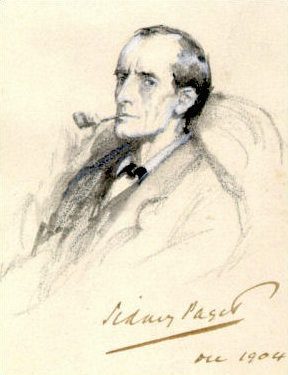
- Sidney Paget's Strand Magazine illustrations fixed Holmes's image; the deerstalker cap comes from Paget, not from Doyle's text
- The record
- Guinness World Records listed Holmes in 2012 as the most portrayed literary human character in film and television, with over 75 actors in more than 250 productions
Introduction
Holmes called himself the world's first and only consulting detective: clients, and often the police, came to his Baker Street rooms when a case had beaten everyone else, and he solved it by observation and reasoning. Britannica calls him the prototype for the modern mastermind detective, anticipated by Edgar Allan Poe's C. Auguste Dupin and Emile Gaboriau's Monsieur Lecoq, but far more enduring than either. Through four novels and 56 short stories, his companion Dr John H. Watson recorded the cases, the violin playing and the chemical experiments.
This page is not a biography of a real man, because there was none. It is the documented history of a character: how a magazine and an illustrator made him famous, how his readers mourned and then resurrected him, and how fiction left marks on real police work, real streets and real fan culture.
Creation: A Doctor, a Professor and a Christmas Annual
Arthur Conan Doyle studied medicine at the University of Edinburgh, where he worked for Dr Joseph Bell, a surgeon famous for diagnosing patients from tiny details of dress, hands and speech. Doyle modelled Holmes's methods on Bell, and said so openly: the detective reads a stranger the way Bell read a patient. A Study in Scarlet, which opens with Holmes inventing a chemical test for bloodstains and meeting Watson, appeared in Beeton's Christmas Annual in 1887. A second novel, The Sign of the Four, followed in 1890.
The novels sold modestly. Fame came when Doyle turned to short stories and The Strand Magazine, a new London monthly, began publishing them in 1891, starting with "A Scandal in Bohemia." The Strand put a complete Holmes case in every issue, and Sidney Paget illustrated them, producing more than 350 drawings across the stories. Paget's Holmes - lean, sharp-featured, elegant - was handsomer than Doyle's text required, and it became the face the world recognised.
Death at Reichenbach and the Readers' Revolt
Doyle soon tired of his creation, complaining that Holmes distracted him from better things. In "The Final Problem," published in the Strand in December 1893, Holmes grappled with Professor James Moriarty, the Napoleon of crime, at the Reichenbach Falls in Switzerland, and both men plunged over the precipice. Doyle considered the matter closed.
His readers did not. Britannica records that popular outcry was great and that more than 20,000 readers cancelled their subscriptions to the Strand. Doyle held out for years, then softened in stages: The Hound of the Baskervilles, serialised in 1901-02, was set before Holmes's death, and in "The Adventure of the Empty House" in 1903 Holmes returned outright, explaining that he had survived and hidden from Moriarty's organisation. Doyle went on writing Holmes stories until 1927.
The Detective Who Taught Real Detectives
Holmes's influence on real investigation is a matter of record, not just admiration. The stories were published when forensic science was young, and Holmes used, in fiction, methods that police forces were only beginning to adopt: fingerprint identification, the preservation and reading of footprints and trace evidence, the chemical analysis of poisons and blood, and monographs on subjects such as tobacco ash. Generations of forensic scientists have credited the stories with popularising the idea that a crime scene is a text that science can read.
The traffic ran both ways. Doyle took Holmes's method from a real doctor's diagnostic observation, and real investigators then took it back from the stories as a model of evidence-led detection. That is why Holmes is routinely discussed in histories of forensic science as well as of literature: he did not invent the methods, but he made millions of readers, including future police officers and scientists, believe in them.
Timeline
- 1887
A Study in Scarlet is published in Beeton's Christmas Annual - the first appearance of Sherlock Holmes and Dr Watson.
- 1890
The Sign of the Four, the second Holmes novel, is published.
- 1891
"A Scandal in Bohemia" opens the short-story series in The Strand Magazine, illustrated by Sidney Paget; Holmes becomes a sensation.
- 1892
The Adventures of Sherlock Holmes collects the first twelve Strand stories in book form.
- December 1893
"The Final Problem" sends Holmes and Moriarty over the Reichenbach Falls; more than 20,000 readers are reported to have cancelled Strand subscriptions.
- 1901-02
The Hound of the Baskervilles is serialised, set before Holmes's death - a return in all but name.
- 1903
"The Adventure of the Empty House" resurrects Holmes, who explains his survival and three years in hiding.
- 1912
Ronald Knox publishes "Studies in the Literature of Sherlock Holmes," treating the stories as real documents - a founding text of Holmes scholarship and fandom.
- 1927
"The Adventure of Shoscombe Old Place," the last Holmes story, completes a canon of four novels and 56 short stories.
- 1934
Christopher Morley founds the Baker Street Irregulars in New York, the first Sherlockian literary society.
- 1990
The Sherlock Holmes Museum opens on Baker Street in London, displaying the number 221B by permission of the City of Westminster.
- 2012
Guinness World Records lists Holmes as the most portrayed literary human character in film and television history.
Significance
Holmes set the template that detective fiction still follows: the brilliant, eccentric reasoner, the loyal ordinary narrator who asks the reader's questions, the recurring police foil, and the case solved by clues the reader was shown but did not read. Agatha Christie's Poirot and nearly every screen detective since are defined partly against him. Britannica notes that although earlier fictional detectives existed, Holmes made a singular impact on the popular imagination and remains the most enduring character of the detective story.
He also pioneered modern fan culture. From 1912, scholars such as Ronald Knox wrote about Holmes as if he were real and Doyle merely Watson's literary agent - a game fans still call playing the Game. The Baker Street Irregulars, founded in 1934, and the Sherlock Holmes Society of London built societies, journals and annual dinners around a man who never existed, decades before organised fandom had a name. Letters addressed to Holmes arrived at Baker Street in such numbers that the building society occupying the real 221 answered them for years, and in 1990 a museum opened at 221B, furnished as the stories describe.
Myths and disputes
Did Holmes wear a deerstalker? Not in Doyle's words. The text gives him an ear-flapped travelling cap in the country and a close-fitting cloth cap in "The Boscombe Valley Mystery," but never names a deerstalker. Britannica is explicit: two emblems of Holmes, the deerstalker cap and the curved meerschaum pipe, are not original to Doyle's writings - Sidney Paget drew the cap in his Strand illustrations of Holmes working in the country, and the actor William Gillette introduced the curved pipe on stage, where it was easier on his jaw through a long performance.
Did he say "Elementary, my dear Watson"? Never, in that form, anywhere in Doyle's stories - Britannica confirms the famous phrase does not actually appear, though Holmes does call things elementary and does address my dear Watson. The sentence is a gift from stage and screen, not from the page.
Did London clerks wear mourning bands when Holmes died? That detail is often repeated, and Britannica repeats it, but later researchers have found no trace of it in the newspapers of the time, and it is best treated as legend. The documented facts are strong enough without it: the Strand lost subscribers in the tens of thousands, by the magazine tradition, and the public pressure on Doyle was real, sustained and eventually successful.
Legacy
Holmes has never been out of print, and the adaptations have never stopped: stage plays from William Gillette onward, Basil Rathbone's films, Jeremy Brett's television series, and in this century Robert Downey Jr., Benedict Cumberbatch and Jonny Lee Miller have all played him. Guinness World Records' 2012 listing counted more than 75 actors in over 250 film and television productions, and the total has grown since.
The deepest legacy may be the habit of mind. A fictional character taught the reading public to expect that evidence, patiently observed and honestly reasoned over, can answer questions that look like mysteries. Doyle, who wanted to be remembered for other books, is remembered for Holmes.
Sources
- Encyclopaedia Britannica - Sherlock Holmes
- Encyclopaedia Britannica - Arthur Conan Doyle
- Indiana University Lilly Library - In the Beginning: The History of the Baker Street Irregulars
- The Baker Street Irregulars - BSI History
- Livingston Public Library - Sherlock Holmes on Page and Screen
- Wikipedia - Sherlock Holmes Museum
The facts on this page were checked against these sources on 19 November 2026. The History Trail's permanent pages are researched and written for this site; the live profiles elsewhere on The History Trail are assembled automatically from Wikipedia and Wikidata.
About the Author
Researched and written by the The History Trail Editorial Team — the accountable editorial function behind this site's permanent story pages. The team works from the published sources cited on each page; it does not invent historians, reviewers or credentials, and it corrects errors openly.
Fact Check
Every load-bearing fact on this page traces to one of the sources listed above, and significant claims link to their source in the text. Our checking method is described on the methodology page; errors can be reported via the corrections page.
Sources & Citations
Cite this page as: The History Trail Editorial Team, The History Trail — this article's title, publication and update dates are shown beneath its headline. The full source list appears under Sources above; the site's source standards are on the sources page.