
People
Agatha Christie
Agatha Christie (1890–1976) was the English detective novelist and playwright who created Hercule Poirot and Miss Marple, wrote 66 detective novels and The Mousetrap, the world's longest-running play, and became — in her official estate's words — the best-selling novelist of all time.
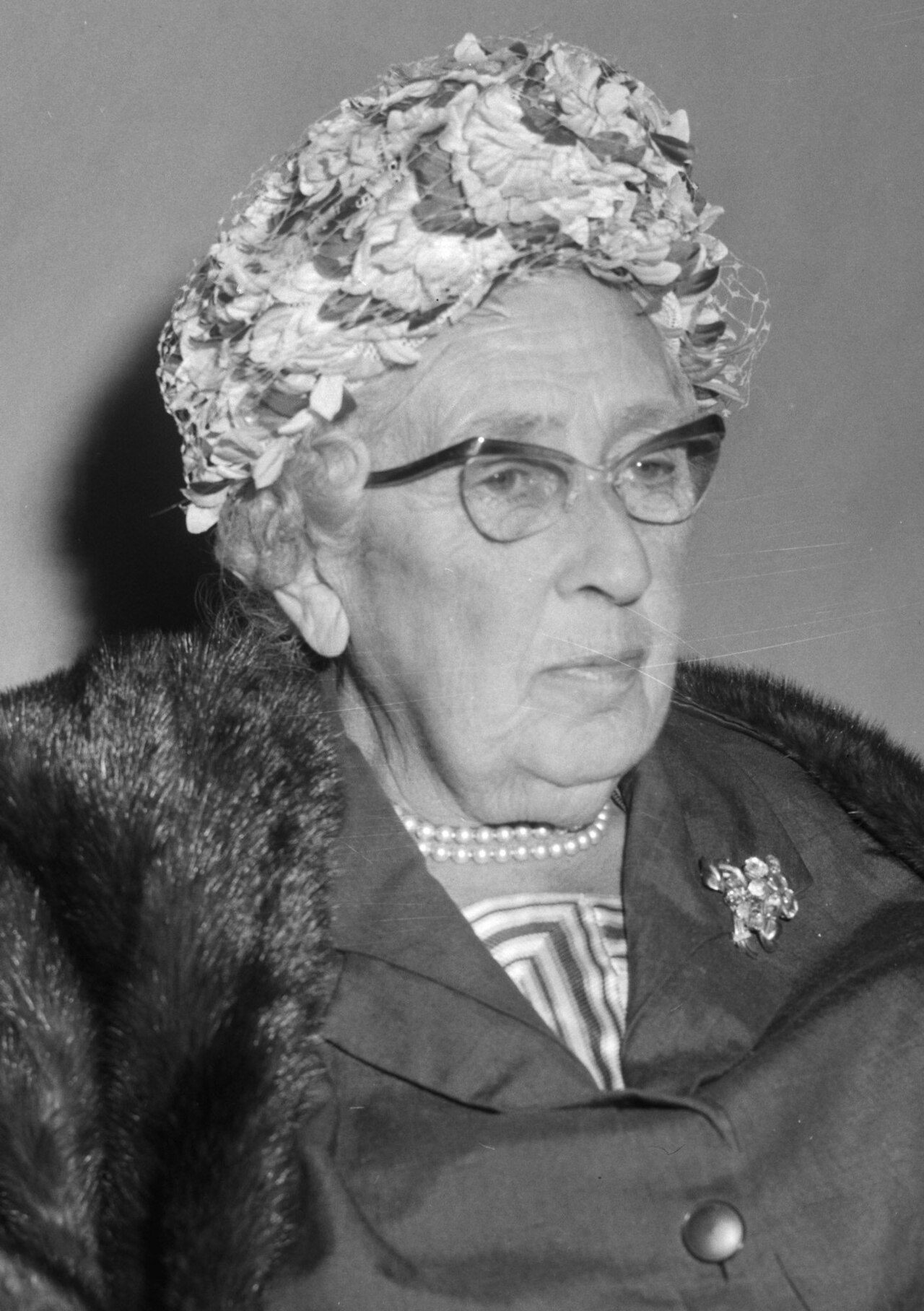
At a Glance
- Born
- 15 September 1890, Ashfield, Torquay, Devon, as Agatha Mary Clarissa Miller
- Died
- 12 January 1976, Wallingford, Oxfordshire, aged 85
- Detective novels
- 66, plus 14 short story collections (official Agatha Christie site)
- Famous detectives
- Hercule Poirot (from 1920) and Miss Jane Marple (from 1930)
- Sales
- Over a billion copies in English and a billion in translation, per the official site
- Honour
- Made a Dame Commander of the Order of the British Empire (DBE) in 1971
- Longest-running play
- The Mousetrap, running in London since 1952
Introduction
Agatha Christie was an English detective novelist and playwright, born on 15 September 1890 in Torquay, Devon, and died on 12 January 1976 in Wallingford, Oxfordshire. Widely known as the 'Queen of Crime', she wrote 66 detective novels and 14 short story collections, built around two of fiction's most durable detectives: the fastidious Belgian Hercule Poirot and the sharp-eyed village spinster Miss Jane Marple.
Her readership is measured on a scale few writers approach. Her official site records that her books have sold over a billion copies in the English language and a billion in translation, and describes her as the best-selling novelist of all time; Britannica notes that her works are reportedly outsold only by William Shakespeare and the Bible. She achieved this from a standing start: a home-educated girl from a Devon seaside town, whose first detective novel was written on a bet with her sister and completed in the middle of a world war.
Background
Agatha Mary Clarissa Miller was born at Ashfield, a large house in Torquay, the youngest child of Frederick Miller, a wealthy American, and his wife Clara. She was, in the official biography's phrase, a 'much-loved afterthought', arriving ten years after her brother and eleven after her sister Madge. She did not go to school; Britannica records that she was educated at home by her mother, and the comfortable, bookish childhood at Ashfield — a big garden, the sea nearby — became the social world her village mysteries would later anatomise so precisely.
The First World War made her a writer. She worked as a nurse in Torquay, then transferred to the hospital dispensary, training under an experienced pharmacist, and in 1917 she completed the examination of the Worshipful Society of Apothecaries — acquiring the detailed knowledge of poisons that runs through her fiction. It was during this wartime work, the official site records, that her sister Madge bet she could not write a good detective story. She worked out her plot, found her murderer, and chose her detective: a Belgian refugee policeman, one of the many Belgian war refugees then in Torquay. She completed The Mysterious Affair at Styles in 1916, and Hercule Poirot entered fiction.
Timeline
- 15 September 1890
Agatha Mary Clarissa Miller is born at Ashfield, Torquay, Devon, the youngest of three children.
- 1914
She marries Archie Christie and begins wartime work, nursing in Torquay before transferring to the hospital dispensary.
- 1917
She qualifies as a dispenser, completing the examination of the Worshipful Society of Apothecaries.
- 1920
The Mysterious Affair at Styles is published, introducing Hercule Poirot; it had been completed in 1916, after a bet with her sister Madge.
- 1926
The Murder of Roger Ackroyd brings her first major recognition — but her mother dies, her marriage breaks down, and in December she disappears for eleven days.
- 1930
Miss Marple makes her first appearance in a novel, in The Murder at the Vicarage; the same year Christie marries the archaeologist Max Mallowan.
- 1939
And Then There Were None is published, later among the best-selling novels of all time; during the Second World War she again works in a hospital dispensary.
- 1952
The Mousetrap opens in London; it becomes the world's longest-running play.
- 1971
She is created a Dame Commander of the Order of the British Empire for her contribution to literature.
- 1975
Curtain is published: Poirot's last case, in which the detective returns to Styles, the scene of his first, and dies.
- 12 January 1976
Agatha Christie dies at Wallingford, Oxfordshire, aged 85.
Significance
Christie's first major recognition came with The Murder of Roger Ackroyd in 1926, and Britannica records that the novels which followed — some 75 in all — usually made best-seller lists and were serialised in popular magazines in England and the United States. Her method was deceptively plain: a closed circle of suspects, clues laid fairly before the reader, and a solution that rearranged everything the reader thought they had seen. Poirot appeared in about 25 novels and many short stories; Marple, arriving in 1930, solved her cases from an armchair, armed with village parallels for every kind of human wickedness.
She was equally successful on stage and in other forms. The Mousetrap, which opened in 1952, set a world record for the longest continuous run at one theatre — 8,862 performances at the Ambassadors Theatre in London — before transferring in 1974 and continuing until the COVID-19 pandemic closed theatres in 2020, by which time it had passed 28,200 performances. Under the name Mary Westmacott she wrote six romantic, non-detective novels, including Absent in the Spring (1944), keeping the pseudonym secret for years. Her books were repeatedly adapted for film — Murder on the Orient Express, Death on the Nile and And Then There Were None among them — and for television.
Legacy
Christie was created a Dame Commander of the Order of the British Empire in 1971, and her Autobiography appeared posthumously in 1977. The figures attached to her work have only grown since her death: the official estate presents her as the best-selling novelist of all time, with sales counted in billions and translations into around a hundred languages. The Mousetrap still anchors her stage reputation, and new film and television versions of Poirot and Marple continue to recruit readers who then work backwards through the novels.
Her deeper legacy is structural. The country-house mystery, the village of suspects, the least-likely murderer and the drawing-room revelation are now the common grammar of crime fiction, parodied and imitated everywhere precisely because Christie fixed their forms. Writers of detective stories still work in a house she built — usually, like her readers, trying to guess the ending before she reveals it.
Sources
- Agatha Christie Ltd (official site) — About Agatha Christie
- Encyclopaedia Britannica — Agatha Christie
- The National Archives — Police report on the disappearance of Agatha Christie
- Surrey Police & Crime Commissioner — Agatha Christie's mysterious disappearance
The facts on this page were checked against these sources on 19 November 2026. The History Trail's permanent pages are researched and written for this site; the live profiles elsewhere on The History Trail are assembled automatically from Wikipedia and Wikidata.
About the Author
Researched and written by the The History Trail Editorial Team — the accountable editorial function behind this site's permanent story pages. The team works from the published sources cited on each page; it does not invent historians, reviewers or credentials, and it corrects errors openly.
Fact Check
Every load-bearing fact on this page traces to one of the sources listed above, and significant claims link to their source in the text. Our checking method is described on the methodology page; errors can be reported via the corrections page.
Sources & Citations
Cite this page as: The History Trail Editorial Team, The History Trail — this article's title, publication and update dates are shown beneath its headline. The full source list appears under Sources above; the site's source standards are on the sources page.