
Things
The Championships, Wimbledon
The Championships, Wimbledon is the oldest tennis tournament in the world and the only one of the four Grand Slam events still played on grass: it was first held in July 1877 at Worple Road, where Spencer Gore won the only event, the Gentlemen's Singles, from 22 entrants, and since 1922 it has been staged at Church Road in Wimbledon, London.
At a Glance
- First Championships
- 9-19 July 1877 at Worple Road, Wimbledon; 22 men entered the Gentlemen's Singles, the only event, paying a guinea each
- First champion
- Spencer Gore, an Old Harrovian rackets player, who beat William Marshall 6-1, 6-2, 6-4 in the final; about 200 spectators paid a shilling to watch
- Organiser
- The All England Lawn Tennis and Croquet Club (AELTC), founded in 1868 as the All England Croquet Club
- Home since 1922
- Church Road, Wimbledon, London SW19, opened by King George V; Centre Court there has been the tournament's stage ever since
- Surface
- Outdoor grass - the only Grand Slam tournament still played on the original surface
- Women
- The Ladies' Singles began in 1884, won by Maud Watson from a field of 13; equal prize money with the men arrived in 2007
- Open Era
- Wimbledon admitted professionals in 1968; Rod Laver and Billie Jean King won the singles, from a total prize fund of 26,150 pounds
Introduction
Wimbledon is less a tournament than an institution that happens to hold one. It is the oldest championship in tennis, the most prestigious by common consent, and the most deliberately traditional: grass courts, white clothing for players, a public ballot, an overnight queue, and strawberries and cream in season. Yet the institution began as a small fundraiser by a croquet club that had only just added a fashionable new game, and its first champion doubted the game had a future at all.
1877: A Croquet Club Tries a New Game
The All England Croquet Club was founded on 23 July 1868, at the height of a croquet craze, on grounds off Worple Road in Wimbledon, a suburb of southwest London. Lawn tennis, publicised by Major Wingfield from 1873, was introduced at the club in 1875 and proved so popular that in spring 1877 the club renamed itself the All England Croquet and Lawn Tennis Club and announced a championship, advertised in the sporting magazine The Field.
The inaugural Championships opened on 9 July 1877. There was one event only, the Gentlemen's Singles; 22 men paid a guinea each to enter, rain stretched the tournament over more days than planned, and the final was played on 19 July. Spencer Gore, a 27-year-old surveyor and accomplished rackets player, beat William Marshall 6-1, 6-2, 6-4 in 48 minutes, received a silver challenge cup valued at 25 guineas donated by The Field and 12 guineas in prize money, before about 200 spectators who had paid a shilling each. The club's committee, meanwhile, had made the decisions that standardised tennis itself: a rectangular court 78 feet by 27 feet, and real tennis scoring of 15, 30, 40, game. Gore himself is reported to have doubted that lawn tennis would ever rank among the great games - the first of many Wimbledon predictions the tournament outlived.
Growth at Worple Road
The Championships expanded steadily. In 1884 the club added the Ladies' Singles and the Gentlemen's Doubles: Maud Watson beat her sister Lilian to become the first ladies' champion, from a field of 13. William Renshaw won seven singles titles in the 1880s, a record that stood for more than a century, and the Doherty brothers, Reggie and Laurie, dominated either side of 1900. Championship status for ladies' doubles and mixed doubles came in 1913. May Sutton of the United States in 1905 became the first overseas champion, and Norman Brookes of Australia in 1907 the first overseas men's champion, marking Wimbledon's turn from a British club event into a world championship in all but name.
The First World War cost four years of Championships, from 1915 to 1918, and by the resumption the Worple Road grounds were too small for the crowds the tournament now drew. A move had been planned before the war; it was completed in 1922.
Church Road, War and the Open Era
In 1922 the club moved to its present grounds on Church Road, opened by King George V and built around a new Centre Court designed to hold about 14,000 spectators - a scale many thought a white elephant. The same year the club abolished the challenge round, under which the defending champion had stood out until the final; from 1922 champions played through every round like everyone else. Suzanne Lenglen and the French musketeers lit up the 1920s, Fred Perry won three titles in the 1930s ending a long home drought, and BBC television broadcast from the courts from 1937. The Second World War stopped the Championships from 1940 to 1945; a bomb struck Centre Court's roof in October 1940, and seating was still restricted when play resumed in 1946.
The postwar decades belonged first to the Australians - Lew Hoad, Rod Laver, Roy Emerson and John Newcombe - and to champions such as Althea Gibson, in 1957 the first Black player to win a Wimbledon singles title, and Maureen Connolly, who won three straight ladies' titles as a teenager. In 1968 Wimbledon went Open: professionals were admitted, prize money was paid for the first time - 26,150 pounds in total, 2,000 pounds to men's champion Laver and 750 pounds to ladies' champion Billie Jean King - and exiled champions returned. Virginia Wade's victory in the centenary year of 1977, before Queen Elizabeth II in her Silver Jubilee year, remains the beloved home triumph of the Open Era's first decade, until Andy Murray ended a 77-year wait for a British men's champion in 2013.
Timeline
- 23 July 1868
The All England Croquet Club is founded at Wimbledon; its first ground is off Worple Road.
- 1875
Lawn tennis is introduced at the club and quickly eclipses croquet in popularity.
- 9-19 July 1877
The first Championships: Spencer Gore wins the Gentlemen's Singles, the only event, from 22 entrants; about 200 watch the final.
- 1884
The Ladies' Singles and Gentlemen's Doubles are added; Maud Watson becomes the first ladies' champion.
- 1905-1907
May Sutton (1905) and Norman Brookes (1907) become the first overseas singles champions.
- 1922
The Championships move to Church Road, opened by King George V; the challenge round is abolished.
- 1937
BBC television broadcasts from Wimbledon for the first time.
- 1940-1945
No Championships during the Second World War; a bomb damages Centre Court in October 1940.
- 1968
Wimbledon goes Open: professionals admitted and prize money paid for the first time; Laver and King win the singles.
- 1977
In the centenary Championships, Virginia Wade wins the ladies' singles before Queen Elizabeth II.
- 2007
Wimbledon introduces equal prize money for men and women.
- 2009
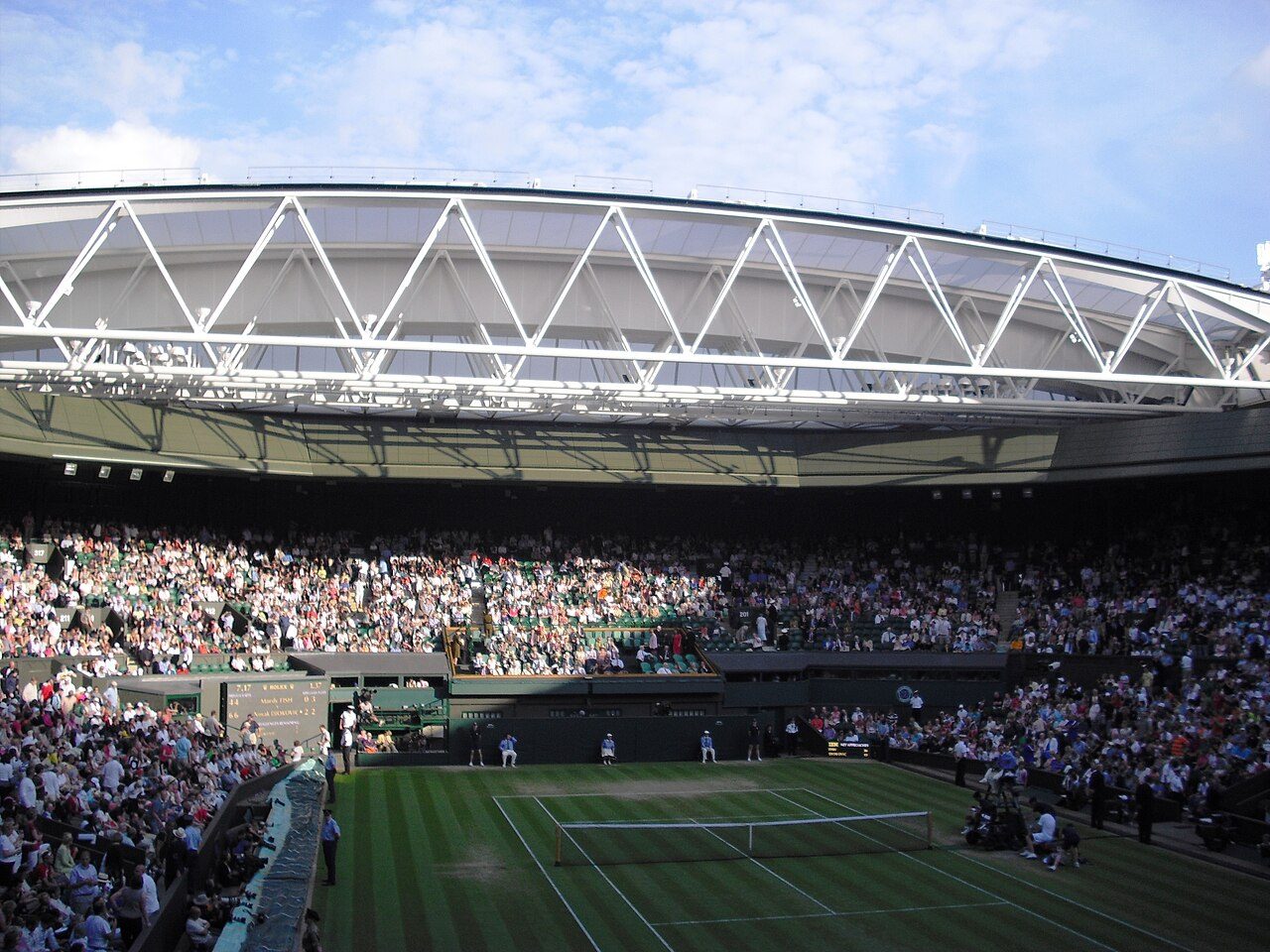
Centre Court's retractable roof is used for the first time; No. 1 Court gains a roof in 2019. The 2020 Championships are cancelled for the pandemic, the first cancellation since the Second World War.
Significance
Wimbledon's significance is that a private members' club tournament became the sport's supreme prize while remaining recognisably itself. Its committee's rules of 1877 became the world's rules; its champions list is the sport's roll of honour, from Renshaw and Lenglen through Perry, Laver, King, Borg, Navratilova, Graf, Sampras, Federer and the Williams sisters; and its fortnight anchors the tennis calendar as the third Grand Slam event of the year and the only one on grass. The club distributes its surplus to British tennis through the Lawn Tennis Association, making the Championships the game's financial engine in Britain as well as its showcase.
Traditions, questions and disputes
Why strawberries and cream? The honest answer is season and fashion rather than invention: strawberries were a fashionable summer food when the Championships began, and the tournament falls in the short English strawberry season. The association is documented from the early Championships, and the scale is now industrial - in 2017, fans consumed 34,000 kilograms of English strawberries and 10,000 litres of cream, figures reported from the club's own catering. The queue is likewise a documented tradition the club itself organises and celebrates: Wimbledon remains one of the few major events where prime tickets are sold on the day, and thousands camp overnight in Wimbledon Park for them, receiving numbered queue cards and court wristbands from stewards in the morning.
Two disputes recur. The all-white dress code - competitors must wear almost entirely white, a rule the club enforces strictly - is defended as heritage and criticised as anachronism; the club has adjusted it in small ways, including permitting women's dark undershorts from 2023, without abandoning it. And the club's wartime and pandemic cancellations settle a common error: Wimbledon has not been held every year since 1877. It was suspended for both world wars and cancelled in 2020, the first peacetime cancellation in its history.
Legacy
The legacy is continuity under pressure. The tournament now fills a 42-acre site, roofs its two main courts against the weather that delayed its first final, and broadcasts worldwide - yet it still plays on grass, still sells tickets to people who queued overnight, and still calls its singles events the Gentlemen's and Ladies'. Spencer Gore thought the game would never rank among the great games. The Championships he won in 48 minutes became the greatest of them all, and the standard by which every other tennis tournament is judged.
Sources
- The Championships, Wimbledon (AELTC) - History
- Encyclopaedia Britannica - All England Lawn Tennis and Croquet Club
- Encyclopaedia Britannica - Tennis
- Encyclopaedia Britannica - What Is the Open Era in Tennis?
The facts on this page were checked against these sources on 19 November 2026. The History Trail's permanent pages are researched and written for this site; the live profiles elsewhere on The History Trail are assembled automatically from Wikipedia and Wikidata.
About the Author
Researched and written by the The History Trail Editorial Team — the accountable editorial function behind this site's permanent story pages. The team works from the published sources cited on each page; it does not invent historians, reviewers or credentials, and it corrects errors openly.
Fact Check
Every load-bearing fact on this page traces to one of the sources listed above, and significant claims link to their source in the text. Our checking method is described on the methodology page; errors can be reported via the corrections page.
Sources & Citations
Cite this page as: The History Trail Editorial Team, The History Trail — this article's title, publication and update dates are shown beneath its headline. The full source list appears under Sources above; the site's source standards are on the sources page.